
The short answer
The City of Potosí, including Cerro Rico’s industrial landscape, remained on UNESCO’s World Heritage in Danger list in 2026. Its silver history includes coerced Indigenous labor and mercury processing.
A mountain and an industrial city
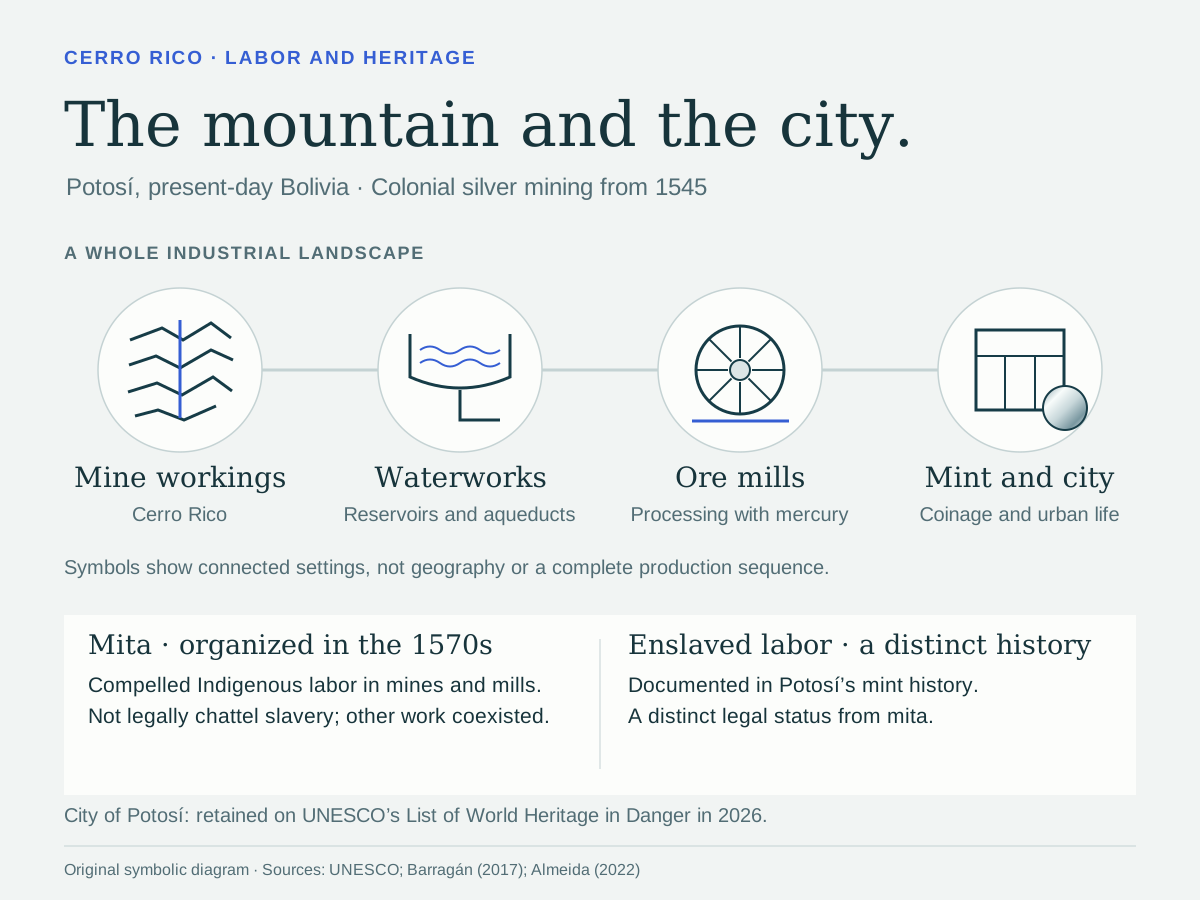
Cerro Rico rises above Potosí in present-day Bolivia. From 1545, colonial mining turned the mountain and surrounding city into a major center of silver production. Its history includes much more than underground workings: mills, reservoirs, aqueducts and a mint formed an extensive industrial landscape, while silver coinage connected the region with commerce across oceans.
Labor behind the silver
That wealth depended heavily on coerced labor. In the 1570s, Spanish authorities organized the colonial mita, requiring Indigenous Andean men to work in Potosí’s mines and mills. Compulsory service existed alongside other kinds of work, and its conditions changed over time. Mita workers were not legally chattel slaves. Enslaved workers also belonged to Potosí’s history, including its mint; those experiences should not be collapsed into a single story about mine labor. Processing silver ore also involved mercury.
A continuing heritage concern
The heritage designation belongs to the wider City of Potosí, inscribed by UNESCO in 1987. It includes Cerro Rico’s industrial remains and the historic city. The property entered the List of World Heritage in Danger in 2014 because of mining-related and conservation threats. UNESCO retained it on that list in 2026, while acknowledging progress and calling for continued protection of the mountain’s structure and shape.
An industrial and human legacy
Potosí’s legacy is both industrial and human, and its conservation remains an active concern.
About this edition
Original source and editorial notes
Adapted from original material by Rich Silver. Original source card: Silver fact: supplied original card (publication date not established).
Reviewed 2026-11-05. This edition places the mine within the wider City of Potosí heritage landscape. It distinguishes colonial mita from chattel slavery, avoids unsupported aggregate death or output estimates, and dates conservation status to 2026.
Sources & further reading
- City of Potosí, World Heritage property 420 ↗
- Rossana Barragán, Dynamics of Continuity and Change: Shifts in Labour Relations in the Potosí Mines (1680–1812) (2017) ↗
- James Almeida, Minting Slavery in the Colonial Andes: Labor and Race in Potosí and Lima (2022) ↗
- UNESCO Decision 11 COM VII.A: Inscription, City of Potosi ↗
- City of Potosi added to List of World Heritage in Danger, June 17, 2014 ↗
- UNESCO Decision 48 COM 7A.33: City of Potosi (2026) ↗