
Silver can travel in hot water
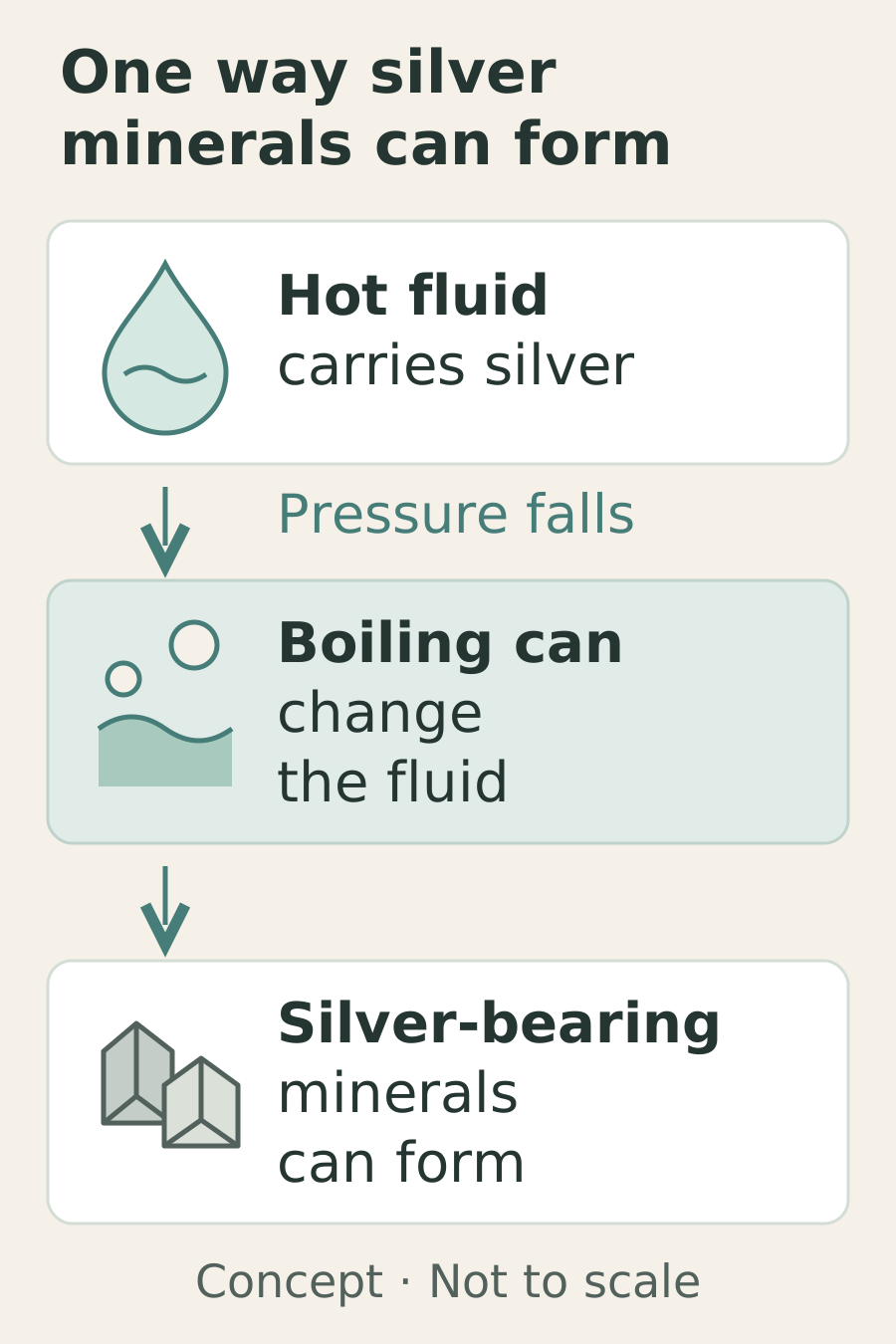
Some silver deposits begin with a journey through rock. Hot water moving along fractures can carry dissolved metals, including silver. Under suitable conditions, boiling changes that fluid enough for silver-bearing minerals to form and remain behind.
This is part of the story of some epithermal deposits: mineral deposits formed by hot fluids relatively near the Earth’s surface. The interesting moment is the change from transporting metal to depositing it.
Pressure changes the boiling point
Underground water does not have to reach the surface to boil. As hot fluid rises and pressure falls, it can enter conditions where liquid and vapor coexist. Some of the water becomes vapor while liquid remains. Geologists call this phase separation.
That separation also changes the chemistry. Dissolved gases can move into the vapor, changing the remaining liquid’s ability to keep metals in solution. Boiling can cool the fluid, too. These linked changes help explain why a moving fluid may leave minerals in the rock.
A Nevada example preserves the evidence
At Mule Canyon in Nevada, researchers identified a later stage of mineral deposition in open spaces within the rock. They linked the formation of electrum and silver selenide minerals to boiling, loss of hydrogen sulfide into vapor, and cooling.
Electrum is a natural gold-silver alloy; silver selenides combine silver with selenium. The deposit therefore records silver in different mineral forms, rather than a single event that painted pure silver onto a crack.
The water’s origin is another useful detail. The study found that the ore fluids were mainly meteoric water, meaning water originally derived from precipitation, that had circulated deep through rock. Hydrothermal water need not all come directly from magma.
A modern glimpse of the process
Ancient mineral veins are not the only evidence. A study of mineral scale inside a geothermal well at Cerro Prieto, Mexico, found gold, silver and other metals. The researchers connected the onset of vapor separation with gas loss and metal deposition.
A well is a modern analogue, not an untouched ancient ore vein. Its value is that it offers a place to investigate processes that can also help build natural deposits.
One route, not a universal recipe
Boiling is an important mechanism in many epithermal gold-silver systems, but it is not the only one. Cooling and mixing with other fluids can also affect deposition. Their importance depends on the particular fluid and deposit.
The takeaway is a change in conditions: silver that could travel in a hot fluid can become part of a solid mineral when that fluid’s chemistry changes. That explains a route to concentration in rock, without implying that a whole silver deposit appeared in an instant.
Sources & further reading
Sources reviewed .
- John and colleagues (2003): Mule Canyon gold-silver deposit, Economic Geology; USGS abstract
- USGS (2018): Descriptive Models for Epithermal Gold-Silver Deposits
- Clark and Williams-Jones (1990): Analogues of epithermal gold–silver deposition in geothermal well scales, Nature (abstract)
- Stefánsson and Seward (2003): Silver sulphide complexes in hydrothermal solutions; University of Iceland research abstract