
The specification desk / Silver bullion
Silver bullion.
Read the specification.
Bullion puts metal content at the centre of the description. But a coin, round or bar still has a maker, a method of manufacture and a history. Learn to separate what an inscription says from what a specification establishes, and what remains to be checked.
Start with the object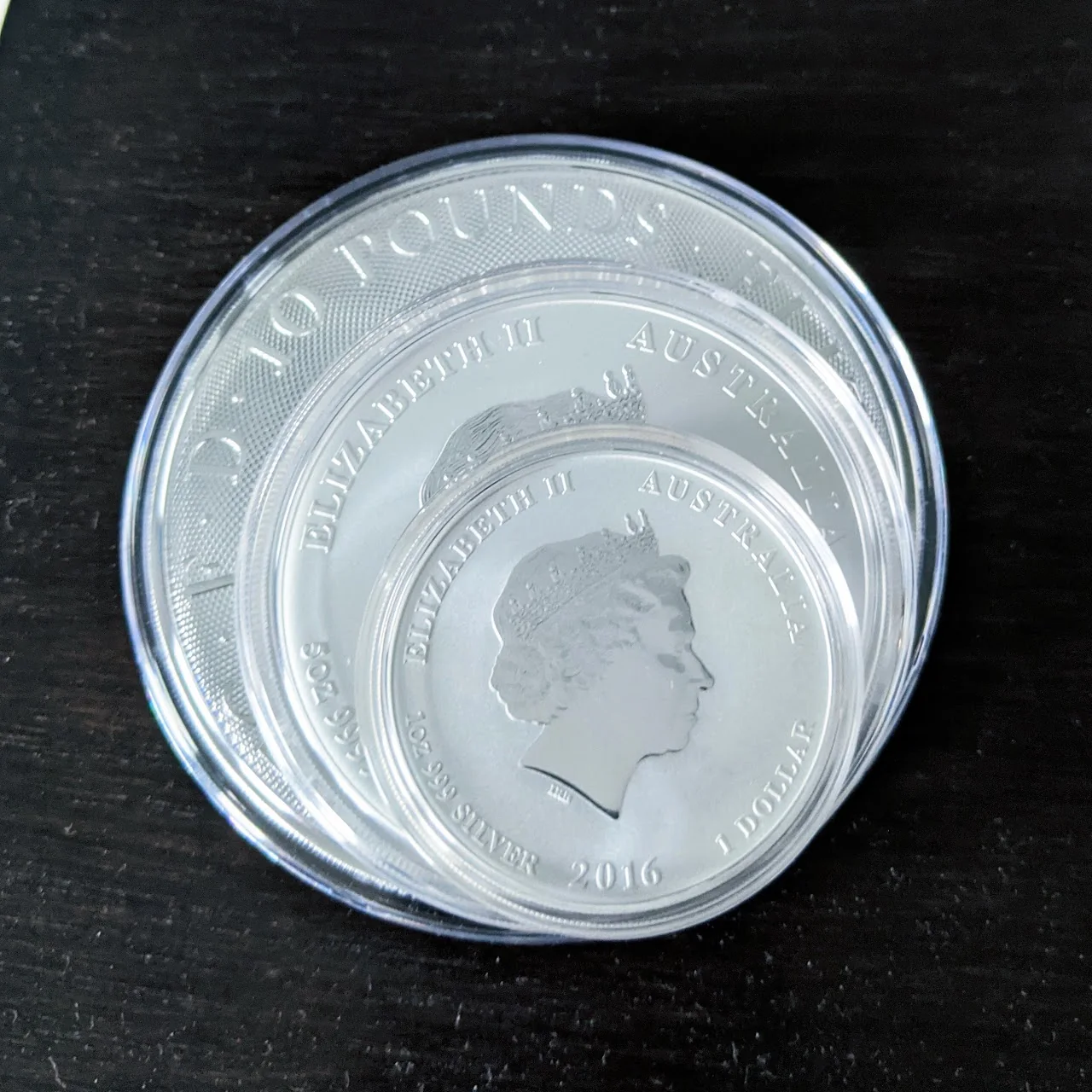
Overlapping coins in clear capsules.
Original collection photograph · View full imageWeightHow much material?
FinenessWhat proportion is silver?
IdentityWhich exact product?
Three forms, different questions
A bullion coin is issued by or on behalf of a government and has legal-tender status. A round can look remarkably similar, with a portrait, date or elaborate border, but is not legal tender. Neither circular shape nor attractive artwork settles the distinction. Look for the issuing authority and the documented denomination rather than guessing from the design.
A bar is another way to shape precious metal. Yet a rectangle is not automatically a bar: The Perth Mint also makes rectangular legal-tender coins. Record the product’s documented identity before assigning its category. The name of a mint, refiner or distributor is a useful research lead, not a complete description.
This guide concentrates on reading bullion specifications. For circulating silver, collector issues and monetary history, continue to Coins & Bullion.
A surface can tell you how it was made
Cast bars take shape as molten metal cools, traditionally after pouring into a mould. Minted bars are struck and typically have more regular edges and a more precisely presented design. Casting texture and a crisp minted finish belong to different manufacturing processes; neither is a shortcut to proving purity.
Describe what you can actually see: lettering, logos, the position of marks, edge shape and surface features. Avoid turning a rough surface into a claim of age or hand craftsmanship without evidence. A historical refiner’s name is worth investigating, but does not by itself establish when a particular bar was made. The Johnson Matthey profile provides a route into that history.
Give every number a job
Keep weight, fineness and monetary denomination on separate lines. A troy ounce is exactly 31.1034768 grams; an everyday avoirdupois ounce is exactly 28.349523125 grams. An unqualified “ounce” in a seller’s description deserves clarification. Millimetres describe dimensions, not metal content.
Fineness describes a proportion by mass. A stated .999 fineness means 99.9% silver; .9999 means 99.99%. Those numbers are material claims, not condition grades. They do not tell you whether an object is scratched, scarce, original or genuine.
The United States Mint specifies its American Eagle silver bullion coin as one troy ounce of .999 fine silver. Use the maker’s exact wording for the exact product and issue. Do not borrow a nearby coin’s specifications because the design looks familiar, or assume every silver-coloured piece has the same fineness.
Gross weight and fine weight are not interchangeable
Gross metal weight includes the silver and the other constituents of an alloy. Fine-silver weight counts only the silver. If a specification already gives fine-silver content, multiplying that number by fineness again would discount the silver twice.
For a hypothetical homogeneous object with a metal weight of 100 grams and a verified fineness of .999, the calculation is 100 × .999 = 99.9 grams of fine silver. This is arithmetic, not a specification for a pictured object. It assumes the weight excludes packaging and that the composition is known throughout the material.
Do not apply that calculation to a plated object’s total weight, or weigh a capsule and call the result silver. A matching weight cannot establish composition by itself. Consult the silver-authenticity guide when the object, material or evidence is uncertain.
A homogeneous material, excluding packaging. Not a measurement of the photographed coins.
Read marks without asking them to prove too much
A maker’s mark, fineness stamp or serial number helps organise an investigation. Transcribe it exactly and photograph its position. Keep your observation separate from the seller’s attribution and the manufacturer’s specification. A neat stamp is not an independent assay of the object in your hand.
Likewise, “Good Delivery” belongs to a defined wholesale-market standard, not a blanket approval of every retail product associated with a refiner. LBMA specifies requirements for qualifying bars, including their markings and fineness. Do not convert a company’s listing into an authentication claim for an individual small bar.
Keep the quotation separate from the metal
A spot quotation is a reference price for metal, not a delivered price for a particular object. A premium adds to that reference; a spread separates buying and selling prices. When comparing descriptions, use the same fine-silver quantity, currency and time. Record any delivery, tax or payment charges separately, and distinguish a seller’s asking price from an actual buyback offer. This makes the record clearer without assuming that a premium will be recovered later.
Build a record that another person can follow
Keep the product name, maker or issuer, date if present, stated weight and unit, stated fineness, dimensions, photographs and supporting reference together. Label a number as measured, inscribed or taken from a specification. If you cannot resolve a detail, record the question rather than filling the gap with a confident guess.
The collector’s object record offers a place to organise those observations. Bullion can be collected for design and manufacturing history as well as metal content. Neither a purity figure nor a documented maker guarantees a future selling price.
Keep the evidence close
Continue your research.
Follow the source notes in these Collect Silver guides for the standards, mint specifications and care advice behind this introduction.
- Weight units & metal valueTroy ounces, grams, pennyweights and grains, with measurement sources.
- United States MintBullion programs, collector issues and the official source record.
- The Royal MintMint history, bullion context and primary-source references.
- Silver authenticityUnderstand what a mark or a measurement can and cannot establish.