
The old mint under the new money
Look just to the right of the date on a Bank of England dollar in Museums Victoria. The museum identifies the remains of three linked letters: PTS, for the mint at Potosí. Around them are a British date, a British design and a value of five shillings. This was already a silver coin before Britain gave it another face. The mintmark identifies where the earlier coin was struck, not which mine supplied the silver. That distinction matters in a city with a silver history as large as Potosí’s.
In 1805, a metalworker named William Henshall was convicted of forging and possessing counterfeit Bank of England dollars. Less than a decade later, Governor Lachlan Macquarie chose him to alter Spanish silver dollars in New South Wales. The basic distinction was not that Henshall had learned to leave good silver alone. It was that a government now wanted him to change it and would recognize the new value.
The Bank’s stamp and the forger’s
Before Henshall’s trial, Britain had tried different ways of using imported coins to make up for a shortage of its own silver money. On another Museums Victoria coin, George III’s head appears in a small octagonal punch. The much larger portrait of Spain’s Charles III still surrounds it. The host coin was struck in Mexico City in 1787; the British stamp is from 1804, when the coin was issued at four shillings and ninepence. The Bank’s five-shilling dollars, by contrast, were struck with new designs across both faces. On the Potosí example, the joined letters survived where much else did not. The Soho Mint overstruck these dollars from 1804 to 1811, but they all say 1804. That date alone cannot tell you when this one was altered.
To imitate a newly stamped dollar was to imitate the authority behind the stamp. In April 1804 the Bank’s solicitors asked counsel whether the Bank itself could prosecute people who copied its re-stamping. The Bank’s archive catalogue records an opinion questioning whether the Bank had enough legal authority to do so. That was advice about a particular practice, not a court ruling that counterfeiting was legal.
Henshall’s conviction was a separate matter. In their study of the Bank’s records, Peter Lane and Peter Fleig describe a January 1805 raid that turned up dies, equipment and counterfeit coins. On March 26, the Warwick Assizes found Henshall guilty of forging and possessing counterfeit Bank dollars. He was sentenced to seven years’ transportation, arrived in New South Wales in August 1806 and received an absolute pardon in September 1812. Neither museum coin is known to have passed through his hands.
Silver that wouldn’t stay
New South Wales had coins, but too few stayed in circulation. Merchants were paid in money that could leave again on the next ship. In November 1812, the Samarang arrived from Madras, now Chennai, with 40,000 already-minted Spanish silver dollars. Madras was the port the shipment came from, not the mint that made the coins.
Macquarie needed someone who could do more than add a punch. Every cut had to make two usable pieces, and both needed new marks. The National Museum of Australia puts the workshop in the basement of a building known as the Factory, used by government printer George Howe in Sydney. The work took more than a year; making the machinery was part of the job. The records do not say exactly why Macquarie chose Henshall. The 1811 muster listed him as a convict without a trade; the 1814 muster called him a silversmith. The two entries record different things about the same person, not an explanation for why he was hired.
One coin becomes two
The holed ring passed for five shillings. Its center, called the dump, passed for fifteen pence. Together they were worth six shillings and threepence at their assigned local values. Cutting had produced two coins, not more silver. The colonial order, transcribed by the Australian Bureau of Statistics, spells out the new inscriptions and values. The date on the pieces is 1813; they entered circulation in 1814.
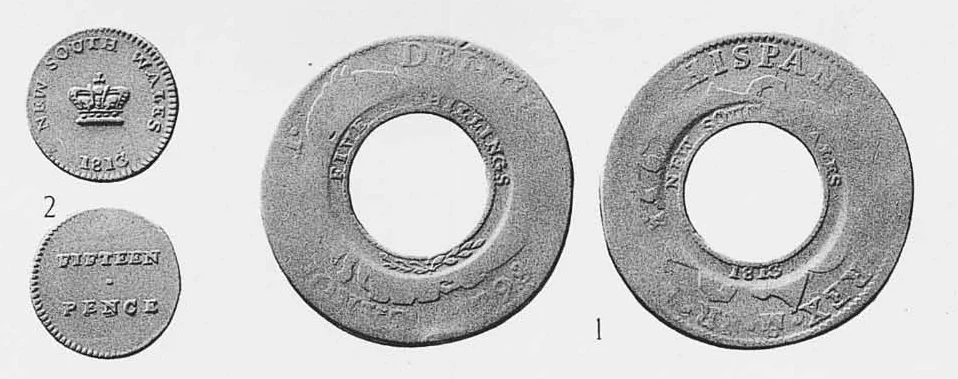
In the historical plate, the ring still carries pieces of the older lettering beyond its new inner border. Look at the two faces of the dump on the left: a crown and date on one side, the new value on the other. The small piece could now buy something in its own right. The hope was that the altered pieces would stay in the colony. They didn’t solve the shortage: the Reserve Bank of Australia Museum notes that the coins remained scarce even with penalties for exporting them.
Three marks, three different claims
The National Museum identifies a tiny H in the spray of leaves on the ring and between FIFTEEN and PENCE on the dump. Lane and Fleig locate it on some reverse dies, not all. Older descriptions read the small mark as a dot or a stop. If the letter isn’t clear on a particular coin, don’t transcribe it as if it were. The plate above shows where to inspect the two designs, not proof that the letter is legible on either coin.
When you photograph a coin like this, get both faces and a detail of each place where old and new lettering meet. On a ring, record the inner border separately from the outer legend. A Potosí mintmark identifies an earlier issue; a five-shilling stamp declares a new value; a minute H on some dies points to the workmanship behind the change. That is what makes Henshall’s story more than a coincidence: good silver could take a new shape, but the marks on it did not all speak with the same authority.
Related reading: The Spanish Dollar: Silver That Crossed Borders follows other ways people reused and marked this denomination.
Sources
Read the records behind the story
- Museums Victoria: Bank of England dollar NU 25953
- Museums Victoria: counterstamped dollar NU 842
- Bank of England: legal opinion, 18A18/1/2
- Peter Lane and Peter Fleig: William Henshall, pp. 4–5 and 20–23
- National Museum of Australia: the Holey Dollar
- Australian Bureau of Statistics: transcription of the colonial order
- Reserve Bank of Australia Museum: colonial coin shortage
The reproduced figure is cropped from a public-domain historical plate. The modern museum photographs of the other coins are linked, not reproduced.