
A silver dollar goes where no one can spend it
On July 8, 1930, as the restoration of USS Constitution was nearing its end, the governor of Massachusetts put a silver dollar under the ship’s mainmast. The dollar was meant to disappear. Once the long wooden mast sat on its foundation, no one could reach the coin simply by opening a locker or lifting a deck board. That was the point. The silver belonged with the ship.
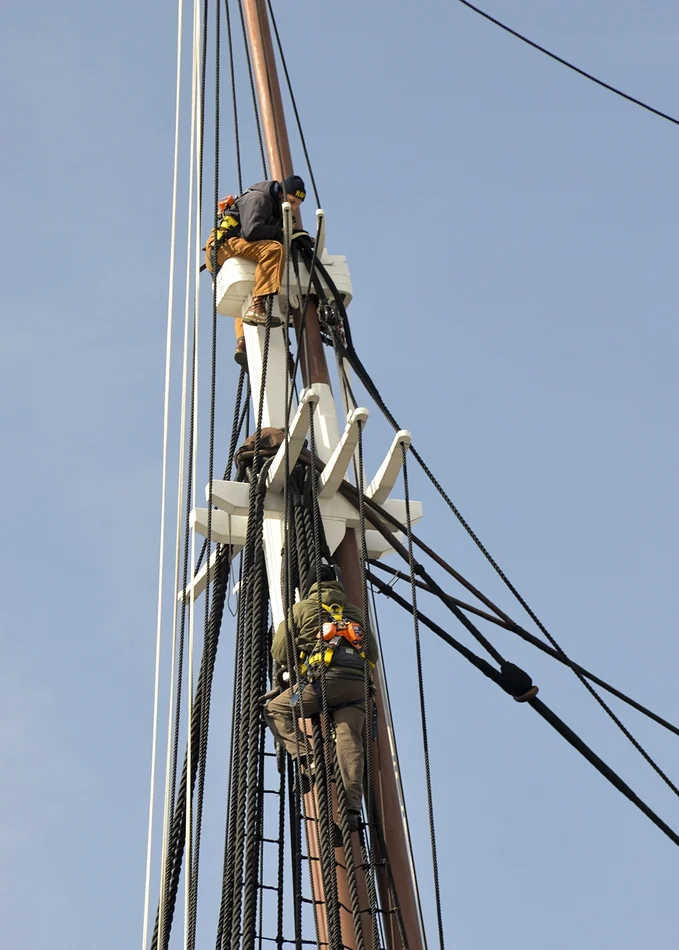
Naval constructor John A. Lord recorded that day’s deposits. They were different under each mast: a five-dollar gold piece at the foremast, the governor’s silver dollar at the mainmast, and an old copper penny with other coins at the mizzenmast. Naval historian Margherita Desy reproduces his account in the USS Constitution Museum’s history of the mast coins. The record establishes the dollar’s denomination and its placement, but doesn’t name a date or design. A photograph of an attractive period dollar would not fill that gap.
Where is “under the mast,” exactly?
What you see above deck is only part of a traditional lower mast. On Constitution, the museum’s 1931 inboard drawing shows the lower mizzen passing through three decks before it meets its foundation on the orlop deck. Naval terminology calls that foundation a mast step. The shaped bottom end of the wooden mast, called its tenon, fits the recess in the step. The enclosed spot explains how something small can stay put until a major repair lets people look again.
The placement wasn’t a means of shoring up the mast, any more than the denomination told you the size of the ship. It was a deliberate deposit at the time the mast went into place. Lord described the pieces as tokens of good luck. The museum also relates an older story about paying Charon, the ferryman of the dead, if the vessel foundered. That is one explanation handed down with the custom, not proof of a single origin or the reason every person left a coin.
The wood kept an impression
When restorers removed the lower masts in 1992, naval staff extracted and catalogued the coins they found. They lent the coins to the museum while work continued. Under the mizzenmast the coins had pressed into the wood at the bottom of the mast. Workers cut off and preserved that piece to show the impressions. The museum has photographs of the wooden end and its impressions. The marks don’t establish that the 1930 silver dollar made them. That dollar was recorded under a different mast.
There were other surprises. The foremast’s documented 1930 gold piece wasn’t found in 1992. And while some of the coins under the masts date to Constitution’s first years, the historian thinks these early cents were probably added in the twentieth century to commemorate the launch and first voyage. The museum doesn’t know whether any of the original steps held coins. Old coins in an old ship don’t automatically make an original deposit. For an example you can hold in a hand, see the punch ladle whose inset coin is older than the silver bowl around it.
A 1944 coin chosen in 2025
In Bath, Maine, a ceremony for the future USS Louis H. Wilson Jr. made the gap between coin date and deposit date intentional. A Navy report of the September 26, 2025 ceremony lists a 1944 half-dollar among the objects put into a mast-stepping box. The date marked the year of Wilson’s actions on Guam for which he received the Medal of Honor. The box also held his dog tags and sand from Asan Beach. Here the coin’s date is not a clue to the ship’s age. It is a choice about whose history the ship will carry.
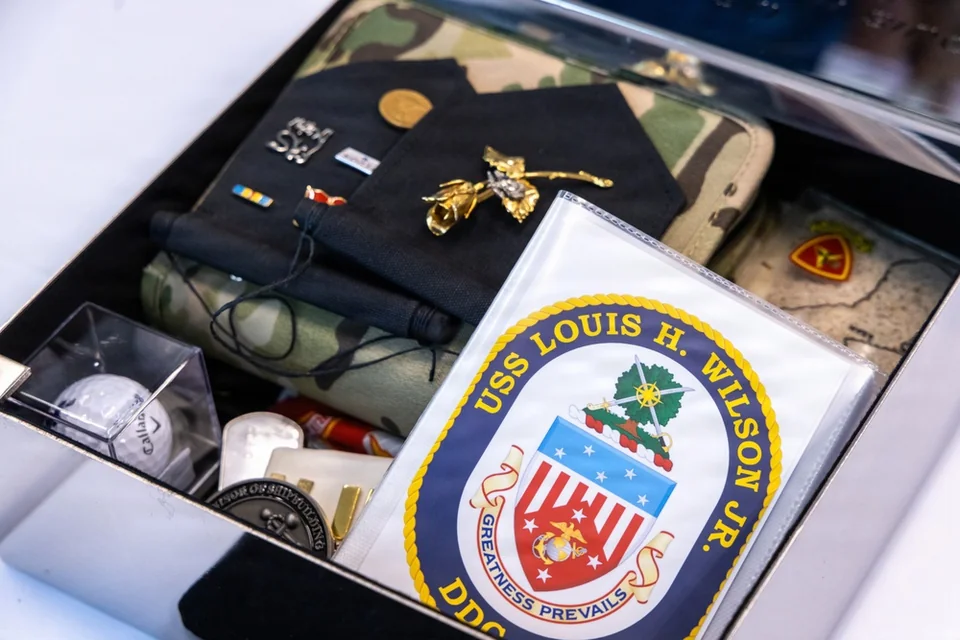
In 1944 the U.S. circulating half-dollar was the Walking Liberty design, from the era when the denomination was struck in a 90 percent silver alloy. The ceremony account gives the date and denomination, not a mintmark or grade. The Navy’s photograph shows the box and its contents; it does not let a reader verify the date on the specific coin.
One object, two dates worth keeping
For a coin that became part of a ship, a vessel, or a building, record the date on the coin separately from the date it was put there. Add the exact location, what was next to it, and the source that connects it to that event. If the object was removed and returned during repair, that belongs in the record too. The guide to documenting collections explains how to preserve relationships like these without confusing the parts with the whole.
A silver dollar under a mast is no longer doing what a dollar usually does. Nobody’s meant to make change with it. The question it leaves behind is not just what it was worth, but who thought it belonged there and what they wanted a future crew to remember.
Sources and photographs
- Margherita Desy, “Hidden Treasures,” USS Constitution Museum, reproducing John A. Lord’s 1930 account and documenting later restoration work.
- Naval History and Heritage Command: Nomenclature of Naval Vessels. U.S. Navy photograph of 2018 mast work, public domain.
- DVIDS: 2025 ceremony account and Lt. Sydney Sisler’s public-domain photograph of the box.
- U.S. Mint: half-dollar design history and historical alloy context.