
The hands that came before the portrait
An early silver dollar carries a portrait, lettering and a date. None of those details tells you who brought the blank to the right weight. To find two of those names, look away from the coin and toward a payroll.
On the Philadelphia Mint’s October 1795 payroll, Sarah Waldrake and Rachael Summers appear in the chief coiner’s department. In the printed transcription, an entry for an adjuster is followed by a run of names whose jobs are given as “ditto.” Waldrake and Summers are two of them. Each was paid 50 cents a day; male workers listed as adjusters on the same page received 88 cents or $1.20. The record does not tell us why the wages differed or allocate a particular silver coin to a particular worker. It does put the two women at the Mint from the early years of American coinage.
What a file could do that a press could not
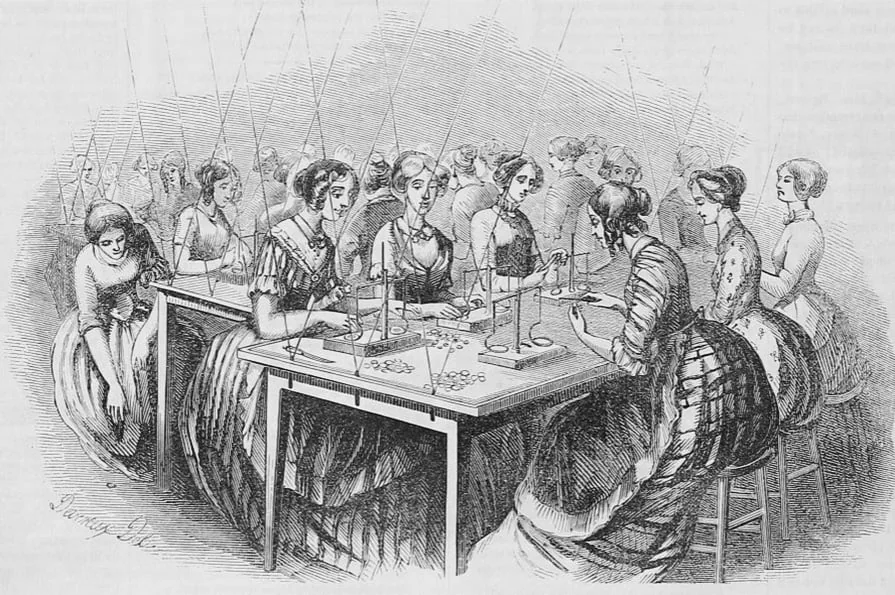
An adjuster worked with a balance and a hand file. A planchet is the blank disc that will receive the coin’s design. The file could remove a little metal from a slightly overweight blank; it could not put metal back if the worker removed too much. George G. Evans’s 1885 account of the Philadelphia Mint describes blanks unsuitable for filing being set aside for remelting. The press came later. It added the design, not the missing weight.
The balance was sensitive enough to turn ordinary air movement into a problem. Evans describes drafts being kept out. The Mint’s historians also describe leather aprons fixed to the worktable to collect filings and short sleeves that kept workers from sweeping metal dust onto the floor. The arrangements made sense on a bench where the amount removed could decide whether a blank went on to the press or back to the furnace.
The factory floor changes around the job
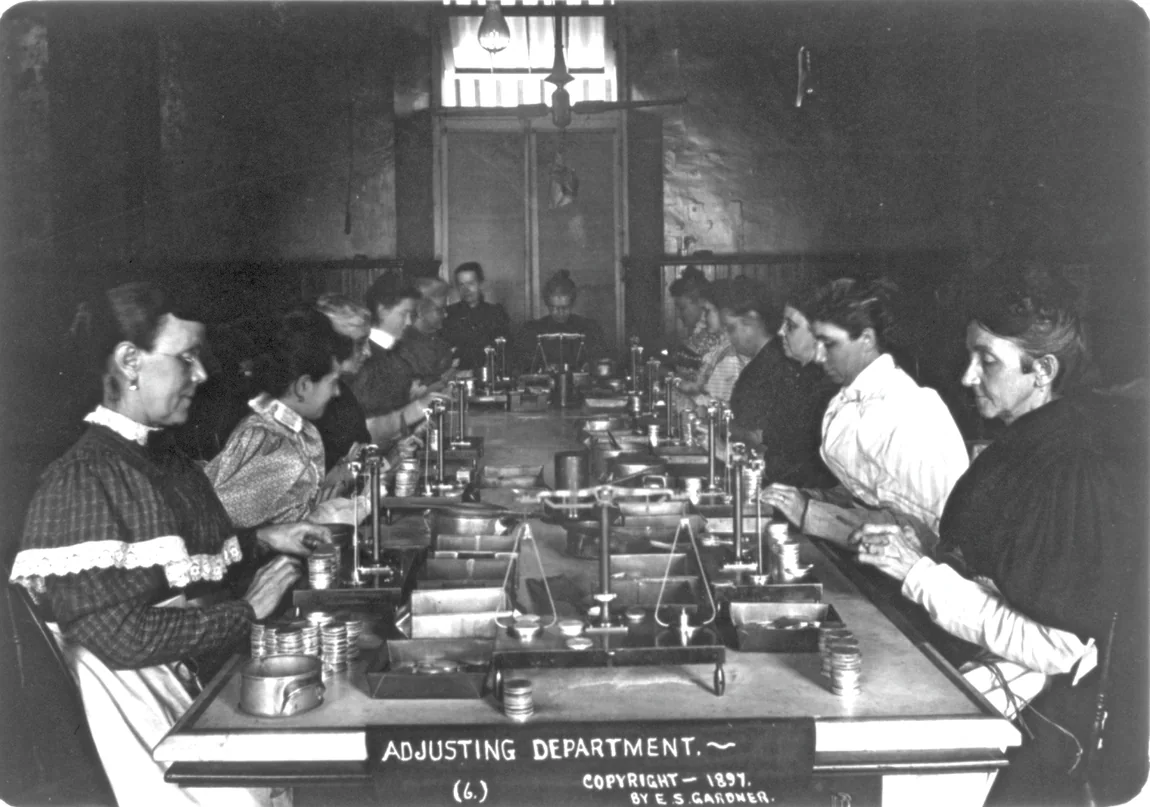
Between the 1795 payroll and the 1897 New Orleans photograph, steam changed the Mint’s machinery. The U.S. Mint’s historical account describes women moving from adjusting into operating mills that raised the rim of a blank and feeding blanks into coin presses. It also records Elvira Cowan taking charge of the adjusting staff at the Carson City Mint in 1877, the first woman the Mint identifies in a supervisory position.
The photograph does not show who was first, who was in charge or which metal was being weighed that day. It shows several workers at separate scales along one bench. That arrangement makes the older job easier to picture. Before any one blank could move on, someone had to pay attention to it.
When a line belongs to the making
A file could leave shallow grooves on an early silver planchet. Striking could flatten much of that evidence, but it did not always erase it. NGC’s guidance on early U.S. dollars describes surviving marks that sometimes show in raised parts of a design, where metal had to fill the recessed areas of the die. A later scratch can cut into an already struck surface. The distinction is about when the line formed, not whether it looks good.
Do not file, polish or clean a coin to test the idea. Photograph it in light from different angles and note how the lines meet the design. If the distinction matters to identification or value, have someone experienced with early U.S. silver examine the coin. A line may preserve the work of someone at the adjusting bench, but it cannot tell us that worker’s name. For Waldrake and Summers, those names survived elsewhere, on a page that recorded the work without picturing the workers.
Keep exploring
Sources
Historical records and image credits
- U.S. Mint: Women at Work, names, working conditions, new roles and the 1852 engraving.
- George G. Evans, Illustrated History of the United States Mint (1885), Library of Congress scan, transcription of the October 1795 payroll and, on printed pages 30–31, the adjusting room.
- Treasury Department, Treasury Women, 1795–1975, corroboration of the hires and 50-cent wage.
- Library of Congress: U.S. Mint, New Orleans, La., Adjusting Department, photograph, attribution and rights advisory.
- NGC: Grading Flowing Hair Dollars and Grading Draped Bust Dollars, surviving file traces and distinction from scratches.