
What the vacuum could not stop
Put sunlight on one side of a vacuum and it can still warm something on the other. Light carries energy through empty space. Infrared radiation can carry heat through it as well. That is the part of the old vacuum flask that the name leaves out. Removing most of the air from the gap greatly reduces heat transfer through the gas. It does not stop radiation from crossing the gap.
A thin reflective layer on the glass facing that gap tackles the other route. It reduces the exchange of heat by radiation between the warmer and cooler walls. The change is useful in either direction: it slows the loss of heat from hot contents and the gain of heat by cold ones. The silver was not there to make the bottle look expensive. In a protected liner it could do its work where nobody had to see it.
A bottle made to buy time in the laboratory
The Royal Institution preserves a flask James Dewar showed there in 1892. It has one glass vessel inside another, with a partial vacuum in the space between and a seal at the neck. The aim was to keep gases that had been liquefied at very low temperatures cold long enough to study. The institution traces an earlier vacuum-insulated goblet to Dewar’s collaboration with Peter Tait in 1872. The flask had a narrower neck, and further improvements included a silvered surface.
The distinction between the gap and the coating also explains the neck. The two pieces of glass have to meet somewhere. Heat can still travel through that solid connection, and an opening needs a closure of its own. The flask buys time; it does not stop every route for heat to move.
Give the laboratory bottle something it can travel in
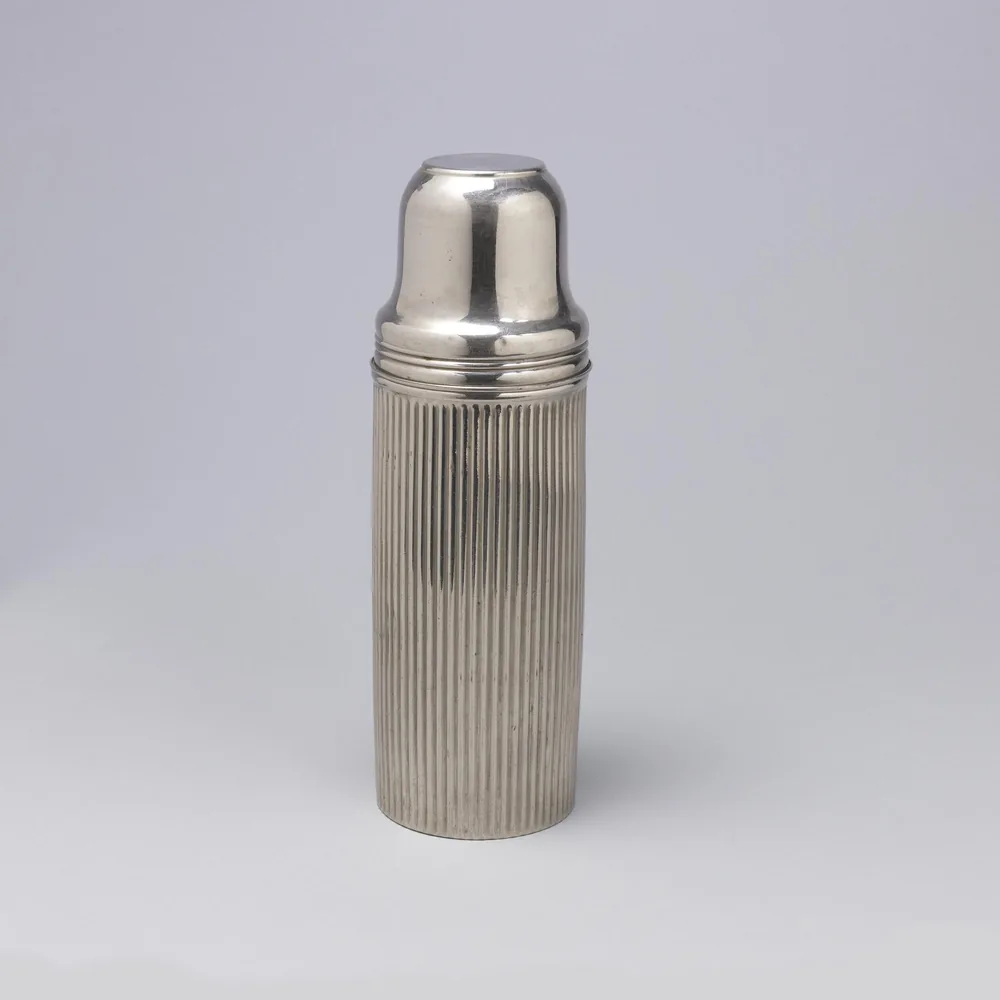
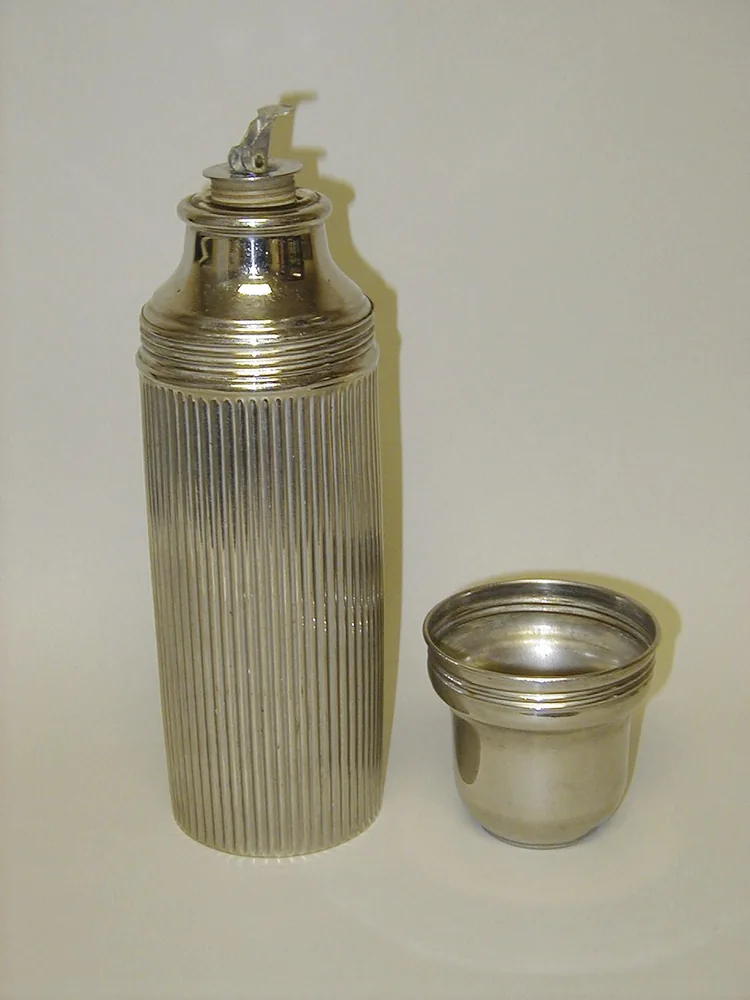
A household vacuum bottle had to stand up to being carried, opened and poured. Cooper Hewitt’s Universal flask, made in Connecticut around 1917, lets us see what was added for that job. The outer metal case surrounds a glass vacuum bottle. The cap comes off and serves as a cup; beneath it is a separate rubber stopper with a latch. The finish you see on the outside and the reflective layer used inside some glass vacuum bottles are different things. Cooper Hewitt’s public record does not identify the composition of this flask’s hidden liner coating.
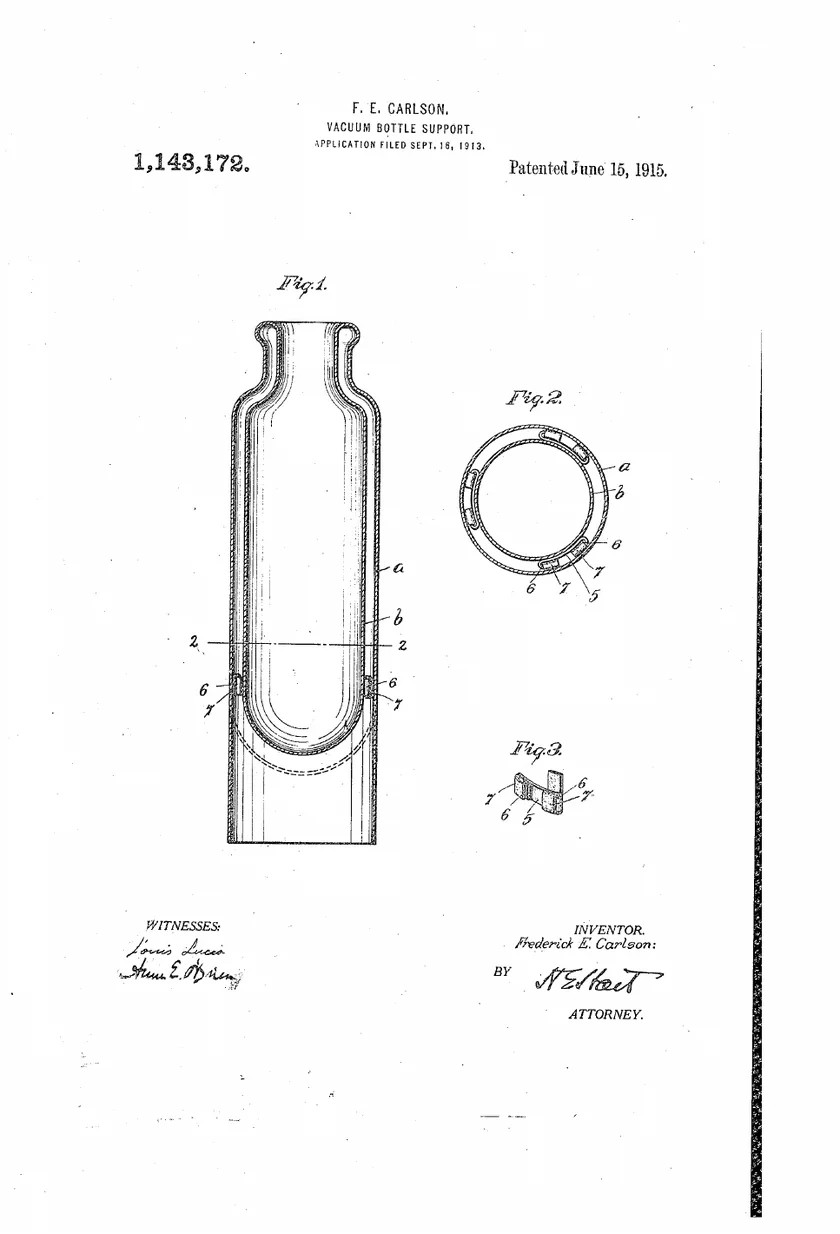
A 1915 patent assigned to the maker, Landers, Frary & Clark, shows another practical concern. Frederick E. Carlson’s drawing puts a support between the glass walls near the bottom, away from their permanent join at the neck. A support helps protect the glass; a poorly chosen one would give heat another path between the walls. Carlson called for insulating material in the support. The drawing shows the patented idea, not an X-ray of the museum’s flask.
The place they left the mirror off
The coating worked so well as a mirror that it presented an ordinary problem: you could not see how much liquid remained through the mirrored glass. In 1935 Arthur H. Payson received a U.S. patent, assigned to the American Thermos Bottle Company, for leaving a clear strip in an otherwise reflective double-walled vessel. The strip was a window in the coating, not a hole in the glass or a break in the vacuum. Payson also wrote that the word “silvered” in the document could cover other mirror-like finishes.
That patent makes a useful distinction for collectors. A shiny exterior is not evidence of a silver liner, and even a reference to “silvering” may describe a finish rather than certify the element. On an old glass-lined flask, the coat, the gap, the glass walls and the outer case should each get their own line in the description. The bottle makes the most sense when you can name what each one does.
Keep exploring
Sources
Museum records and U.S. patent drawings
- Royal Institution: James Dewar’s 1892 vacuum flask, the original object, the earlier goblet, partial vacuum, and later silvering.
- Cooper Hewitt, Smithsonian Design Museum: Universal, ca. 1917, exact object, materials and two photos.
- Frederick E. Carlson, U.S. patent 1,143,172, 1915 support assigned to Landers, Frary & Clark.
- Arthur H. Payson, U.S. patent 2,001,154, 1935 sight-window patent assigned to American Thermos Bottle Company.
- Science Museum Group: Dewar vacuum vessel with clear strips, a separate collection example of selective silvering, not a stated example of Payson’s method.