
Look at the point
At first glance, the narrow silver object looks like a short pen. At one end is a point; at the other is a small round fitting. Between them, a decorated barrel about as long as a hand is wide. The Metropolitan Museum of Art catalogues the 11.3-centimeter instrument as a pencil with an eraser and lead holder, made by S. Mordan & Co. of England in 1848–49. Its silver is the part you see and hold. It isn't the part that makes a mark.
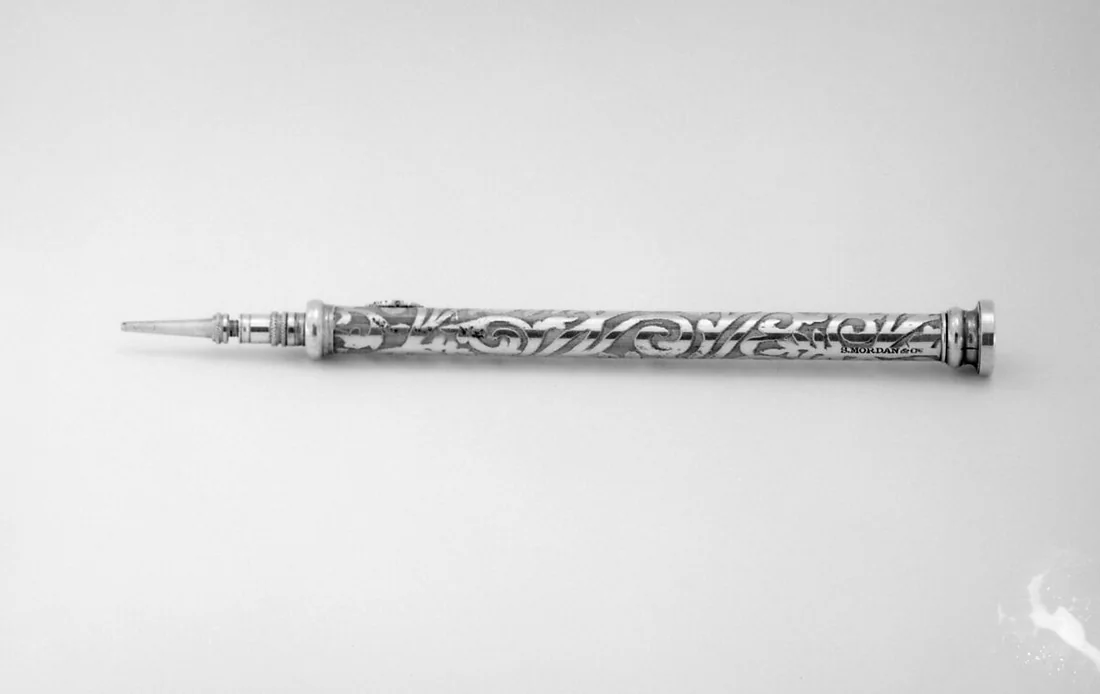
What changed with a propelling pencil was not the line on the page. It was the moment when the line began to fade. Instead of cutting away wood, a writer could advance the dark core and pick up the same sentence.
A screw instead of a knife
In 1824 the Register of the Arts and Sciences illustrated a patent issued to engineer John Isaac Hawkins and portable pen maker Sampson Mordan (spelled “Mordant” in that report). The drawing, on printed page 166, cuts through the length of the pencil case. A threaded driver holds the writing core. When the case turns relative to the nozzle, the screw converts that turn into motion down the length of the instrument. The point moves forward or back.
The journal says the outer case could be silver, gold, ivory or tortoiseshell. Silver was one of several choices for the outside of the mechanism, not a necessary ingredient in the screw. And although the surviving pencil is from Mordan's firm, it dates from more than two decades after the illustration. The photograph cannot establish that its hidden parts follow the drawing exactly.
A little writing desk, packed away
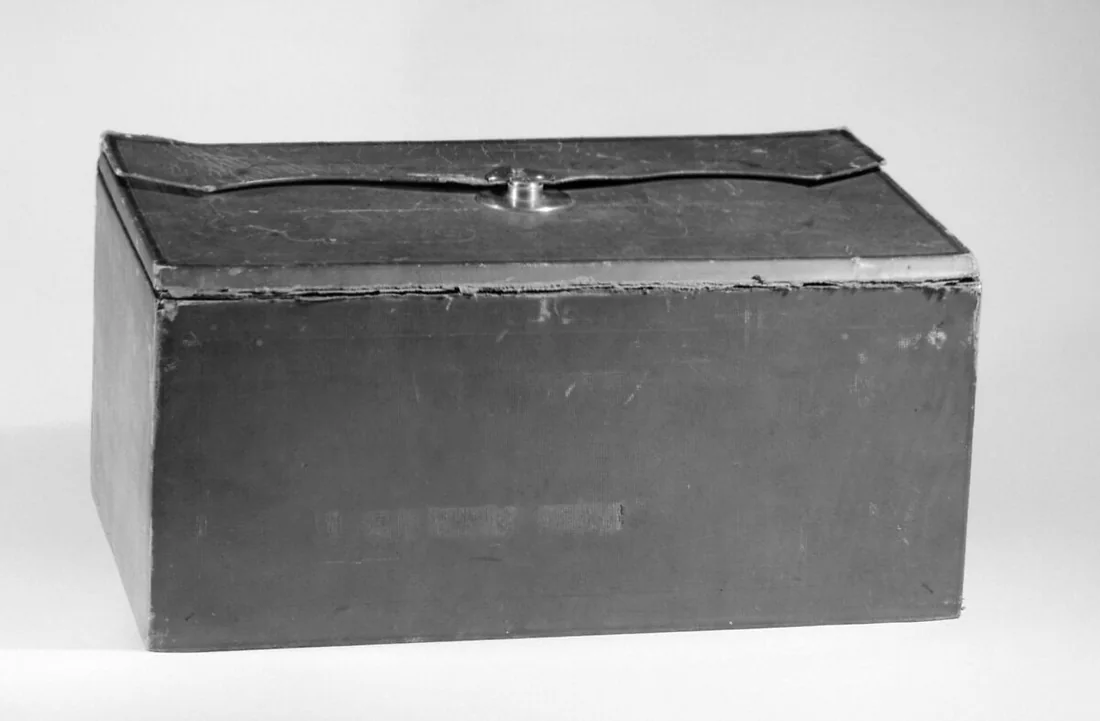
The Met describes a set of more than fifty items bearing the initials CMI. The pencil belonged to that set. A leather-and-silk case with trays and drawers survives alongside its contents. The donor's family associated it with Colin Macrae Ingersoll and travel by stagecoach in Russia. That's a family account, not a record of the pencil being used on a particular journey.
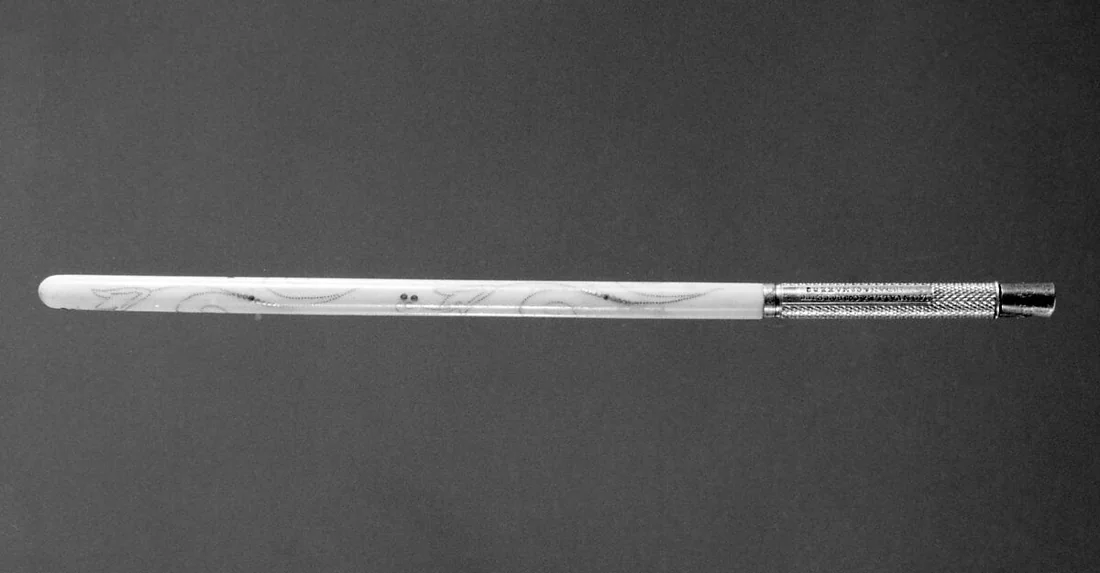
A silver-and-ivory pen handle from the same set, also by Mordan's firm, makes the pencil easier to interpret. The set preserved both tools rather than replacing one with the other. A silver pounce pot tells the other half of that story: when writing with wet ink, preparing the paper and dealing with an unready stroke could be separate jobs. A jot in pencil called for no inkwell.
What to tell a collector
Start with what the object can show you: the point, the end fitting, any seam or collar, the dimensions and the marks. Photograph each before trying to turn anything. If a part resists, leave it where it is. Don't infer a working movement, a matching refill or even a maker's identity from the barrel design alone.
Mordan's firm also made a silver horn with two scent compartments: a hinged grille at one end and a screw cap at the other. You wouldn't identify it by its outline alone either. The vinaigrette guide shows why the way a silver object opens sometimes tells you more than its silhouette. On the pencil, the clue is at the point, but some of the best evidence is out of sight.
Sources
Period illustration, museum records and image credits
- The Met: S. Mordan & Co., Pencil with eraser and lead holder, 1848–49, 68.33.34a–c, silver and lead as catalogued.
- The Met: S. Mordan & Co., Pen handle, 1848–49, 68.33.32, silver and ivory.
- The Met: Case with tray and drawers, 1848–49, 68.33.1a–k; dimensions and family tradition.
- Register of the Arts and Sciences, vol. 1 (1824), pp. 166–67, period drawing and technical description.
- The Met: Vinaigrette and scent flask, 1871, 1983.575.22. Linked as a related museum record.