
Two matching vessels, two different jobs
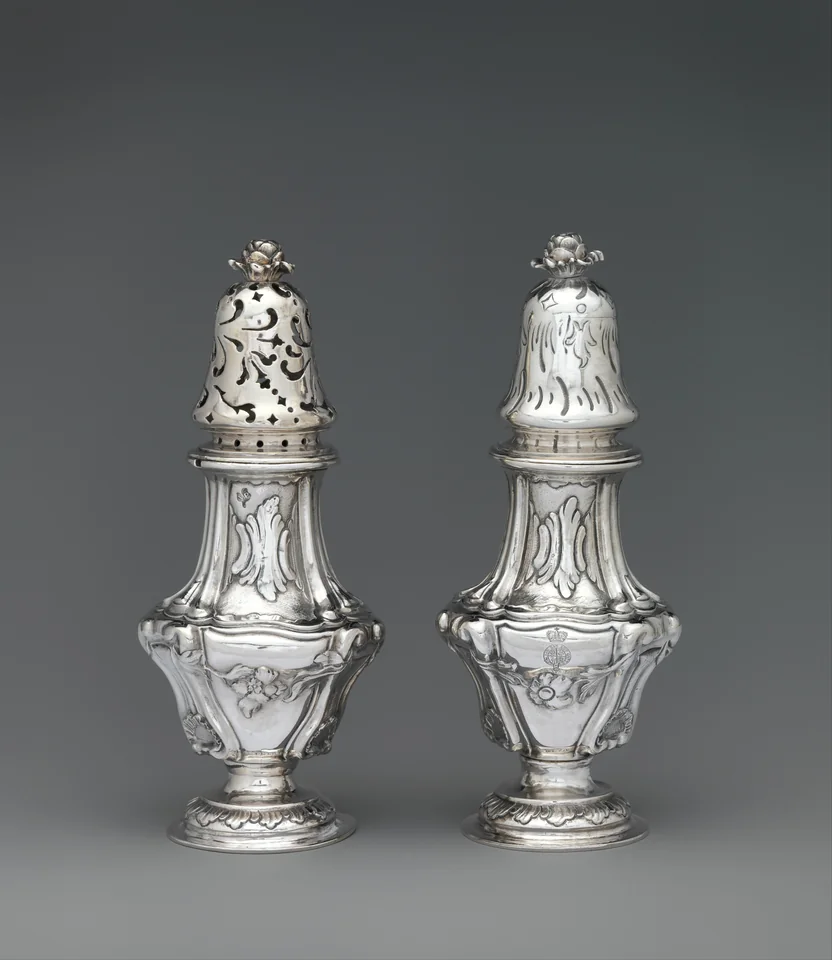
Look at the tops before the bodies. On the left, the silver dome is cut with open scrolls. The one on the right repeats the tall outline and the little finial, but its dome is closed. From across the table they could pass for two versions of the same vessel. At serving distance, the difference is the whole point.
These vessels were made by Josephus Pasperger I in Pest around 1765. The Met identifies the pierced one as a sugar caster and the other as a mustard pot. The caster shakes dry sugar out through a pattern of holes. The mustard pot has a hinged lid and an opening at the rim for a small ladle. Similar outlines disguise two quite different ways of getting a condiment onto the plate.
The pair has not always been understood that way. The museum's catalogue notes that one earlier publication called them two casters and another identified the pierced one as a pepper caster. That is a useful warning for a collector: a silhouette can get you to the right family of objects without telling you what is in your hand.
Read the lid before you name the pot
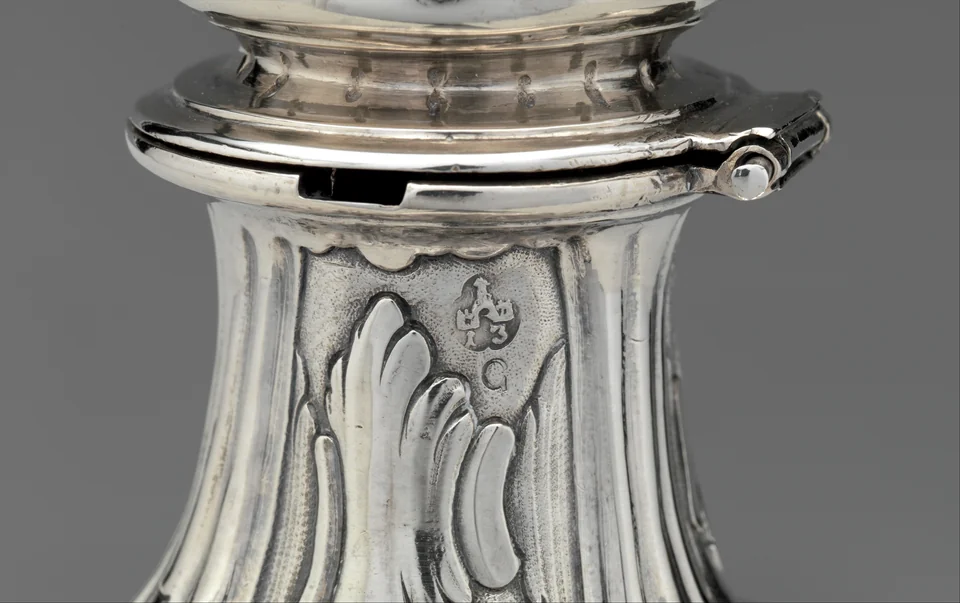
On the Pasperger pot the useful opening sits just under the cover, not out on the dome. The close photograph shows a small rectangular gap and the hinge to its right. The gap gives a utensil handle a route out of the vessel even when the cover is down. It does not make the pot a shaker.
Mustard did not always arrive at the table in the same form. The Met's account of its Paris mustard pot distinguishes powdered mustard from a preparation mixed with vinegar. Powder could be kept in an unpierced caster or one whose holes were closed off by a sleeve. Prepared mustard could be served with a spoon, or from a small pouring jug. That is why a notch is a useful clue, not a requirement, and why some mustard pots can resemble covered milk jugs.
The little opening is part of a wider silver-table vocabulary: a shaker lets particles through its perforations; a spout directs a liquid; a spoon lifts a portion. The familiar shape of a vessel can hide the particular movement a maker intended. See how the same question works on larger serving pieces in the study of silver sauceboats and their pouring lips.
London and Paris: one problem, two surfaces
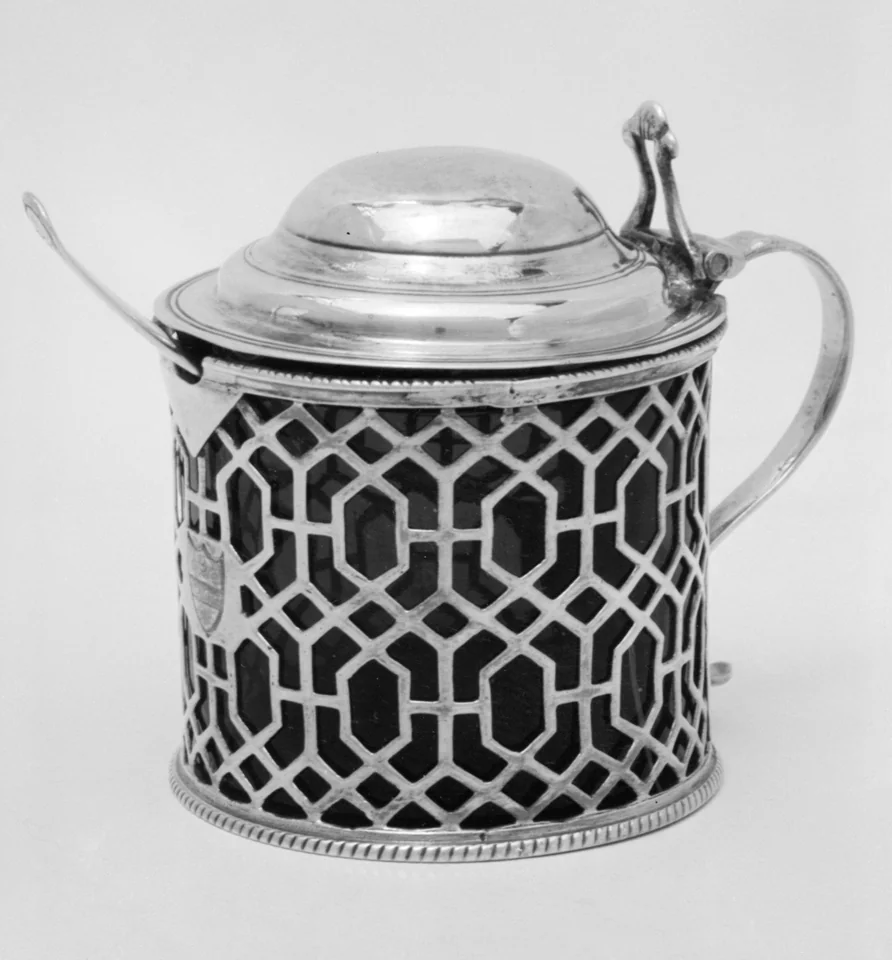
In a London example dated 1771–72, Edward Aldridge II's geometric silver lattice wraps around a short cylinder. At the left of the museum photograph, a slender handle projects from beneath the rim of the cover. Unlike the Pasperger detail, this photograph gives us a utensil to look at as well as a space for one. The Met catalogues the pot and spoon together, as one of a pair. The record for this particular object is not a shortcut to deciding whether an unprovenanced spoon belongs with a pot.
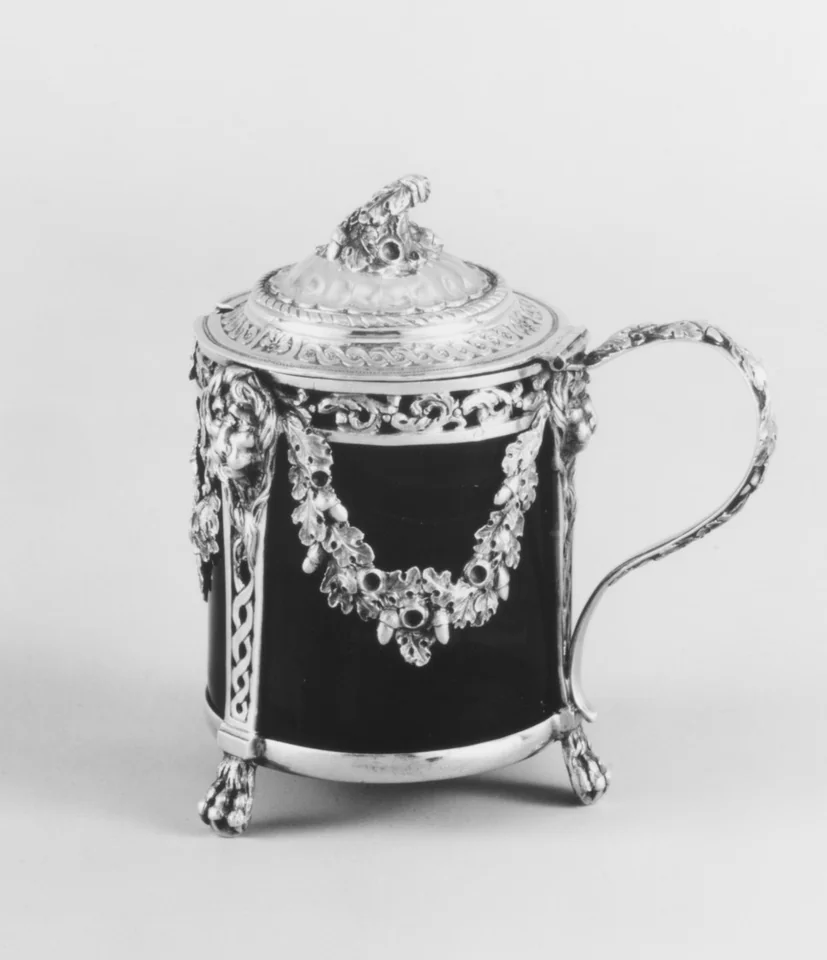
A Paris pot of 1777–78, attributed to Pierre-Nicolas Sommé, puts garlands and a line of openwork against a blue glass liner. The museum's photograph is monochrome, so the blue is a fact from the catalogue, not a color to infer from the image. The glass forms the continuous wall inside the pierced metal frame. Without a liner or some other closed interior, that openwork would not contain a wet condiment. The contrast between frame and liner also makes the pattern easier to read.
Blue glass is not a name tag. A glass-lined vessel might have held salt, mustard or something else, and the material alone does not answer how it was served. Compare the rim, cover and openings; then look for a documented example with the same arrangement. The standing-salt story shows how differently another table condiment could be presented.
Tiffany makes the little pot a showpiece
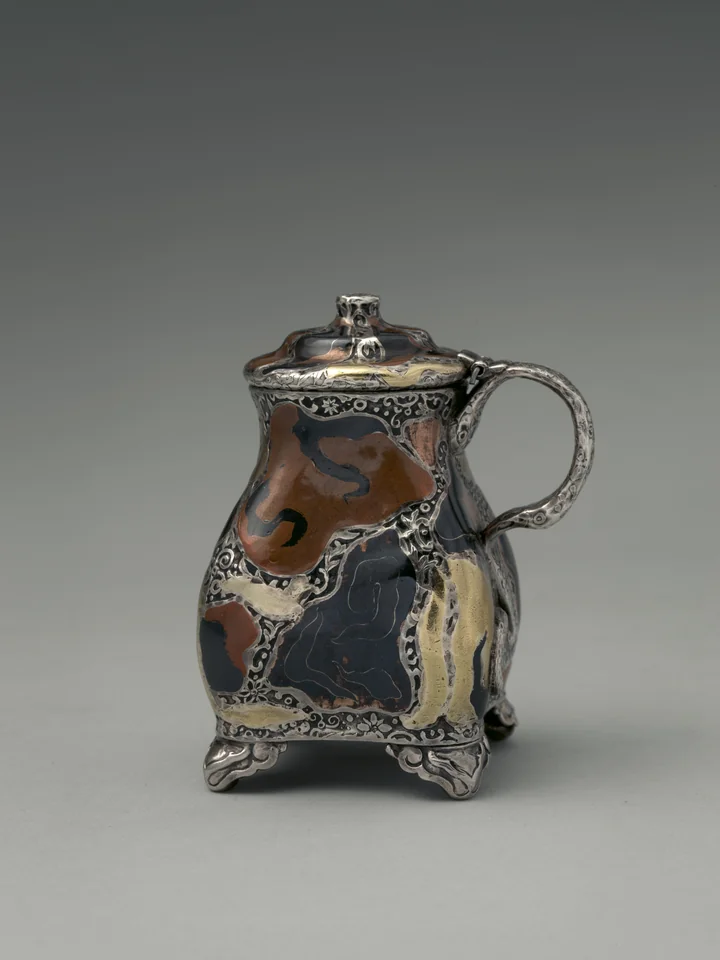
Turn to Tiffany's New York mustard pot of about 1879 and the surface is no longer a regular lattice. Dark and copper-toned panels break up the body. The Met identifies several materials, including patinated copper alloys and niello. It relates one patinated copper-gold alloy to the workshop's interest in Japanese shakudō and points to surviving Tiffany designs and archive entries.
Here the record does work a photograph cannot. The archive ties the mustard pot to a pepper vessel with a design number, even though they need not be encountered together today. The name is not derived from the color of the sides or from a rule about what mustard pots have to look like. It is written into the history of the design. For another Tiffany object whose color can be misread if you see only the word silver in the catalogue, compare the workshop's frog tray.
What to check if you find one
- Photograph the lid and rim together. Look at the hinge, the front edge, any spoon slot, the spout if there is one, and any perforations. A notch that aligns with a utensil is evidence to record, not a test to repeat by forcing in a spoon.
- Check the frame and liner separately. Record the liner's rim, thickness, color and how it sits. Photograph gaps or obvious damage with the liner in place. If it will not lift freely, leave it alone. A matching fit does not by itself prove that a liner is original.
- Say what came together without assuming it began together. A pot, glass liner and little spoon can be catalogued as three parts. If provenance, marks or fit do not establish a relationship, label it as uncertain. The Collect Silver documentation guide explains how to keep records for related parts.
Start with the smallest change the maker made to the form. On one vessel it is a row of holes at the top; on the other it is a short opening at the edge. Those details tell a more useful story than the reflection in the silver.
Sources and object records
- The Met: Josephus Pasperger I, mustard pot, ca. 1765. Object record, close view, and catalogue discussion of its matching caster and earlier attributions.
- The Met: Edward Aldridge II, mustard pot and spoon, 1771–72. London example catalogued with its spoon.
- The Met: Mustard pot attributed to Pierre-Nicolas Sommé, 1777–78. Paris object record and discussion of dry and prepared mustard.
- The Met: Tiffany & Co., mustard pot, ca. 1879. Object and materials record with Tiffany archive evidence.
All photographs are from The Met's Open Access collection and are in the public domain. No image has been colorized.