
Look at her neckline
Thomas M. Easterly photographed Josephine Clofullia in 1853. Follow the chain around her neck and it leads down to a pocket watch in her lap. Look back toward her collar. A small oval brooch holds a second photograph. The Missouri History Museum identifies it as a daguerreotype of her husband, the landscape painter Fortune Clofullia. One piece carries the time. The other carries a face.
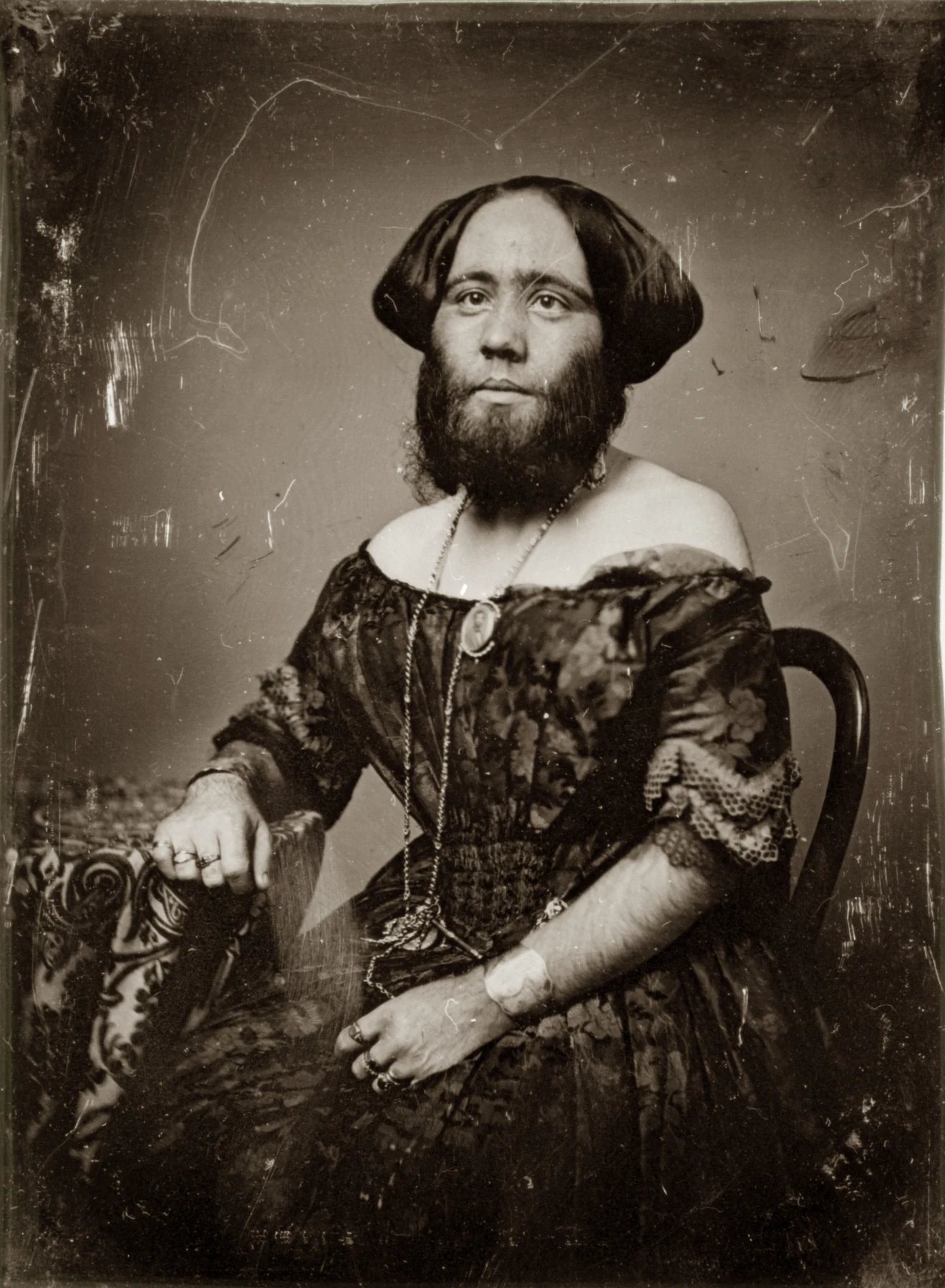 Full portrait
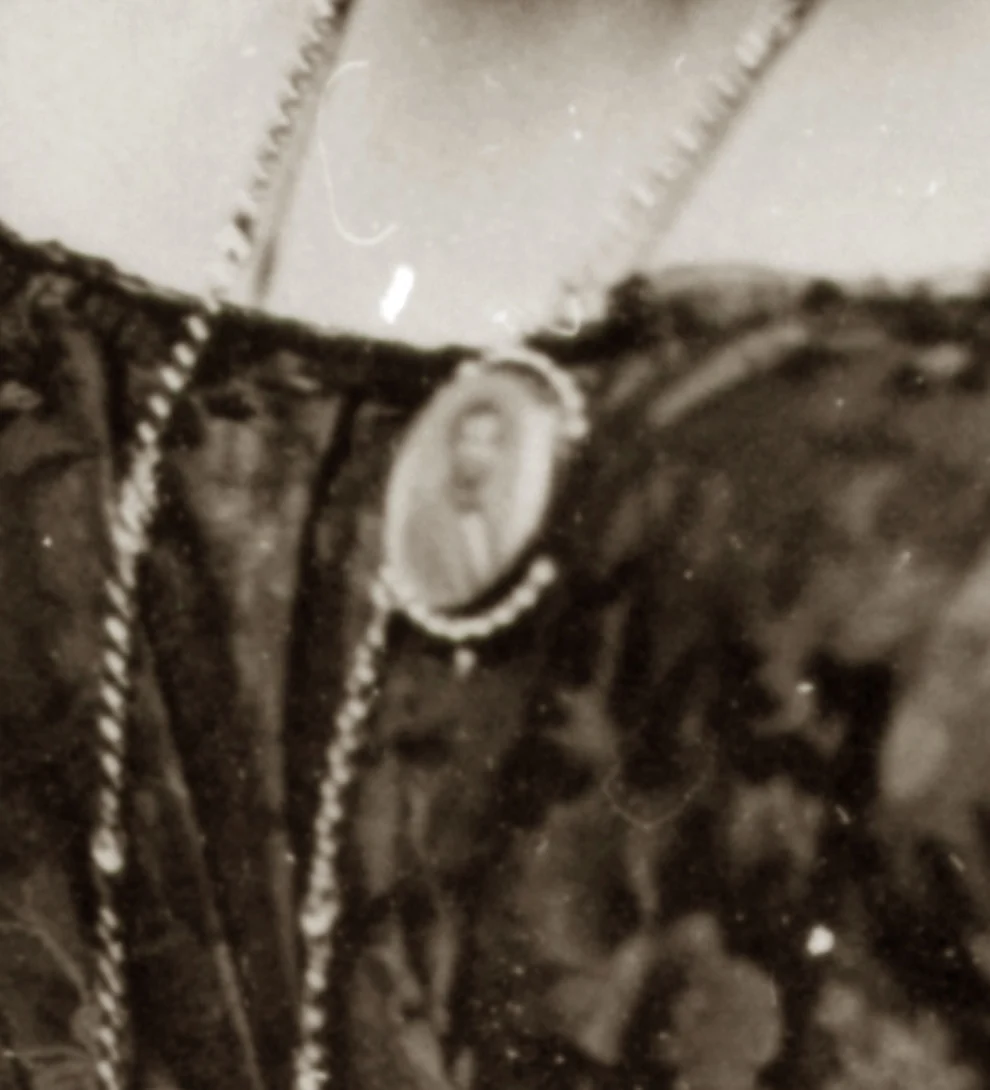 Brooch detail
The enlargement lets you see where she wore the brooch and the shape of its frame. It does not make the sitter in the tiny portrait clear enough to identify from sight. The name comes from the museum’s record. The record does not identify the maker of the miniature or the alloy of its mount.
Studios made photographs to wear
An advertisement for Robert Cornelius’s Philadelphia studio, preserved in a Library of Congress presentation, offered daguerreotype miniatures from life or copied from an existing portrait. A customer could ask for one small enough to fit a medallion or a breast pin. That is evidence that studios offered photographs expressly for jewelry, not an attribution of either Clofullia photograph to Cornelius.
A separate brooch in the Science Museum Group collection, dated about 1850, shows one way to fit a portrait: an oval daguerreotype swivels in a pinchbeck frame. Pinchbeck is a copper alloy. The museum also lists other materials; its description of the frame does not describe every part. This is a different brooch, not a match for Clofullia’s.
Where the silver actually is
A typical daguerreotype is made directly on the polished silver surface of a copper plate. There is no separate negative used to print that plate. Because the surface reflects its surroundings, changing the viewing angle can make light and dark appear to reverse. The same plate carries the image either way.
That is a different job from the silver on Henry Draper’s telescope mirror: the mirror gathered light, while his photographic plate recorded a separate image. Draper used a different photographic process. In Clofullia’s brooch the silver surface was part of the picture. Whether the surrounding frame also contains silver is a separate question.
When you describe a piece of photographic jewelry, name the image process only when you can identify it, and record the mount on its own evidence. A metal surround does not tell you what kind of photograph it holds. The portrait does not tell you what metal went around it.
Keep the photograph and the setting in the same record
Start with a front photograph and a side view of the mount. Record what you can see of the pin, ring, cover glass or frame without taking it apart. If a name came from a family note or museum catalogue, preserve that source with the name. If you cannot identify the alloy, “metal mount, alloy unconfirmed” is enough.
If the cover glass or plate is loose, do not open it or polish the picture surface to see more. The Canadian Conservation Institute’s guide explains why the image and its housing matter together. Ask a photograph conservator before intervening.
Keep reading: silver in historic photography · how to read the parts of a locket or pendant.
Sources and image rights
Read the records behind the story
- Missouri History Museum catalogue, N17387: Easterly attribution, watch and miniature. Digitized portrait and public-domain basis: both views use the same scan; the brooch detail is cropped and resized.
- Cornelius’s studio advertisement, reproduced in Rachel K. Wetzel’s Library of Congress presentation, PDF page 17 (slide marked 18).
- Science Museum Group, 1990-5036/2296: comparator and identified frame material; linked, not reproduced.
- Library of Congress preservation research: mirror-polished silver and direct image; Canadian Conservation Institute: viewing angles and care of encased photographs.