
A cap that unscrews
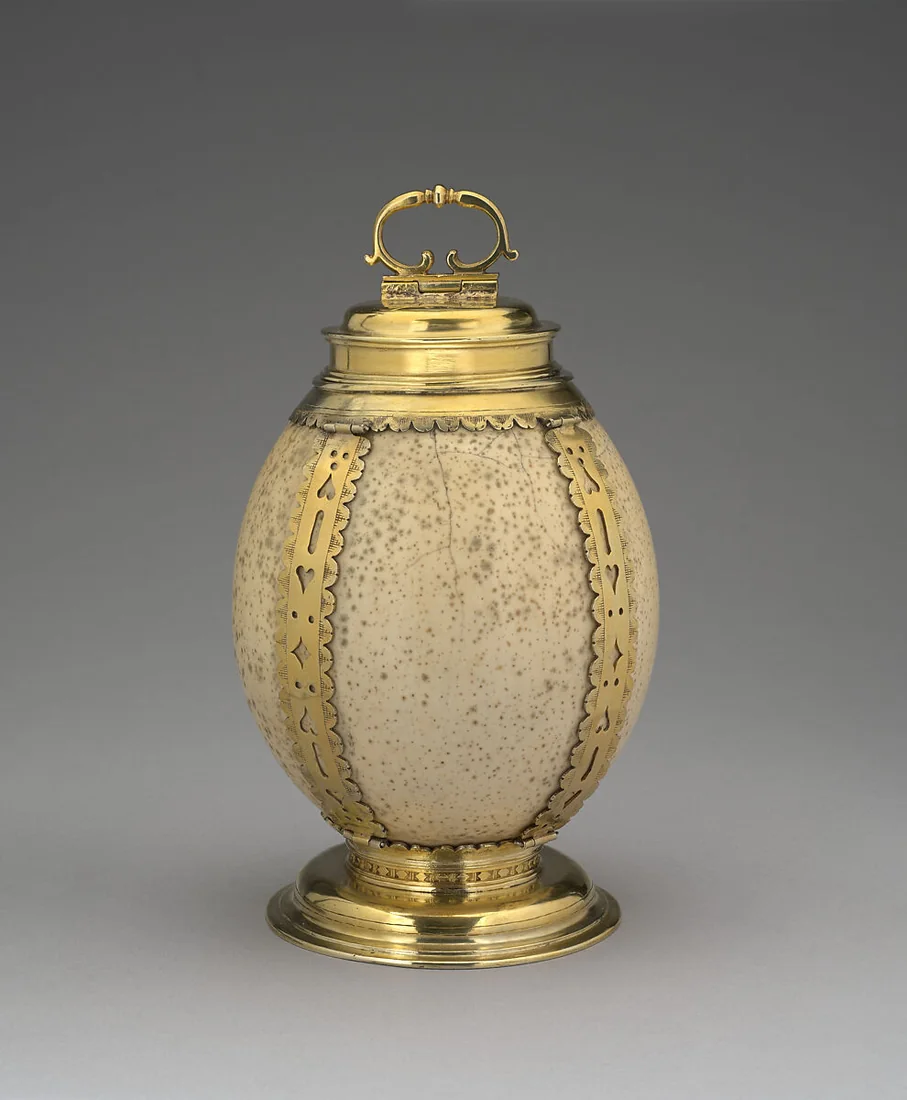
At first the Met's flask looks like a piece of speckled pottery with brass bands. Look up to the metal collar and curled handle on the cap. This is a screw-top flask, made around 1600, probably in southern Germany. The pale, speckled body isn't fired clay, and the metal isn't brass. It is an ostrich egg mounted in gilded silver.
The metal is concentrated where it changes the usefulness of the shell. A broad foot gives the ovoid body a stable place to stand; the bands connect the foot and the neck in a visible framework; the top provides a closure. It would be easy to call the gold-colored parts an ornamental cage. But the closure is part of how the vessel opens. You can read that much even though the record doesn't describe a liquid it carried or a journey it ever made.
Cutting a cup's lid
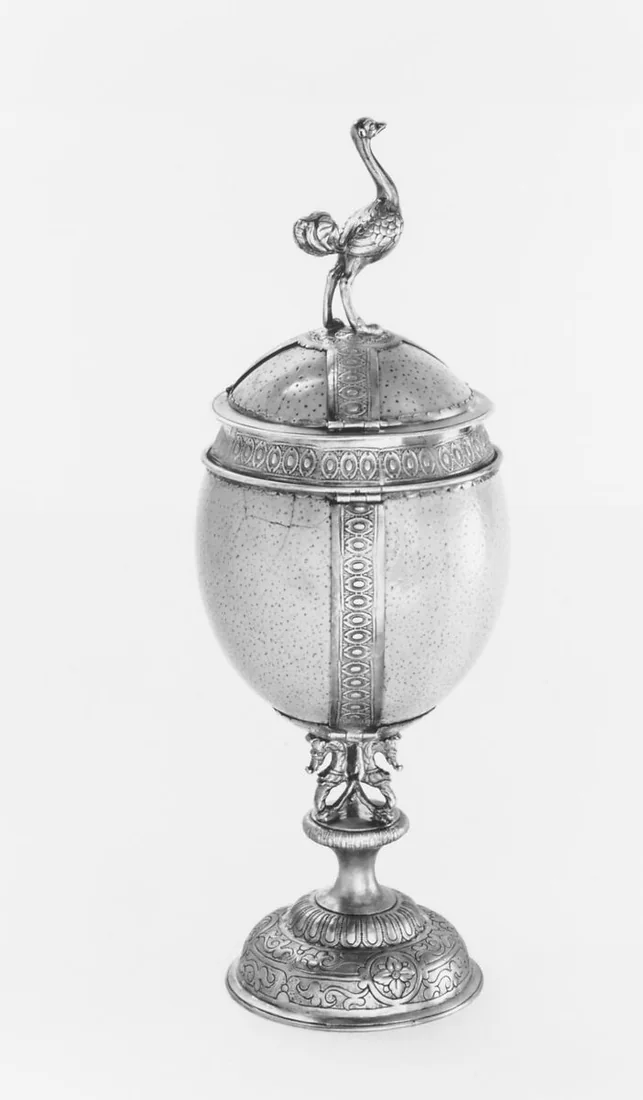
In London a silversmith answered a similar problem in another way. On the Met's cup with London marks for 1591, the egg was cut through near the top. Instead of discarding the small piece, the maker used it for the cover. That accounts for the pale dome crowning the silver rim and for the material continuing above the broad band. The larger part of the egg forms the bowl. A much taller stem raises it up.
There is no need to read the two vessels as stages in one invention. Their makers faced the same starting shape and gave it different openings: a comparatively small neck with a screw cap on the flask, a broad lift-off cover on the cup. The shell cap isn't a trick of the silverwork; it is another piece of the egg. The older Untermyer collection catalogue, no. 17, records the London marks. The photograph is monochrome, even though the mounts are gilded.
The bird came later
A tiny modeled ostrich stands on the London cup's cover. It's the most legible clue to the identity of the large pale bowl and perhaps the detail you'd notice first in a cabinet. It's also the part you should hesitate to date from the marks. The Met's current entry calls the finial a probable nineteenth-century addition, not a securely documented sixteenth-century feature. The label can say 1591 without saying that every component you see was made in that year.
That difference is worth carrying to other sorts of mounted silver. A mark on the mount provides evidence about the mount. It doesn't automatically date an older shell, a later replacement, or a detail attached to the cover. The mother-of-pearl mounts story follows similar evidence at seams between other natural materials and metal. The two egg vessels give a useful additional clue: ask what actually opens and which material moves with it.
The ostrich without an egg
In Augsburg around 1689 to 1692, Marx Weinold made a different sort of ostrich vessel, now at the Met with a basin by Johann Mittnacht I. The ewer is a striding silver bird with a small figure of Cupid on its back. There is no eggshell in the museum's material entry. The cover that looks like a fringed saddle blanket is detachable and acts as a stopper. The bird's base fits into the basin's sun motif for display, but the museum photograph presents them separately, with the basin standing upright.
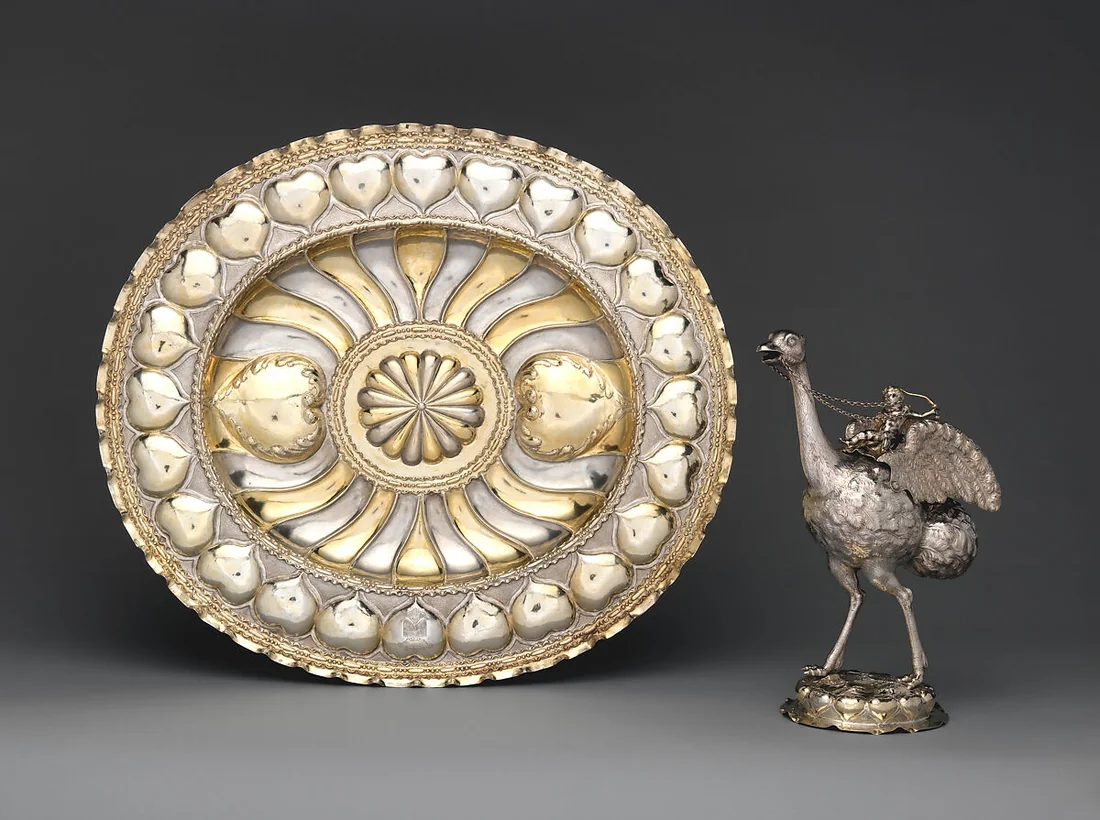
The Met suggests two possible settings: washing hands at a banquet or displaying the set on a show buffet. Neither possibility is proof of how an owner actually used it. A documented ewer-and-basin routine makes a useful comparison: a set can be read by looking at the two pieces together, but a basin does not tell you which room the pair stood in or who poured the water. In this case the vessel offered something to see even if no water passed through it.
Form isn't a record of use
Why mount a real egg instead of modeling one in metal? The flask's bands leave most of the shell visible. The unusual material was part of the appeal, especially in the princely settings where European collectors put natural specimens alongside objects that showed off skilled workmanship. The silver did not make the shell less strange. It gave people a familiar way to approach it, with a foot, a neck, and a top they could recognize.
Start a description at that point: “ostrich egg with gilded silver mounts,” if supported, and then account for the foot, the way it opens, and any metalwork that may belong to another date. Keep the degree of certainty attached to the particular part. Don't force a lid open or fill a composite antique to see whether it holds water. The screw top tells us what the flask was made to resemble and how it was meant to open. The quieter fact is that the shell was still meant to be seen.
Sources
Museum records and image credits
- The Metropolitan Museum of Art, Ostrich Egg Screw-Top Flask, ca. 1600, 2024.178a, b: material, probable origin, construction and period collecting interpretation.
- The Metropolitan Museum of Art, Cup with Cover, London, 1591, 68.141.295a, b: the cut egg cover and probable later finial. English and Other Silver in the Irwin Untermyer Collection, no. 17, documents marks for London, 1591; follow current record on finial dating.
- The Metropolitan Museum of Art, Ewer in the Form of an Ostrich and Basin, ca. 1689–92, 2014.265a, b: separately made basin, actual closure, display fit and possible uses.