
See the dots on the casket
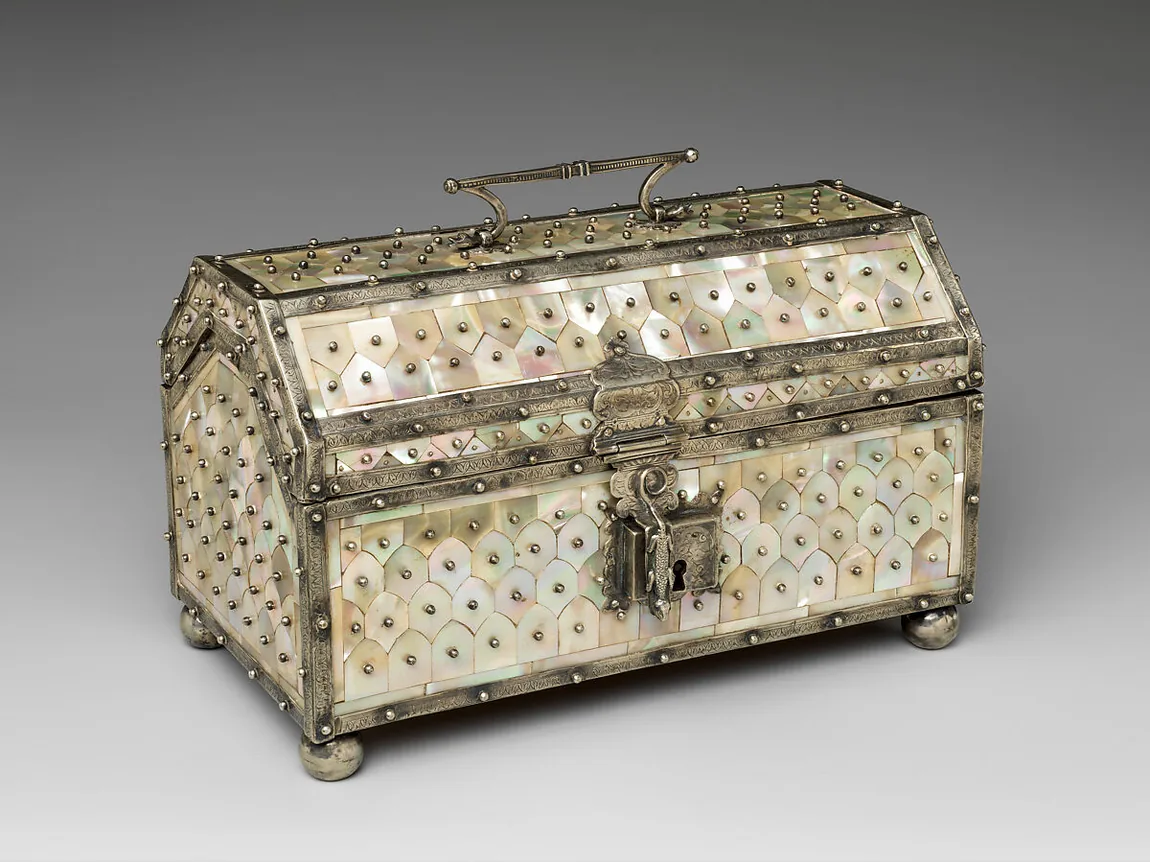
At first glance the pale surface looks like a single shimmering skin. Look again and it breaks into small pieces of mother-of-pearl. The dark dots interrupting the pattern are worth a closer look. The Metropolitan Museum of Art identifies silver pins as the fasteners that hold the shell tiles to this sixteenth-century bridal casket. Silver is at the heart of the construction even where the shell takes the light.
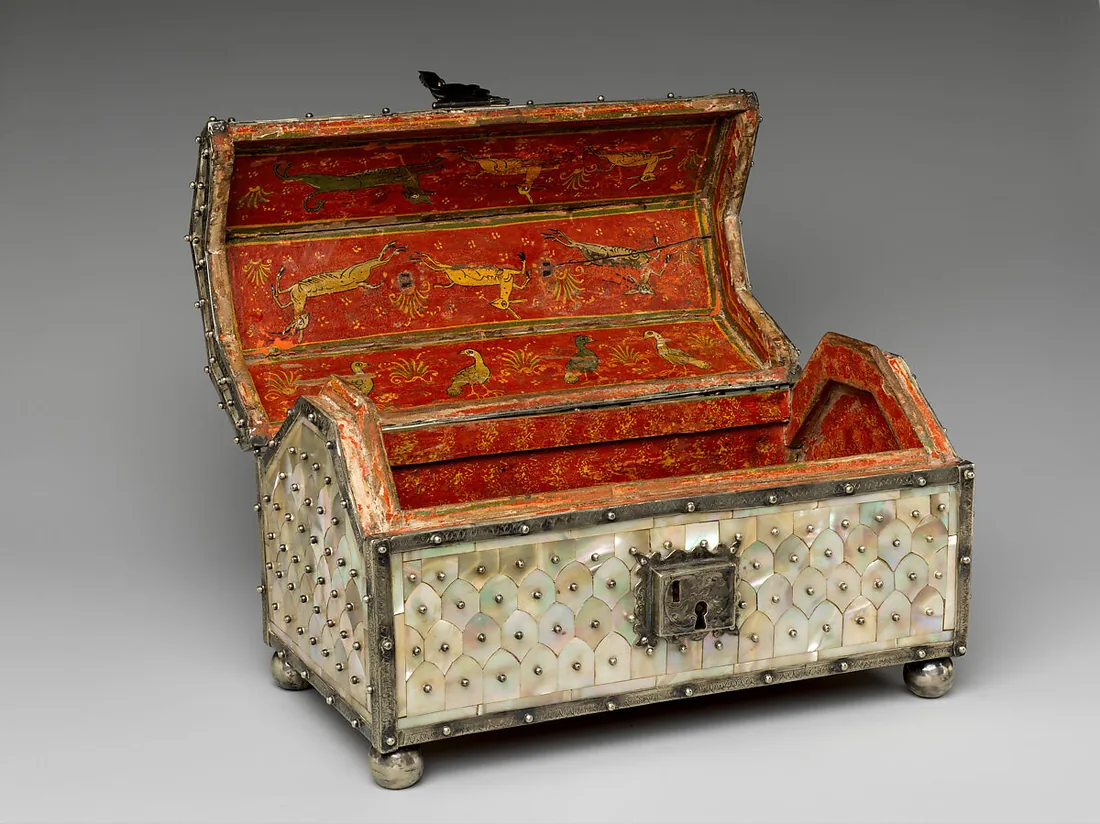
The box is about 26 centimeters long. Its structure is teak. Open the lid and the surface changes abruptly: the pearl shell gives way to a painted interior. The arrangement keeps the materials legible. Wood makes the container, shell supplies the luminous exterior, and the mounts and pins do different jobs in the assembly.
A technique and a customer can have different addresses
The Met links this group of objects to Gujarat on the western coast of India. The small shell pieces work like tiles, a method often described as tesserae. The museum identifies the casket form as European and the surface workmanship as Indian. Its label lists Gujarat and “Goa or Lisbon”; that last choice is an uncertainty, not two extra stops we can place on a map.
Portuguese customers commissioned objects in this group, and the Met notes that such pieces were initially intended chiefly for use in Asia. Some became prized in Europe. That is the context of this work, not a shipping manifest for this box. A Gujarati plate in The Met, with shell pieces pinned over a wooden substrate and a copper-alloy rim, is another reminder that the shellworkers’ technical choices were not confined to one form or one metal. The materials deserve to be described before the whole object is assigned a single place.
What happened when the shell was wanted for itself?
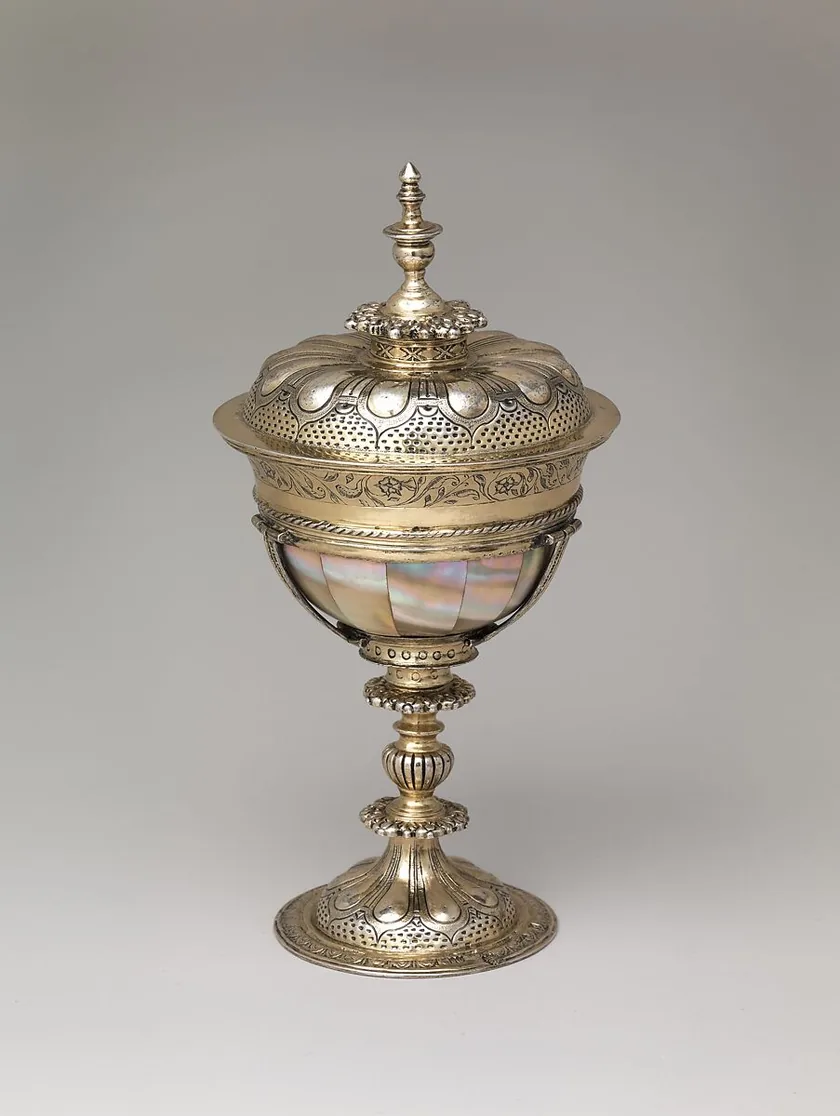
The trade could move more than finished boxes. The Met’s covered cup from 1590–91 brings together mother-of-pearl associated with Gujarati workshops and gilded silver made in London. Its curator explains that inlays were removed from an earlier vessel and fitted into new mounts. The little heraldic roses on the foot and lid speak to the Elizabethan setting of that work. The shell was not discovered as a raw material in London. Someone had already cut and arranged it before the London mount gave it a new outline.
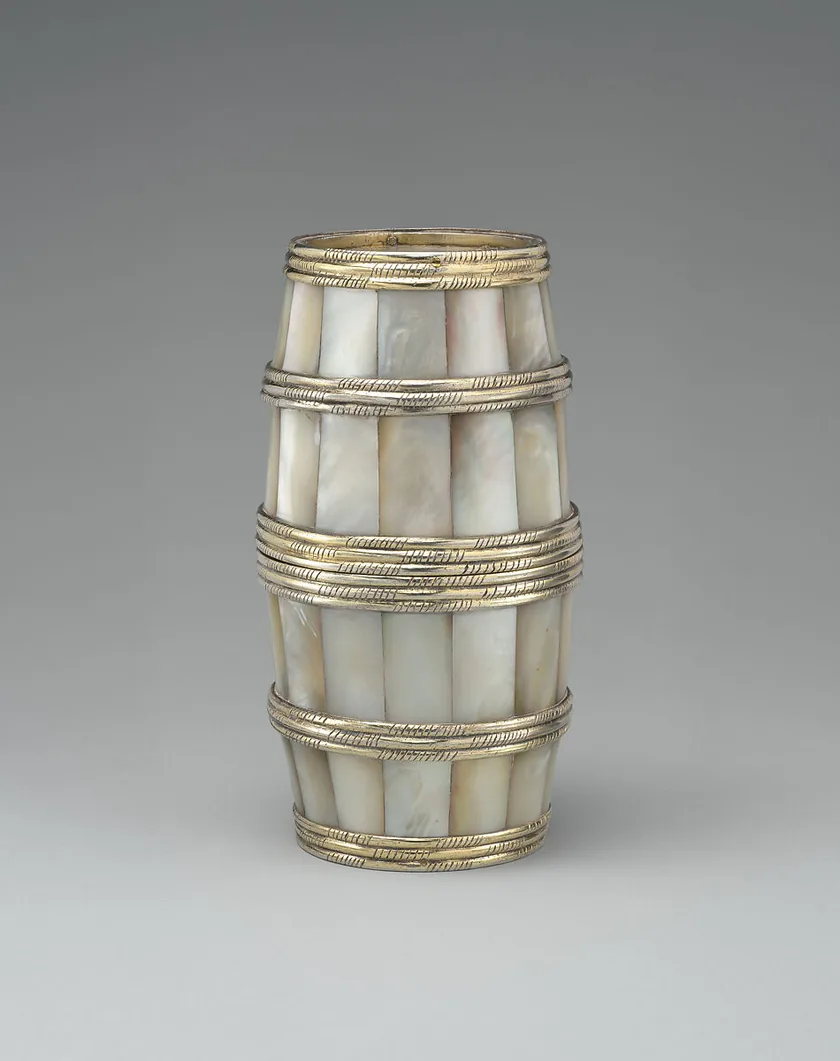
A related move took place in Nuremberg. The goldsmith Georg Rühl made a double beaker from gilded silver and mother-of-pearl around the turn of the seventeenth century. Assembled, it looks like a barrel; its silvery-white shell segments sit between bands of gilded metal. The Met considers it likely, not proven, that the bands of shell came from another object made by Gujarati artisans. There is no evidence here that the casket, cup and beaker shared an earlier owner or that one supplied parts for another.
Follow the join before you name the whole object
Look for the edge where one material stops and another begins. On the casket, the question is how a small tile stays on a wooden core. On the London cup, it is where older shellwork meets a new foot, rim or lid. On the Nuremberg beaker, it is which bands belong to the shell and which belong to the mount that reorganized it. A mounting date is valuable evidence, but it does not date the making of every component.
That distinction matters at home too. On a piece combining shell, wood and metal, record lifting tiles, visible fasteners and loose edges before you clean anything; do not prise up a tile to find out what holds it. Different materials can respond differently to moisture and movement. The nicest thing you can do for the history is to keep the joins intact and the description precise.
Keep exploring
Sources
Museum records and public-domain image credits
- The Met: bridal casket 2024.480a, b, silver pins, teak, shell veneer, painted interior and geographic attribution.
- The Met: London covered cup 68.141.120a, b, older shellwork remounted, date and heraldic decoration.
- The Met: Rühl double beaker 2008.543.3a, b, barrel form, date and likely Gujarati source for the shell.
- The Met: Gujarati plate 2006.313, pin-fastened shell on wood and the Portuguese trade.
- The Met: The Care and Handling of Art Objects, conservation considerations for composite objects.