
Look behind the animal plaques
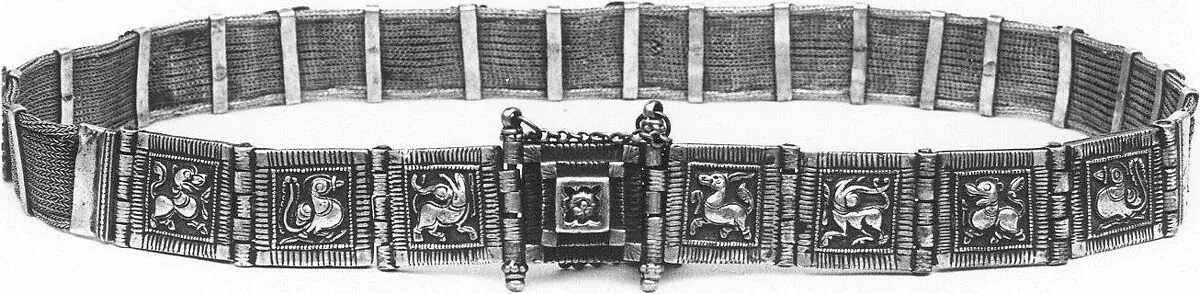
Across the front of this belt, small square panels show long-necked birds and curling, catlike creatures. Turn your eye to the back, where the decorated panels stop, and you see a different rhythm: what look like narrow strands of chain laid side by side. The Metropolitan Museum of Art identifies some of the creatures as the hamsa, a sacred bird, and the yali, a mythical feline creature. Its record attributes the piece to Chennai, historically known as Madras, and describes this kind of belt as typical of South India and worn by women.
The belt once belonged to the American artist and designer Lockwood de Forest, whose collection includes jewelry he gathered during travel in India from 1879 to 1881. That tells us something about how the belt reached a museum collection, but it does not prove where he bought this particular piece or name the person who wore it. The wire tells a separate story, and even a good photograph cannot tell it all.
What the X-ray revealed
In the technical appendix to Islamic Jewelry in The Metropolitan Museum of Art, Marilyn Jenkins and Manuel Keene publish an X-ray of this exact belt, accession 15.95.13. Their caption identifies hollow tubes knitted from wire along both edges. The wider section between them is knitted too. The authors describe the center as imitating the appearance of several linked chains laid next to one another. See figure TA 3 in The Met’s published catalogue, printed page 144. The photograph on this page shows the visible pattern; the published radiograph is the evidence for how those sections were made.
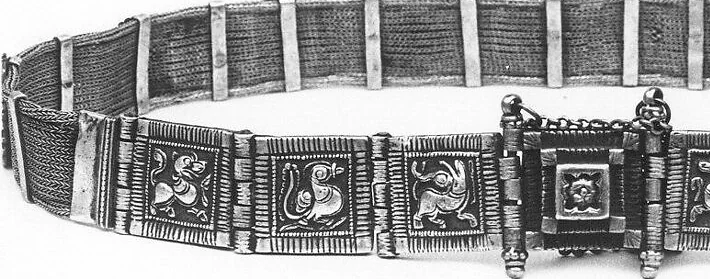
There are two differences here worth keeping separate. One concerns the building blocks. In a linked chain, separate wire rings can be folded and passed through their neighbors. Knitted wire makes a fabric-like structure by looping lengths of wire through preceding loops. The other difference concerns the space inside. At the belt’s edges, knitted wire makes the wall of a hollow tube. The center is also documented as knitted; that does not mean the center and the edges are the same shape, or that the silver wire itself is hollow. One word describes the result; the other describes how the wire is arranged.
A real chain can look like a braid, too
Compare the belt’s texture with The Met’s gold necklace from second-century Roman Egypt. Its collection record explicitly calls it a loop-in-loop chain. Near the clasp, the chain looks tightly braided, yet the name refers to a construction made from separate interlocking units. This comparison is about structure, not a claim that the two jewels share a maker, date, alloy or line of descent.
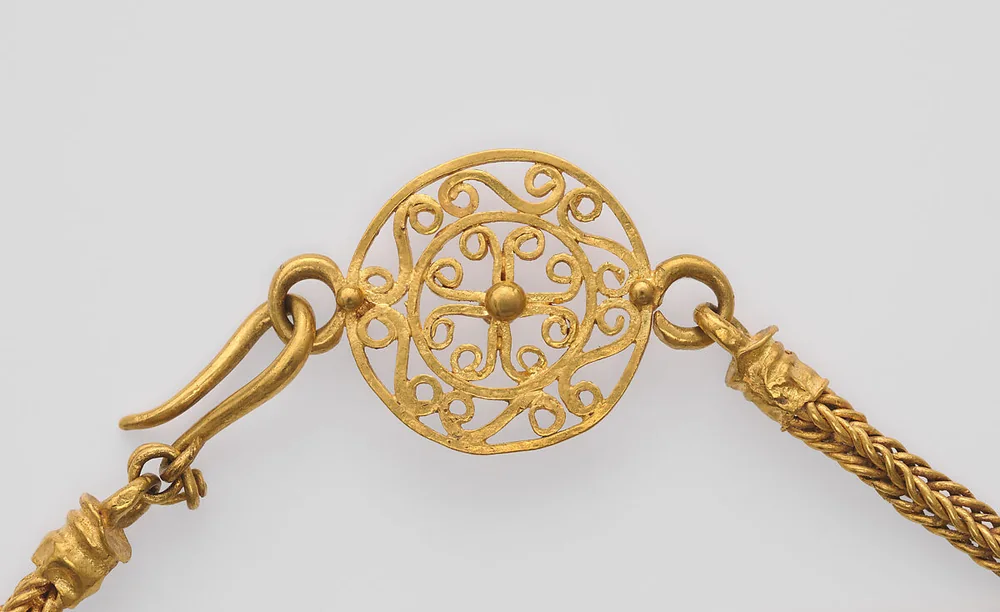
On the belt, rows that look like chains turn out to be a knitted band. On the necklace, something that looks braided turns out to be linked. Each is a reminder to describe the repeated pattern before declaring the method. In both cases, knowing the exact museum record makes the comparison more useful than guessing from texture alone.
Three separate entries for a collection record
Write down the pattern first: which units repeat and how far you can follow them around the back or toward a fitting. Describe the construction next, using language that matches the evidence. “Close parallel rows, construction not confirmed” is a good description when a photograph cannot settle it. If the documented interior is hollow, name the hollow part: the wire, a single link, a bead or the tube formed by many loops. They are not interchangeable.
Last, record the material and what supports it. Hollow describes space inside a component. Sterling names an alloy standard. Silver plate describes a surface coating. The Met calls the belt silver but does not publish a sterling fineness for it on this object record, and the radiograph is a study of construction, not a fineness test.
Look carefully at any existing exposed ends or joins under good light, without prying a cap loose or deliberately bending old wire. The useful record may stop at “knitted-looking texture; composition and interior unverified.” The belt is a good reason to leave those two questions open until you have evidence for each.
Keep exploring
Sources and image credits
Museum records, technical catalogue and image credits
- The Met: Belt, 15.95.13, object record, geography, material, wearer context, provenance and public-domain photograph.
- Marilyn Jenkins and Manuel Keene, Islamic Jewelry in The Metropolitan Museum of Art, Technical Appendix, printed pp. 143–144; see TA 1 for linked structures and TA 3 for the radiograph of 15.95.13. Radiograph is link-only, not reproduced.
- The Met: Gold loop-in-loop chain with a Bes pendant, 40.9.12, record and public-domain clasp photograph.