
A match on the handle, seven choices at the table
Suppose the handle of a piece of inherited Gorham silver shows Vulcan handing thunderbolts to Jupiter. You have a strong lead: it belongs to the Mythologique pattern. You still don’t know what the piece is. Gorham offered that same scene on utensils as different as a cold meat fork and a gravy ladle.
Elizabeth A. Williams of the RISD Museum compared the firm’s pattern booklet, which lists 72 offerings across 24 mythological designs. Vulcan’s scene alone turns up on seven: the gravy ladle, large sugar sifter, cold meat fork, preserve spoon, tablespoon, large cheese scoop and pea spoon. The childhood of Marsyas, by contrast, appears on two, a pickle fork and a sardine fork. A pattern name, the scene on the handle and the name of the utensil belong in separate fields.
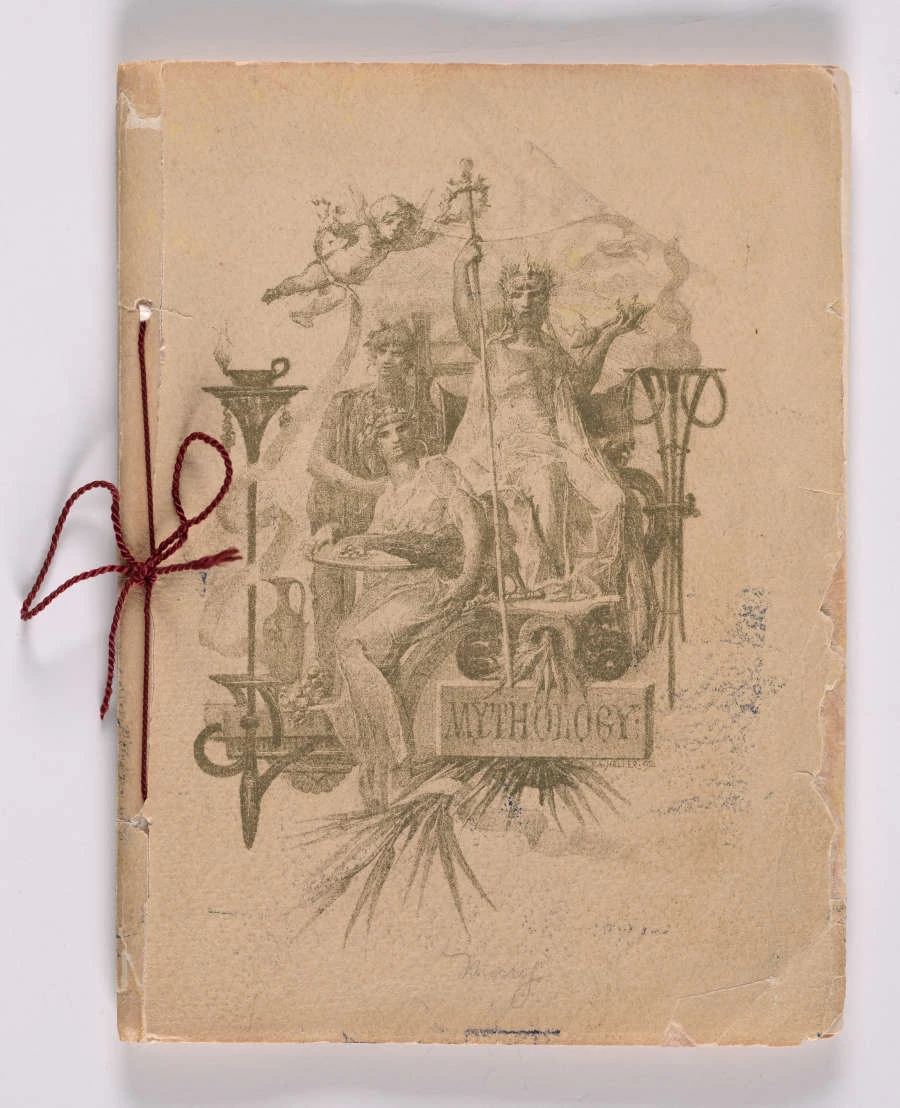
At the table, the variety gave diners a utensil for a particular job. In a collection, the variety means one good match can narrow a search without finishing it. A likely scene is the moment to turn the piece around, not to stop looking.
Why the fork looks unfinished
The RISD Museum’s 1894 pattern sample for a table fork shows Charon ferrying souls to Hades. Florentin Antoine Heller designed it for Gorham. The ornamental handle is sharply defined, but the working end is not finished like a fork you would set beside a plate. RISD explains that the set was deliberately left flat and partly unfinished. What looks wrong for a dinner fork is useful evidence of how it was made.
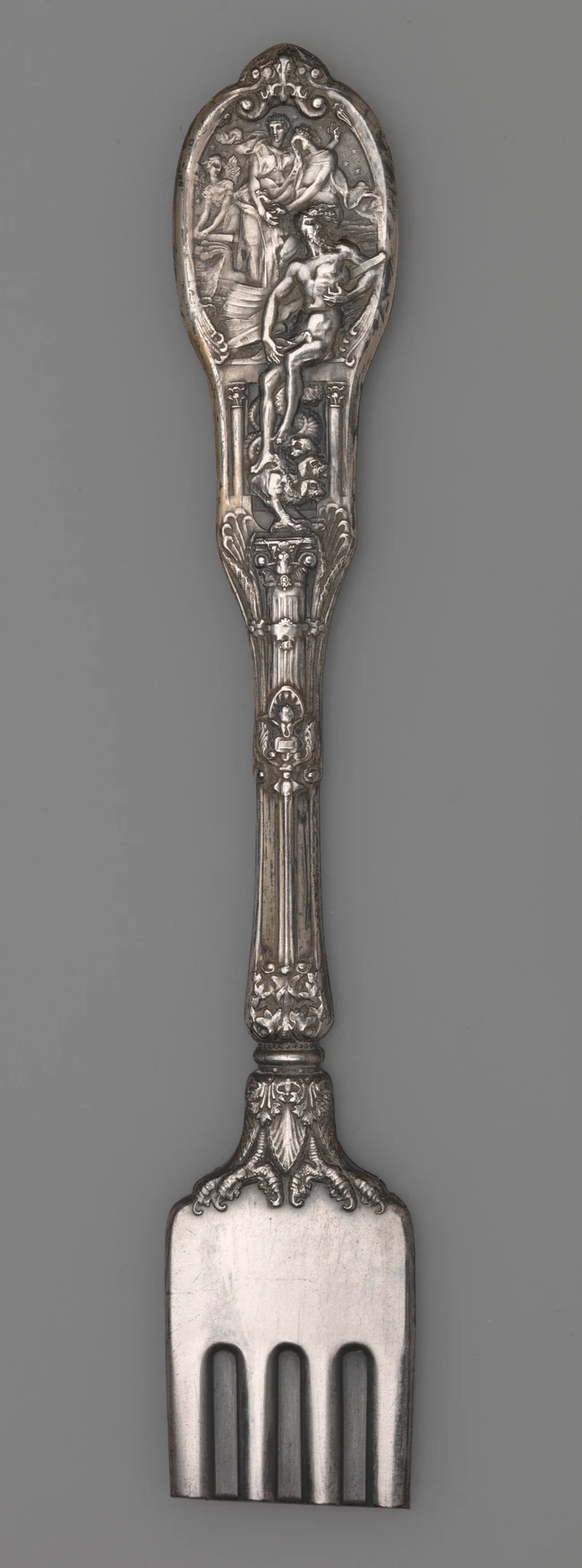
Williams connects that contrast to Gorham’s production methods. Heller’s detailed modeling supplied the design, while a steam-powered drop press reproduced it in metal. The sample lets you see where that work had stopped: the design was already legible, but the metal at the working end had not been trimmed and shaped into a finished utensil.
The museum records this sample as 16.5 cm long. That number identifies this specific sample, not every finished table fork. Compare with a documented finished utensil before using dimensions to settle the identity. The sample and a retail piece can share a design without being the same thing.
Compare the end you didn’t photograph
Take a straight-on photo of the front and back, from the handle tip to the working end, with a ruler alongside. Once you have a probable pattern and motif, compare the form: tines, bowl, scoop or perforations. Record length and width, then check borders, bowl decoration, monograms and back marks. Keep condition separate: a bent tip or later repair is not proof of a different design.
A listed finished cold meat fork provides a comparison with the shape a retailer identifies. The booklet gives the historical combinations. Use both kinds of evidence and leave a question mark by the exact form if the working end or the dimensions don’t line up.
The flatware identification guide walks through the same process with other makers. For more on the firm that made the pattern, see the Gorham maker profile.