
Start with the writing
On the front of a small parcel at the Tokyo National Museum, the characters 銀壱枚 say “one unit of silver.” The writing on the back, 未五月七日 銀座, gives the seventh day of the fifth lunar month in a Year of the Sheep, and names Ginza, the silver mint. The museum also identifies many seals on both faces, including a mark reading 大黒常是, Daikoku Jōze.
The museum puts a question mark after “eighteenth century.” The Year of the Sheep repeats, and the day and month are not a modern May 7. The writing gives us a date we can read without giving us a single year to put on an inventory card. See both faces of the actual packet in Japan’s Cultural Heritage Online catalog (Tokyo National Museum, E-20093).
One unit, not one coin
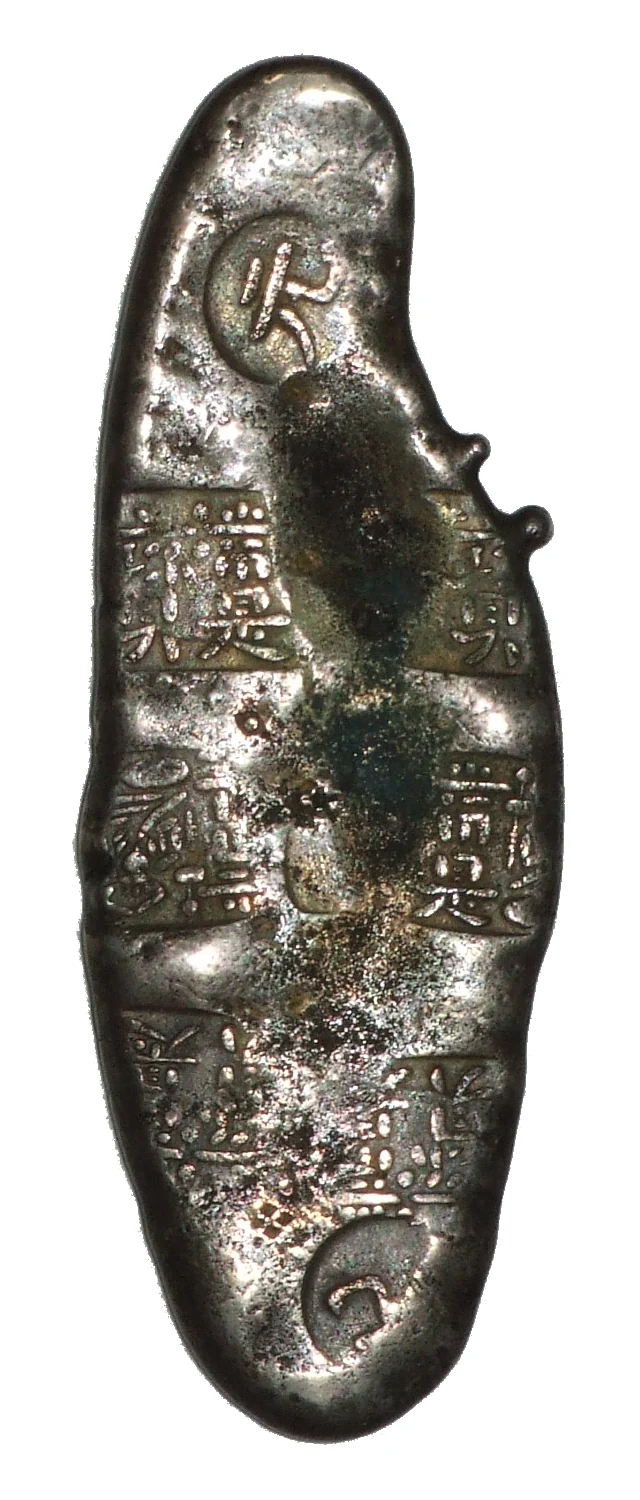
In Edo-period Japan, much silver money was reckoned by weight. A long piece called a chōgin (丁銀) could provide most of the weight; smaller pieces could make up the balance. The museum describes this unopened packet as containing chōgin and small silver pieces it calls kodama-gin (小玉銀). It does not identify the individual pieces inside.
Kenjiro Yamaguchi and Mari Ohnuki’s study of Edo money wraps gives 43 momme, about 160 grams of silver coinage, as the customary equivalent for one unit. That is a historical convention, not a measurement of this object or a statement about how much pure silver it contains. The museum says packets marked “one unit of silver” were often used as gifts. It does not say whether this one was given, or to whom.
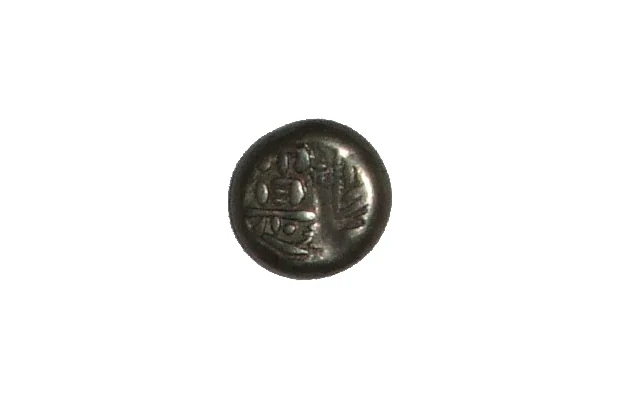
Here are two separate loose examples, not the contents of the packet and not shown to scale. The shorter example is catalogued as a Genroku mameitagin, a name for the type shown here rather than an identification of the packet’s smaller pieces.
The work the seal did
Before accepting silver paid by weight, someone had to check it. The wrap gave the recipient something else to inspect: a declared amount and the marks of whoever stood behind it. Yamaguchi and Ohnuki describe wraps passing unopened in larger transactions when the issuer was trusted. They also explain why someone might want to open a wrap at an authorized money changer’s counter: a holder who broke the seal on their own and found a shortfall could bear the loss.
That is how sealed wraps could work, not a record of how this one was used. Some silver money was counted rather than weighed, especially as counted denominations became more common later in the Edo period. And nothing in the museum’s record establishes that this packet circulated. What survived is the paper, seals and silver together. Opening it just to count the pieces would destroy that association in its intact form.
When paper and metal belong together
A U.S. silver certificate is a useful contrast. It was a paper claim redeemable for silver under specific rules. This wrapper held the silver itself. Both pieces of paper made an amount legible. Opening the wrapper would reveal the metal; redeeming the certificate required an exchange.
For a collector, the useful habit is to photograph a wrapper, holder or envelope before separating it from an object and keep the pairing in the object record. Sometimes the package is the most informative surface there is.
Sources
Read the museum and monetary history records
- Cultural Heritage Online: 包銀(銀一枚), with two photographs of Tokyo National Museum E-20093; official collection entry and museum’s historical exhibition list. The exact packet is linked, not reproduced.
- Yamaguchi and Ohnuki, The Gold and Silver Wraps of the Edo Period, Bank of Japan Institute for Monetary and Economic Studies discussion paper 97-E-10, printed pp. 2–3 and 10–12. The paper presents the authors’ findings, rather than an official Bank policy statement.