
What do the towers mean?
On Danish silverware, the historical three-tower mark is a silver control mark, not a claim that every marked piece is sterling. A separate Danish two-tower mark was used on silver-plated ware. That one-tower difference can change what you’re looking at, but a worn edge on a stamp is not a tower count. Photograph the complete punch and the other marks beside it before deciding what you have.
A spoon beneath a Copenhagen street
When workers were building Copenhagen’s Trianglen metro station, archaeologists retrieved a little spoon from the excavated soil. Only the bowl and the lower half of its thin stem remained. On the underside were three separate impressions: the maker’s initials, a numerical mark for the silver standard, and the three towers.
The Museum of Copenhagen report calls it a coffee or demitasse spoon and lists it as 0.826 silver. That figure is how the report classifies this find, not a new test of the metal and not what three towers necessarily mean on every piece. The exact numeral should not be asserted as a personal transcription. See the spoon and the close-up in figures 11–12.
The report read the initials as L.G. One candidate, Laurits Theodor Grün, worked in Copenhagen. Another, L. Grønlund, worked in Odense. The researchers preferred Grønlund based on the form, and offered 1893–1937 as a likely range, not a date stamped on the spoon. Finding it in Copenhagen did not make it the work of the Copenhagen smith. The spoon came from a spoil heap, so the report also cannot tell us exactly where it was dropped.
A shaker with two countries on it
A 1926 Georg Jensen cocktail shaker in the Art Institute of Chicago shows why it pays to read all the marks. The museum records the three towers above 26 alongside 925 S and design number 462. It also records an English import mark and an English 925. One set concerns the Danish object and its control marks; the other concerns the silver entering the English market. The second set does not turn it into an English-made shaker. See the museum catalog, object 1991.305.
Try it on your own piece
Start with a picture of the whole object and a closer one showing where the stamps sit. Then take an angled-light close-up and write down the towers, letters and numbers without trying to interpret them yet. If the outline is incomplete, write “two towers visible” rather than “two-tower mark.” Once you can see the whole impression, compare the shape and neighboring punches. An 830 or 925 mark can be useful in its own right; Danish silver need not look like either tower example.
Record what each clue actually supports. The control impression and fineness number can help with the silver standard. The initials start a maker search. The object’s form can help you choose among similarly named workshops. A recovery location, family story, or shop address belongs in a different column.
For the next step, use the mark identification guide, or follow the initials with our maker-mark research guide. For more examples from the same house as the shaker, visit the Georg Jensen profile.
Sources and photograph
- Museum of Copenhagen: Trianglen excavation report, KBM3841, printed pp. xxx and xxxv–xxxvi, find FO 100156. The spoon and its marks.
- Cohr workshop history and marks. See the section on historical Danish silverplate marks.
- Art Institute of Chicago, Gifts Beyond Measure, cocktail shaker 1991.305. The catalogue’s transcription is the source for the shaker’s Danish and English marks.
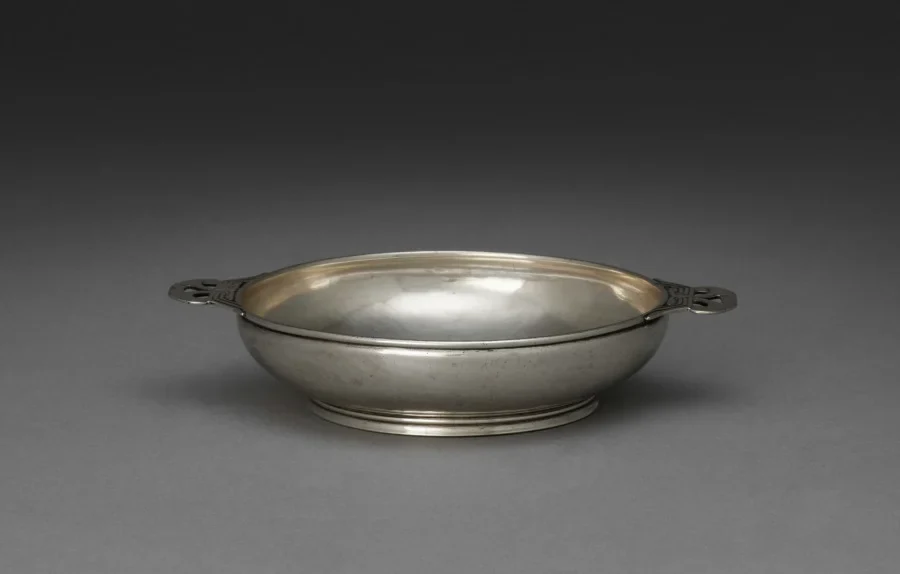
- Cleveland Museum of Art: Bowl with Two Handles, 1982.250. Open-access contextual photograph.