
A match at first glance
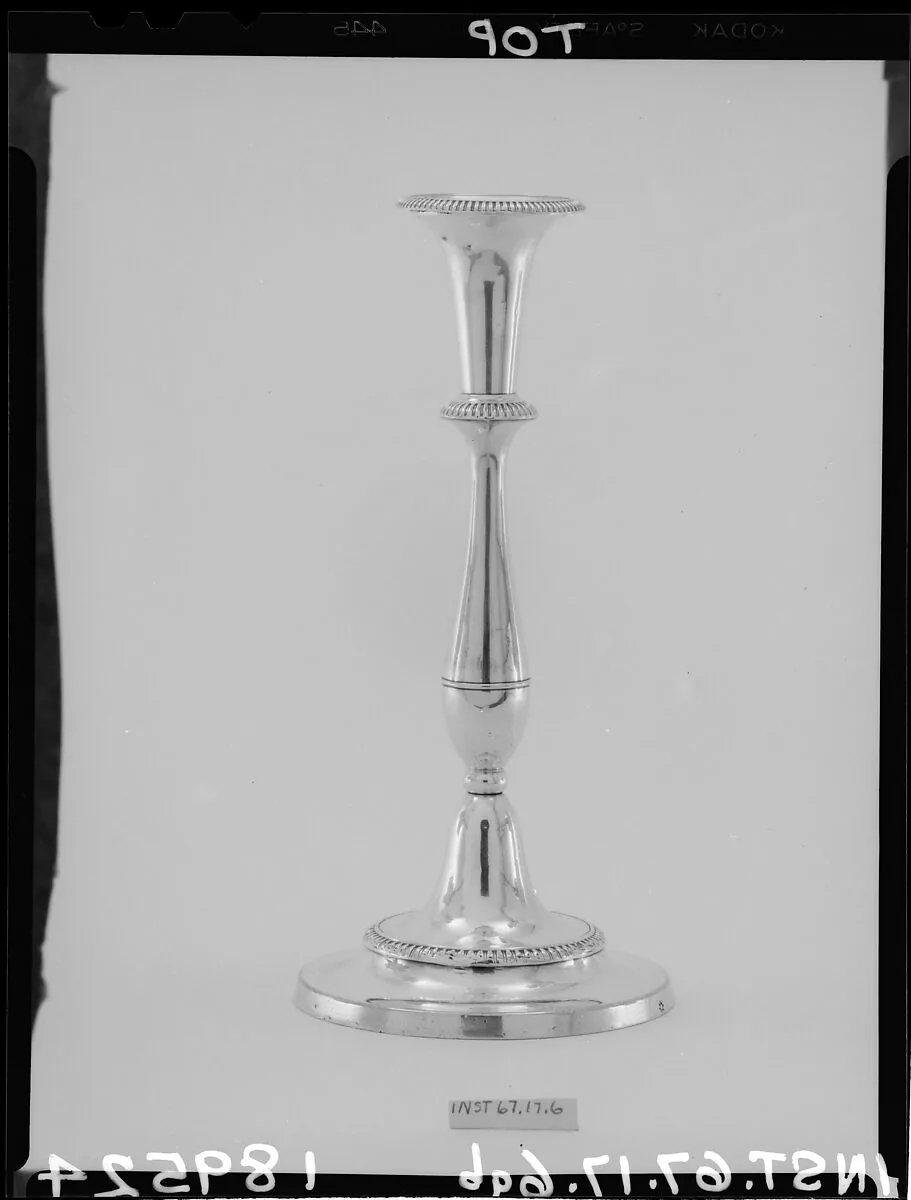
Start with the foot. In the Science Museum Group Journal’s comparison photograph, the curves sweep around both scalloped bases. The stems swell at the same place. If you were shopping from photographs, you might file the two under the same pattern and keep scrolling.
The match is real, but it stops short of the metal. On the left is one silver candlestick from a pair in the Birmingham Assay Office collection, hallmarked for Chester’s 1768–69 assay year. On the right is one from a pair in Sheffield plate that Chiswick Auctions catalogued around 1768. The journal attributes both bodies to the same forming dies. The two versions are credited to the Soho workshop of Matthew Boulton and John Fothergill, but they belong to different sets. What looks like a pair across the photograph is a comparison, not a pair as sold or used together.
There is a second catch. The workshop’s silver pair has Sheffield-plate nozzles, the removable fittings at the top. The auction house also thought the removable sconces on the plated pair were probably later. That last point is the auctioneer’s judgment, not an established replacement date. What the documents do establish is a useful distinction: you can recognize the design and identify the body without knowing whether the fitting above it is original, a replacement or even the same metal.
Why the pattern repeats
A die is a tool with a shape cut into it. A drop stamp drove sheet metal against that shape, allowing the workshop to repeat an ornament instead of forming each example from scratch. Copper and silver had already been bonded together before Sheffield plate went through the rolling mill. The rolls thinned the joined layers into sheet; they did not merge them into one alloy. The shape came later, when that sheet was worked. An equivalent design could also be formed from silver sheet without the copper core.
A deep relief could take repeated blows, with the metal softened by heating between stages. A candlestick made by the high-relief stamping method might use eleven or more separately shaped components. That is a figure for comparable work, not a count of the parts in either example here. The stamped pieces still had to be assembled and soldered. On the plated version, filing a joint too aggressively could break through the silver at exactly the place a finisher was trying to make inconspicuous.
The workshop kept the skill as well as the tooling. An indenture in the Library of Birmingham records that Boulton and Fothergill engaged the Birmingham candlestick-maker John Fellowes in December 1776. That contract puts a specialist in the workshop’s orbit, but it comes too late to tell us who made either of these earlier candlesticks.
Read the base and nozzle
Three place names come up in this case. Birmingham takes you to the workshop. Chester takes you to the assay office that marked the silver pair’s base; Birmingham did not have an assay office of its own until 1773. Sheffield, in “Sheffield plate,” describes the material and process here, not where these candlesticks were made.
The auctioneer recorded B&F between crowns on the foot rims of the plated candlesticks. Read in its proper context, that mark helps identify the workshop; it does not say that the objects are sterling. Conversely, the Chester hallmarks on the other set support the identification of its silver bodies, but they do not describe the removable nozzles. A photograph captioned simply “marks” can hide the most useful fact: where on the object they were found.
How to check a pair
- Compare the shapes without reading more into them. Set the two bases side by side and look at where motifs repeat, stop or change. Compare the stems next and the tops last. Write down whether it’s the pattern that matches or whether you’ve found evidence that the pair originally belonged together.
- Photograph each piece before cleaning. Take one full view per candlestick, then the underside, the foot rim and any marks. Keep enough of the surrounding metal in at least one frame to show where the close-up belongs.
- Check the fittings separately. If a removable part lifts easily, look underneath it and give it its own photo. If it resists, leave it. Compare the profiles, marks and existing wear. An unmatched top calls for a closer look; it isn’t, on its own, proof of a replacement.
- Write the description to match the evidence. “Matching design; one marked base; nozzles unverified” says more than “matching pair of silver candlesticks” when the second description depends on assumptions. If you can’t establish an original pairing, say so.
The eye was right about the curves. It just couldn’t answer a question about the metal. The strongest description of a candlestick starts by saying which part you’re describing.
Sources and related reading
Read the records and image credits
- Science Museum Group Journal, research and figure 8: same-die attribution, BAO 1140, Chester assay year and drop-stamp context.
- Revolutionary Players, Birmingham Assay Office candlestick: records the Sheffield-plate nozzles on the silver pair.
- Chiswick Auctions, lot 501, 25 March 2020: plated bodies, foot-rim marks and assessment of the sconces.
- Library of Birmingham, Boulton family papers, MS 3782/12/95: item 30, the December 1776 indenture with John Fellowes.
- The Metropolitan Museum of Art, Inst.67.17.6.
- John Holland, 1834, vol. III, fig. 33 (Wellcome book record).
Next: How makers shape silver · Solid silver vs. plate · Candlesticks and other table objects