
Start with a hole, not a decoration
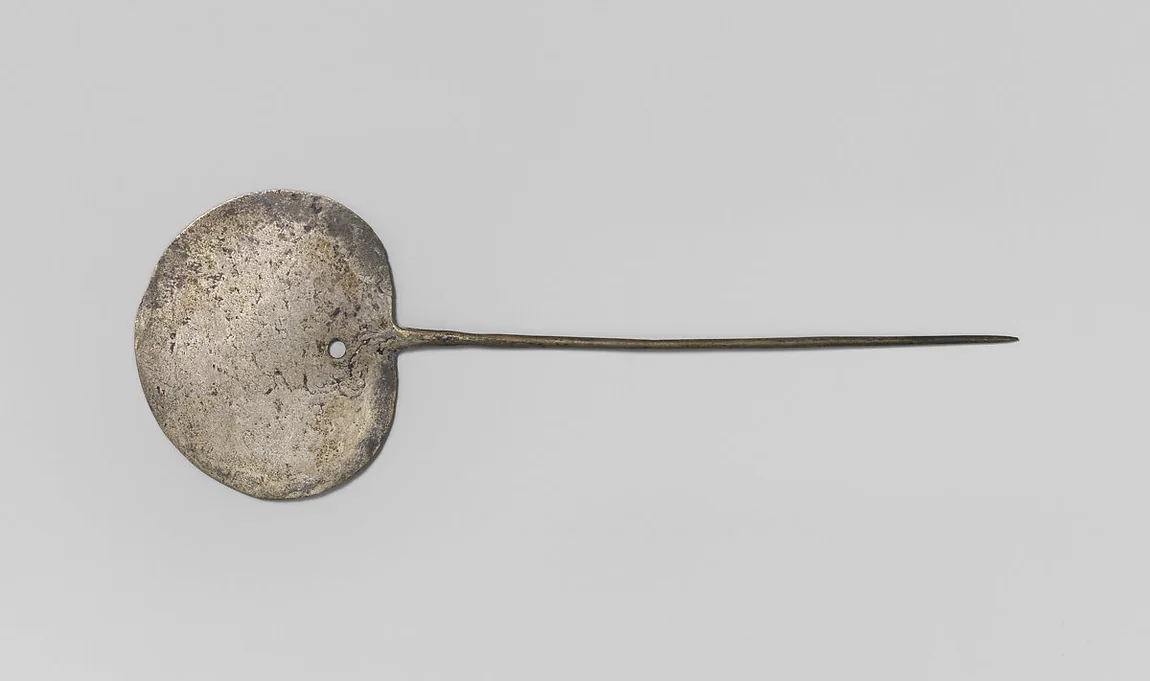
Look just above the stem of this silver pin. The little hole in its broad head is easy to miss. It does not pierce the cloth; that is the job of the long, pointed stem. The hole gives a thread or cord somewhere to go. Once you see it, an object that could pass for a piece of jewelry laid out flat begins to look like part of a fastening system.
This is a tupu, a Quechua name for a pin. In Aymara it is called pithu. In one use documented by The Met, Andean women wrapped the acsu or anacu, a rectangular garment of camelid wool, around the body and fastened it at the shoulders. A pin at either shoulder could sit with its stem pointing up and its broad head below. A cord could connect the two heads through their holes. A smaller pin, sometimes called a ttipqui, could secure a separate cloth around the shoulders, the lliclla. The names and arrangements are not identical across communities.
How a silversmith made the head and stem
The first pin is wide and thin at one end, narrow and round at the other. The Met’s study reads those contrasting forms as the work of a hammer on one piece of silver. The maker spread the metal at one end of a rod to make the head, leaving the other end as the stem. The museum suggests the worker reheated the metal between bouts of hammering to make it easier to shape. The finished hole was punched. The broad head was not a separate plate fastened to an existing needle.
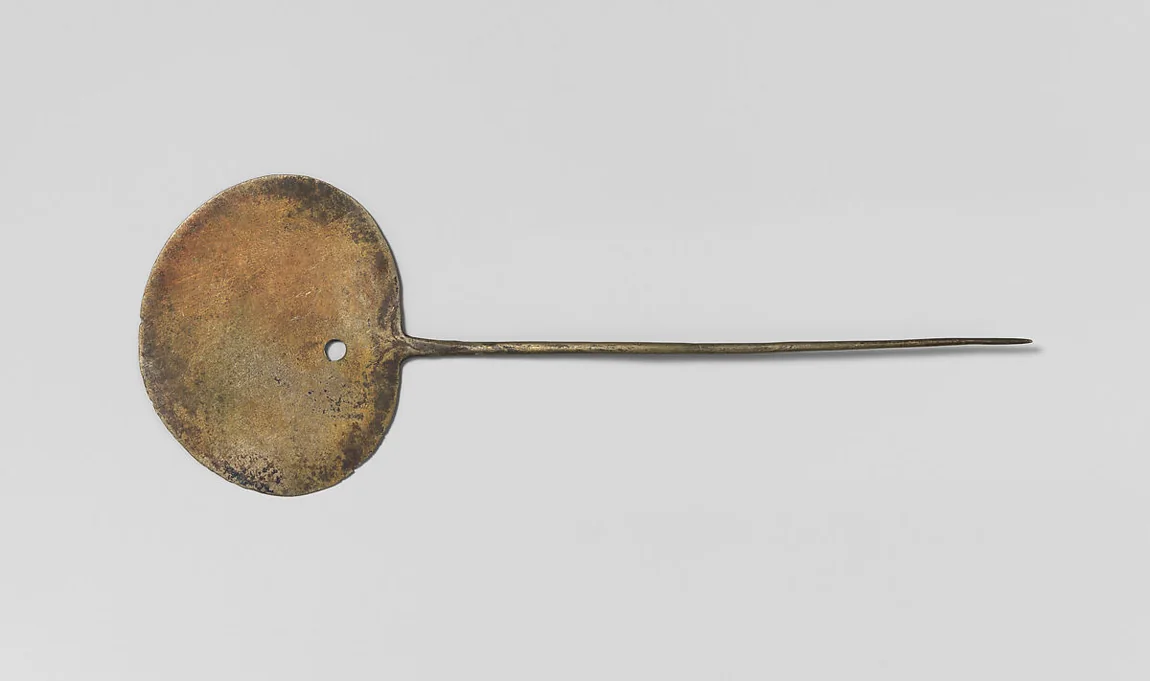
The Met has another pin of nearly the same size, shape and construction. Its study identifies a burr along part of the hole on the front and reads it as evidence that the punch went through from the back. The same study reports a lattice-like pattern in the surface oxidation. That might be a trace of cloth that touched the metal during wear or burial. It does not identify a specific garment, and the museum notes that a gold-colored patch is not enough to confirm gilding.
A plausible pair is not a proven pair
It is tempting to put these two Met pins on the shoulders of one person. They are remarkably alike and have a modern collecting history in common. Yet no archaeological record puts them together on a body, in a grave or even at a securely identified site. They could have been worn as a pair. It would be a mistake to turn that possibility into a caption that says they were.
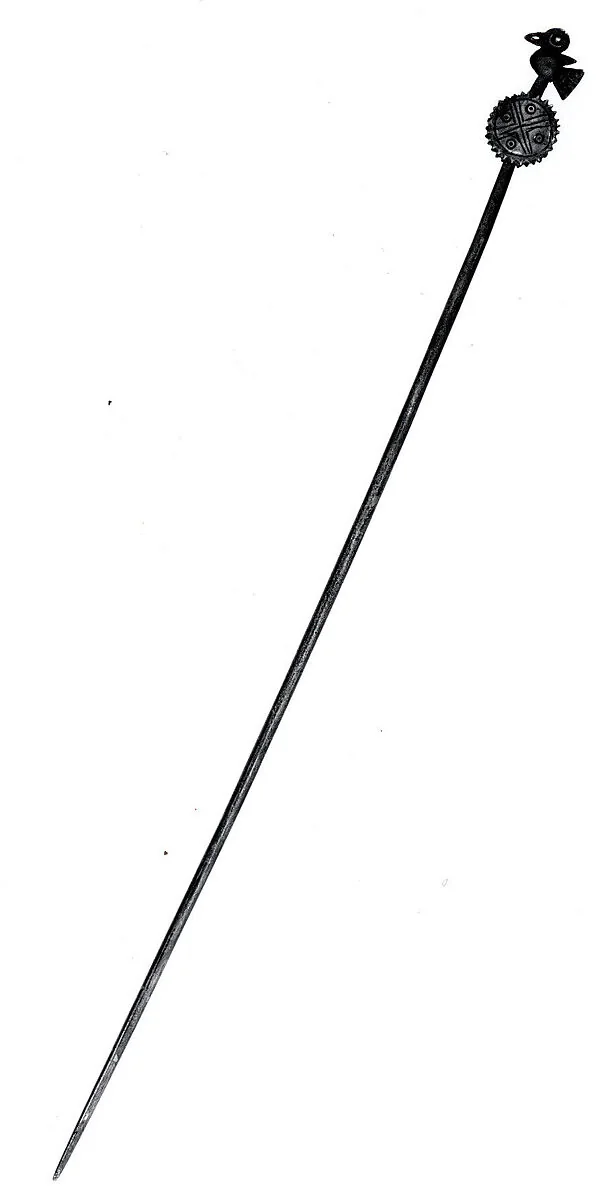
The shape itself cannot settle the matter. The Met compares these heads with examples across a broad part of the Andes, from what is now highland Ecuador to north-central Chile, and over a long span of time. And it was not the only shape. A separate Chimú pin in The Met, from Peru and dated to the 12th through 15th century, is catalogued as silver and measures 24.8 centimeters, nearly ten inches. It provides a documented comparison with a much more elaborately worked head, not a proposed match to the other two.
The difference a drawing makes
A seventeenth-century manuscript preserves a view the detached pins cannot. In his illustrated chronicle about the Inca past and Spanish colonial rule, Felipe Guamán Poma de Ayala drew Mama Huaco, the first quya or queen, wearing two discs with the stems pointing up. In its discussion of another tupu, The Met points to the connecting cord and to attendants who use pins across their shoulder cloths. It also notes that exactly where Mama Huaco’s pins pass into the clothing is hard to make out. This is a drawing made after the Spanish conquest, not an eyewitness record of the individual who wore either silver pin in the museum.
Together, the drawing and the objects help us put the metal back in contact with cloth. The drawing gives a way to place the pins on the body. The surviving silver reveals where the maker left a hole or how the metal spread under a hammer. The uncertain pair shows where the evidence stops. All three are worth keeping separate.
Keep exploring
Sources
Museum records and manuscript sources
- The Met: silver tupu 64.228.703, one-piece construction, the clothing arrangement, shared collection history and the limits of the paired attribution.
- The Met: silver tupu 64.228.702, punched hole, surface observations, terms and garment use.
- The Met: Chimú silver tupu 1974.271.39, object details and exact photograph.
- The Met: Inca tupu 64.228.701 and curator’s discussion of Guamán Poma.
- Royal Danish Library: Guamán Poma’s illustrated chronicle, manuscript context, date and facsimile portal (linked only, not reproduced).