
Start with the corner that isn’t there
At roughly fourteen millimeters long, the Cleveland Museum of Art’s punch-marked silver coin is easy to mistake for a scrap. It is barely wider than a fingernail. One corner is clipped, the sides don’t make a regular rectangle, and no portrait sits in the center. Turn it toward the light and you find the evidence that it is something more deliberate: a cluster of small designs impressed into the silver.
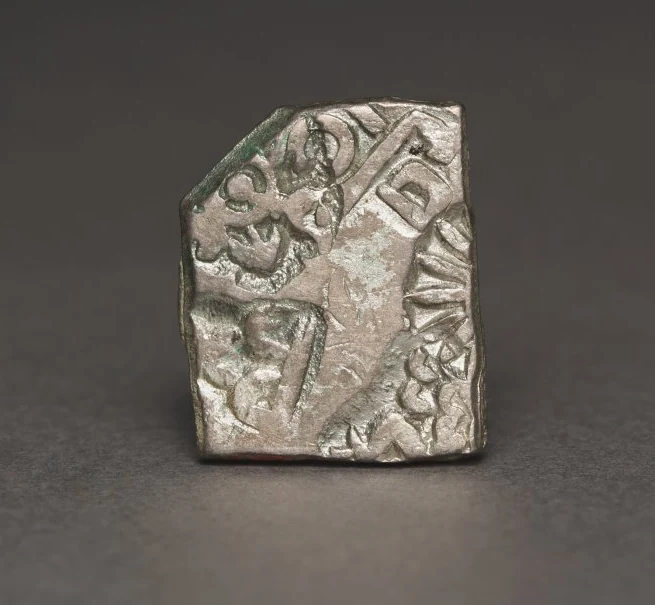
The museum catalogs it as Rajasthan, 400–300 BCE. Look for a circle with radiating lines near the upper part of this face, then follow the edge where the sheet stops. This is early money that’s easier to understand if you start with the marks and the weight rather than looking for the features of a modern coin.
Why cut away good silver?
The Government Museum in Chennai studied punch-marked coins from Vaigainallur in Tamil Nadu. Its catalogue of the hoard describes a way to make blanks from hammered sheet: cut out a piece, then clip excess metal until it comes closer to the intended weight. The shape can be irregular because the edge is where the maker makes that adjustment. If a blank is too heavy, it is easier to remove a little from one corner than to remake the whole piece.
That account explains why a clipped corner can belong to a coin’s manufacture rather than being damage acquired in a pocket. It doesn’t prove the history of every notch on Cleveland’s example. Later chipping, trimming, or corrosion can change an edge too. For a collector, the question to ask is not just “is a corner missing?” but “what other evidence makes a particular explanation likely?” The front, back, thickness, and weight all help.
One small punch at a time
In the manufacturing method the Reserve Bank of India’s Currency Museum describes, the devices weren’t assembled on one large die and transferred in a single blow. Each mark had its own punch. That helps explain why two marks can crowd each other, why a symbol can run into an edge, and why the front can look crowded while the reverse is comparatively open.
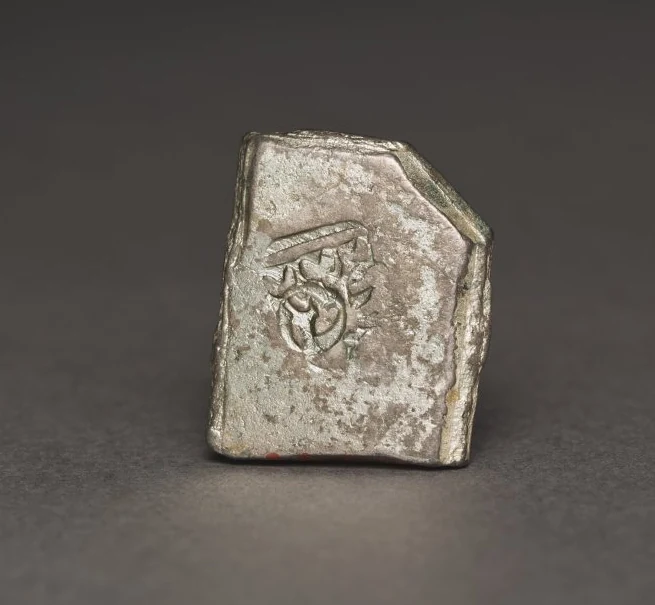
The other face of this particular coin shows a single deep circular mark. The difference is visible; its cause is a separate question. A photograph alone does not establish who applied a punch or whether one was made at issue or added later. That distinction matters when comparing it with the much later chopmarks on a U.S. Trade dollar. On the American coin the mint design came first, and the East Asian trade stamps came afterward. Both objects can carry a mark sunk into silver without those marks having the same history.
How do you classify a coin without a name?
Compare the cluster rather than taking a single sunburst as a signature. The British Museum’s money gallery guide explains that, in the absence of portraits or writing on its Magadha example, numismatists distinguish types by numbered series and their combinations of marks. A recognisable design can narrow the comparison, but it is not the same as reading an inscribed ruler’s name. The piece in Cleveland has its own record; the British Museum’s example illustrates the method, not an attribution for this coin.
A 2024 study of nine coins held at Banaras Hindu University describes five official front punches in its discussion of imperial issues and notes that some designs overlap or are partly off the blank. That is a pattern in particular series, not a rule that every early Indian silver coin must show five clear pictures. The RBI distinguishes earlier local issues from later imperial ones. The number of punches to expect depends on the type you are comparing.
What the mark cannot tell you
A punch is good evidence that somebody pressed a particular design into the metal. It is not a modern fineness certificate. Researchers on the nine Banaras Hindu University specimens used laboratory measurements to investigate the surfaces; they found varying amounts of silver and copper alongside corrosion-related elements. They did not test the Cleveland coin shown here. And the results from the surface of a coin are not the same as the silver fraction throughout it.
If you’re documenting one, record both faces, its edge, actual weight and dimensions, and any published provenance. Note which marks are complete and which are fragments. Don’t try to brighten the metal to make a stamp easier to read. Oblique light and a second photograph do that work without taking away part of the surface. An irregular edge, in this case, deserves the same careful attention as the sunburst.
Sources and object records
- Cleveland Museum of Art: punch-marked silver coin, 1967.243; open-access photographs 1967.243.a and 1967.243.b (CC0).
- Government Museum, Chennai: study and catalogue of the Vaigainallur coins; Reserve Bank of India: Ancient India Coinage.
- British Museum: Money Gallery, Room 68, case 1.
- Surface elemental and structural analysis of ancient Indian punch-marked coins, Scientific Reports (2024).