
Start at the edge
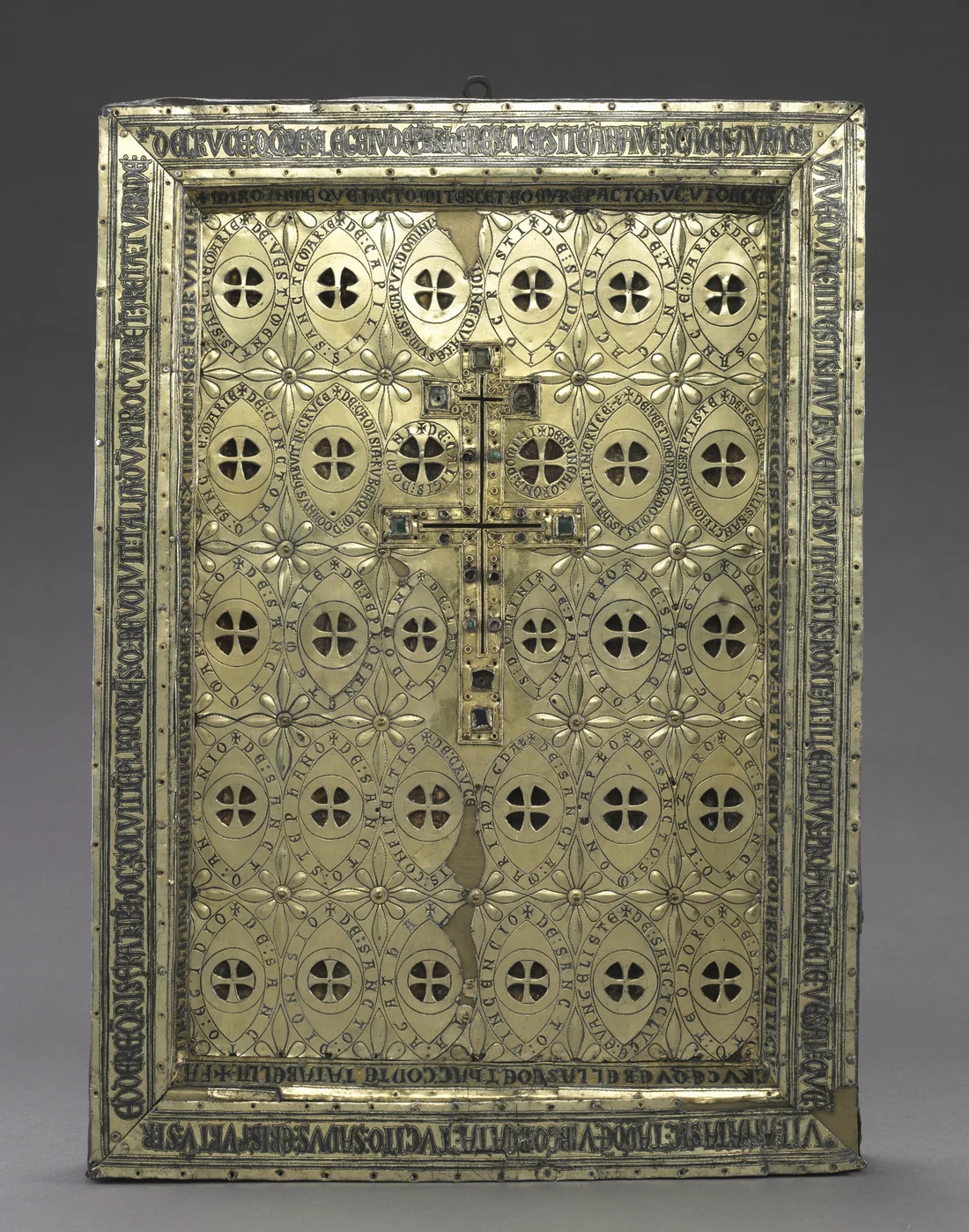
The stones catch your eye first. They pick out a double-armed cross against a field crowded with small oval frames and four-lobed openings. That is the center of the silver reliquary in the Cleveland Museum of Art. To find why it was made, though, look where the maker put the words: in two bands of dark lettering around the edge.
The Latin begins by telling whoever wants to know about the cross to read. It ends by saying the panel was made in February 1214. The inscription gives a compact lesson in what an old object can tell you. One sentence dates the container. The story between those lines tells what its makers or patrons wanted people to believe about what it contained. The two are not the same kind of evidence.
A storm in the inscription
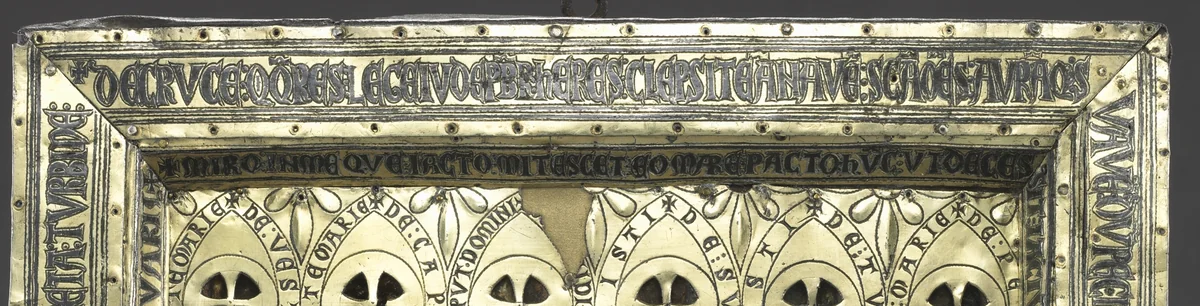
A priest takes a cross relic and boards a ship. The breeze he hopes for becomes a storm. The Virgin tells him he will recover if he returns what he took. The inscription says he gives it back to the brothers of the Temple. When he dies, those aboard cast him into the sea. The storm ends, and the voyagers reach Brindisi with the cross.
That is the account on the panel, not an independently verified ship’s log. It doesn’t name the priest or say where he took the relic. Brindisi, on Italy’s Adriatic coast, is a place the text actually names, but the scene of the landing does not tell us where the finished panel was made. The episode helps explain why someone would put a long story on a sacred object. It presents the relic’s movement as a theft put right, and the people who brought it ashore as custodians of something worth protecting.
The story begins with a priest described through a comparison with Judas. That detail tells you how the writer wanted readers to judge the theft. It is not a family identification. The characters’ actions, and what the text says happened at sea, belong to a religious account preserved on the object.
What February 1214 dates
The date at the end belongs to the panel. The closing Latin calls it a tabula, a tablet or panel. It does not date the wood believed to be from the cross on which Christ was crucified. It does not give the day of the storm. And it need not date the metal cross you see in the middle.
In the exhibition catalogue for Treasures of Heaven, art historian Holger A. Klein distinguishes the double-armed piece from the rectangular panel that now surrounds it. He identifies the central piece as the front of a reliquary cross, whose design points toward the Latin Kingdom of Jerusalem. Cleveland catalogues the panel separately, placing it in the Rhine-Meuse region. Klein says the exact place of manufacture is unknown and sees the layout as evidence that its makers knew a Byzantine model. Brindisi is named by the inscription; the regional attributions come from studying the object. Neither produces a securely named workshop.
That leaves two histories on the front of the same object. The metal cross had a history apart from the display around it. The panel gave it a setting, an account of its passage and a date that the panel’s makers could set down in silver.
Silver that labels its contents
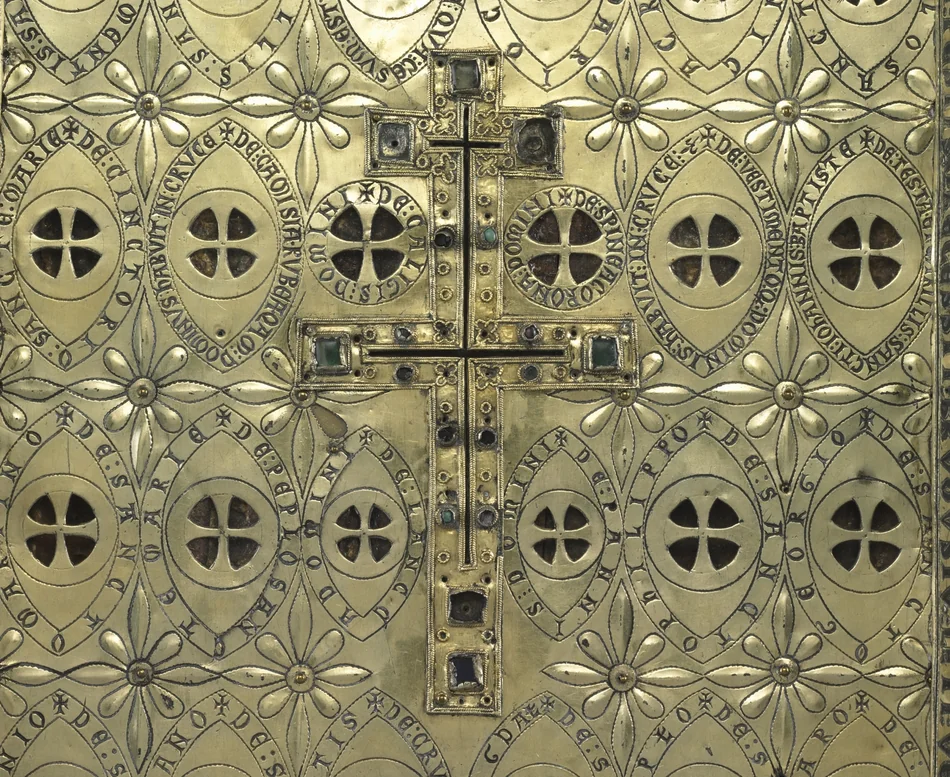
Cleveland’s materials list reads like a description of parts: silver, gilded silver, niello, precious stones and walnut. Gilding accounts for the gold-colored metal surfaces that the museum identifies as gilded silver. The dark lettering is a separate treatment, niello, used to fill the cut lines. It makes words stand out against a bright surface without needing a separate label.
Look again at the ovals around the cross. They have writing, too. According to Klein’s catalogue, the panel contains thirty other relics. The labels name things believed to be associated with Christ, the Virgin and saints. They range from clothing to parts of the body. Those are identifications preserved on the panel, not identifications a photograph can confirm. The short labels tell readers what they are looking at; the border tells them how to understand the central object’s journey.
The arrangement has its own logic. First the eye is drawn to the cross. Then the words, if you follow them, lead you out to a story. What you can make out from a distance is the arrangement. To read the story, you have to stand close.
Reading an old inscription
Three notes would keep this piece straight in a collector’s record. First: date and component. “February 1214, by the inscription on the panel” is stronger and more precise than “cross dated 1214.” Second: transcription and translation. Save the visible words and their location before relying on an English rendering. Latin abbreviations have to be expanded in transcription. A translation does not replace a good photo. Third: claim and source. Keep what the inscription alleges distinct from what examination and ownership records can establish.
Cleveland’s published provenance names Albin and Georges Chalandon and the dealer Adolph Loewi. The exhibition catalogue also records a purported association with Cologne Cathedral. Treat that last word seriously: the record raises a possibility, not a documented chain from 1214 to Cleveland. The dated silver panel can survive a gap in its paper trail. The job is to preserve the gap, not smooth it away.
See How silver is decorated for the difference between dark niello and a gold surface, and Documenting collectibles for recording inscriptions without turning a claim into a fact.
Sources and image credits
Museum catalogue, inscription and photograph credit
- Cleveland Museum of Art: Reliquary of the True Cross, 1952.89. Object record, photograph, materials, provenance and inscription in translation.
- Holger A. Klein: Panel-shaped Reliquary of the True Cross. Exhibition catalogue entry, Latin transcription, thirty additional relics, and separate attribution of cross and panel.
- Photograph and detail crops: The Cleveland Museum of Art, Purchase from the J. H. Wade Fund, 1952.89. CC0.