
Look up from the birds
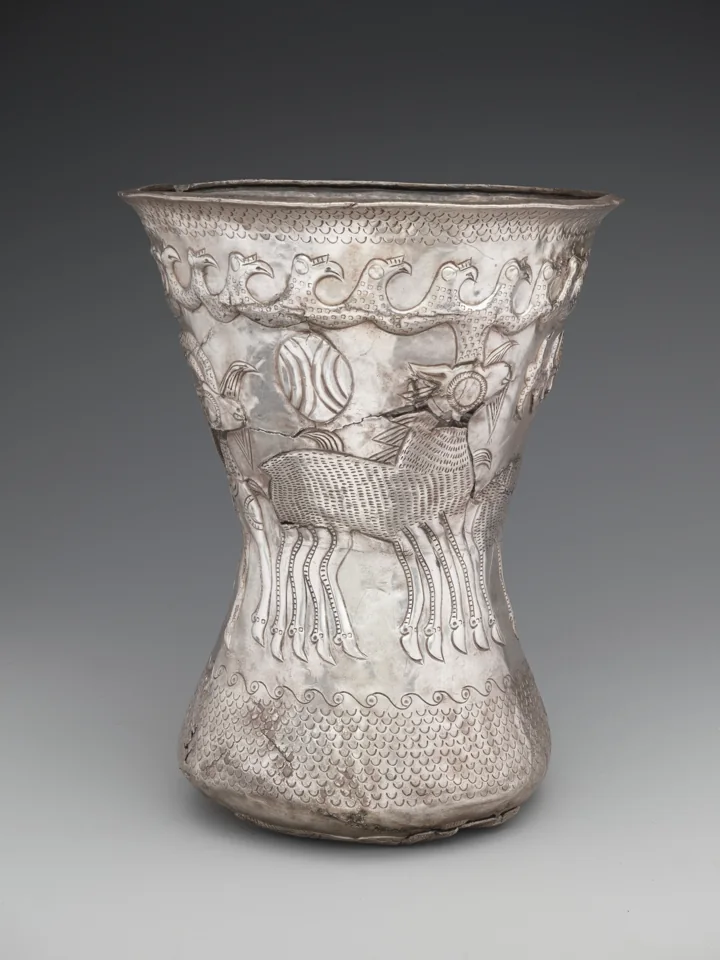
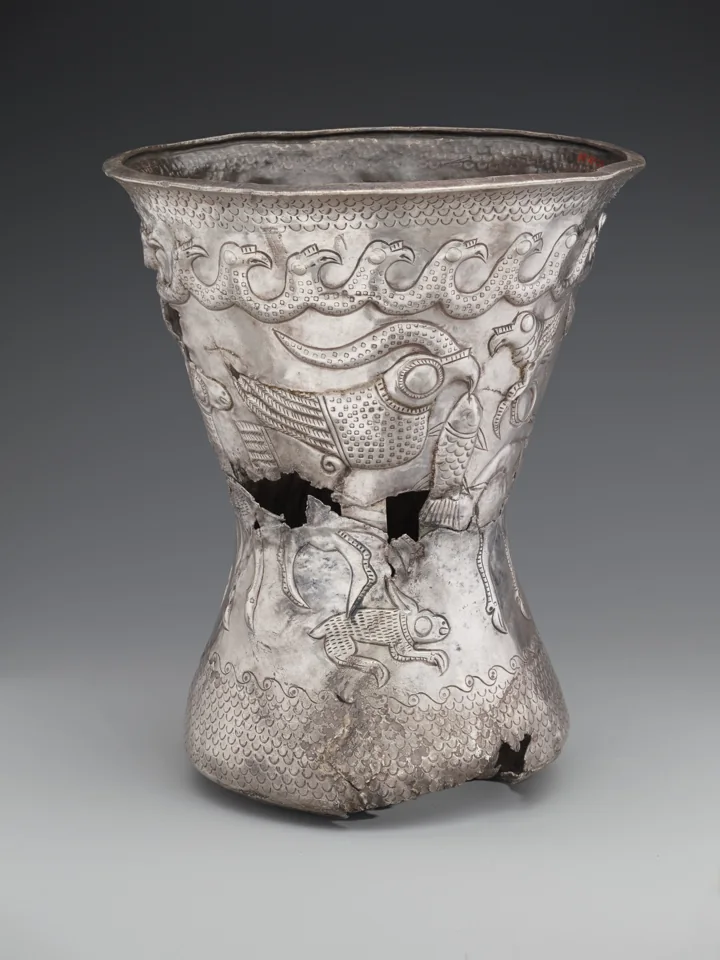
The most conspicuous thing on this beaker is a bird with a fish in its beak. Antlers elsewhere on the vessel end in smaller bird heads. It takes some effort to stop following the creatures around the silver and look at the very top, where the rim flares out from the wall. That is where the maker solved a problem the decoration can’t explain.
The Metropolitan Museum of Art dates the beaker to about the fourth century BCE and attributes it to Thrace, probably the area of present-day Romania or Bulgaria. In a technical study of this same object, the museum’s researchers reported that the beaker had been hammered from one piece of silver. At the top, the maker folded the upper edge over and hammered the doubled metal down. A fold on this piece is not a foil wrapping a different metal. It is the edge of the same sheet, turned back on itself.
This matters if you’ve learned to look for folded rims on Old Sheffield plate. A fold may help identify the way an individual plated object was finished. But a fold and a coating are different things, and one cannot prove the other. The Thracian beaker gives us an unusually well documented counterexample.
One sheet, two thicknesses
The museum study gives an average metal thickness of about 0.42 millimeters. That is for the sheet, not a width across the rolled-over rim. The technical drawing in the paper shows the doubled edge in section. You can follow it from the broad flare to the narrow return, which makes it easier to understand why the lip can look more substantial than the wall beneath it.
It would be tempting to say the maker did this to make the rim sturdier or smoother to the touch. Those are plausible effects of the fold, not a recorded explanation from the workshop. The firmer claim is about construction: the edge is thicker because the silver was doubled, not because the body was cast in a mold or fitted with an unrelated collar.
The work was not limited to raising a smooth vessel. Metal pushed out from the reverse makes the animals stand in relief; marks made on the surface supply much of the detail. The study describes chased, engraved and punched work. Our guide to shaping silver from sheet separates the work of giving a vessel volume from what happens to its surface afterward.
Two folded edges need not tell the same story
On the eighteenth-century plated meat dish in the Colonial Williamsburg collection, the starting material already combined silver and copper. The museum describes that turned edge as both a way to strengthen the dish and finish its perimeter. The starting material on the Thracian beaker is different, even if both ends call attention to the same part of the object.
There is no reason to draw a line of workshop descent from the ancient beaker to the Georgian dish. Putting them beside each other is an exercise in reading evidence, not a theory that one maker copied the other. Both show how a silversmith had to decide what to do with an exposed edge. The fold is an answer to that smaller problem, not a label for a particular century or material.
The holes in the wall have another history
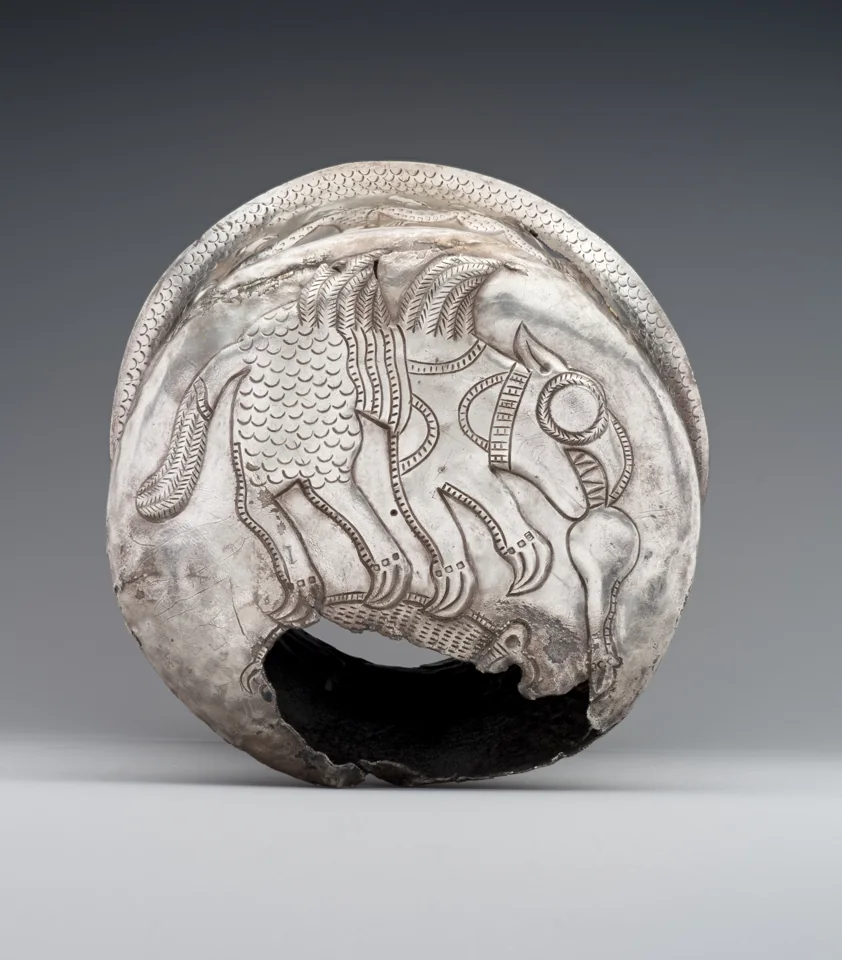
The underside carries a creature of its own. It also shows a large loss plainly visible in the museum photograph. If the rim tells us something about the original making, the breaks tell us that the vessel changed after the workshop. The researchers documented cracks, mechanical deformation and restored breaks, including solder visible inside.
Do not count every line as either a maker’s seam or a sign of a fake. A return at the rim, a split in the body, a later solder repair and a drawn line in a photograph can all look deceptively alike from one angle. Compare positions first. Our guide to silver patches and repairs uses that distinction on a casting and a thimble.
And although the museum suggests the animals may belong to a native legend, it does not assign a secure story to every creature. It is possible to see more of the making without claiming to know the beaker’s exact first owner, the occasion on which it was used, or the name of the story on it.
What to record when a rim catches your eye
- Photograph the edge from both sides. Include the inside wall as well as the underside of a rim. Use angled light if a line is hard to see. A raised return and a break in the color may be two different clues.
- Look for repetition. Does the line continue around the vessel, or does it end at a dent, patch or seam? Document the full object and take a closer photo with a scale, rather than forcing open a folded edge.
- Keep construction and composition separate. Write “edge turns inward” before writing “plate.” Compare exact construction, period, marks and museum records. If metal content matters to a purchase, ask a qualified examiner about an appropriate nondestructive check rather than making a fresh scratch.
The rim is worth looking at precisely because it is not an instant answer. The fold records an action. What silver it was, how the sheet reached that shape, and when the damage happened are questions you answer with separate observations.
Sources and museum records
- The Met: Beaker with birds and animals, 47.100.88. Object record, animal imagery and photographs.
- The Metropolitan Museum Journal: Three Silver Objects from Thrace. Technical study, cross-section (fig. 3), thickness, forming, and condition. The paper’s diagram is linked, not reproduced.
- Colonial Williamsburg: Meat dish, one of a pair, 1973-12,1. The historical Sheffield plate comparison.