
A kilo under each foot
The first place to look is where the rider put a boot. The footplates of these Mongolian stirrups are broad, almost round, and busy with raised ornament. The decoration continues up the sides to a narrow opening for a suspension strap. Nothing about that opening would be out of place on ordinary riding gear. The surprise is what you would feel lifting the pair: the Met records the weights as 1,053 and 1,073 grams. That's 2.126 kilograms of object between them.
The museum dates them broadly, from the late eighteenth to the mid-nineteenth century, and identifies the metal as silver cast through the body, not silver applied as a finish. It does not publish an assay number for the pair. The combined weight is therefore a weight for the objects, not a measured quantity of pure silver. Nor does the catalogue identify a rider. The weight tells us something about the silversmith's choice, not who sat in the saddle.
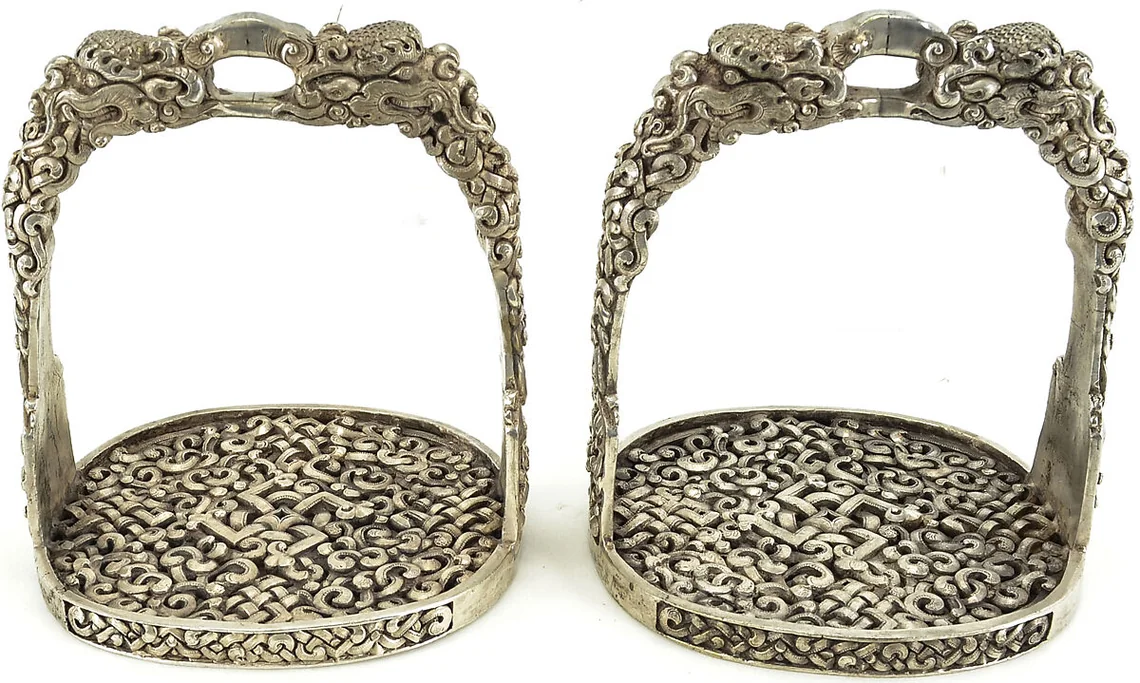
Silver through the body
A stirrup has two parts you can pick out without knowing much about saddlery: an opening at the top that takes the strap and a tread at the bottom that supports the foot. On this pair, both belong to the same visual composition. The top opening sits between elaborate raised forms, and even the tread carries a dense pattern. The rider's boot would occupy precisely the place the photograph lets us study most closely.
Casting makes a form by introducing molten metal into a mold. The Met's identification tells us that silver was used to create the working body, not just to make another metal shine. It doesn't tell us whether the smith used a particular mold material, how many operations the casting required, or exactly how the relief was finished. Compare a technical study of cast silver and the clues left by its maker: a documented manufacturing method is not a license to fill in the missing steps.
A saddle with a history
The Met situates ornate Mongolian horse equipment in a tradition where tack could express a rider's means and standing. That's useful context for the pair, but it would go too far to assign it to a particular parade, household, or official. A separate Tibetan set shows what a more complete record allows us to say.
A saddle and its stirrups from the Surkhang family belonged to a ceremonial set. The saddle was made at Derge in the 1930s for Surkhang Wangchen Tseten while he governed eastern Tibet. His son, Surkhang Wangchen Gelek, later used the saddle on ceremonial occasions, according to the Met. Its decorative surfaces include silver scrollwork with red copper foil behind it. The museum describes the set's relatively plain stirrups as cast in nearly pure silver, without publishing a numerical fineness in that record. Those are different stirrups in a different historical setting. The point of the comparison is that conspicuous ornament and a high silver content need not travel together, even within the equipment for one horse.
Silver on the surface
Turn to two Moroccan stirrups, dated to the nineteenth or early twentieth century. You can see the flaring sides especially well on the one photographed at an angle. The square footplate meets those sides almost like the bottom of a little box. The Met lists iron, silver, and copper. Its description calls the silver decoration plated and notes incised vegetal designs and geometric bands. It doesn't specify an electrical plating process, silver thickness, or exactly where all three metals begin and end.
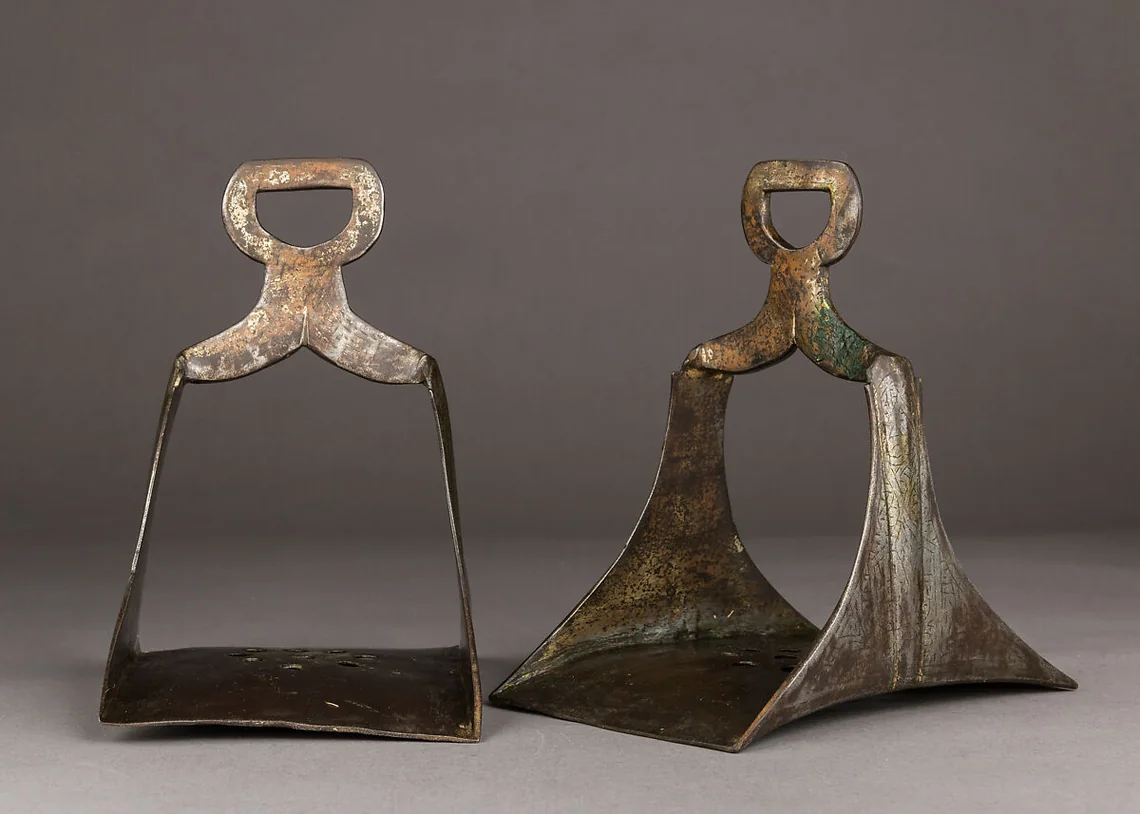
The catalogue also describes the importance of showy horse tack to Moroccan riders at festivals and parades. That context explains why a decorative surface mattered even when the object was built from other materials. It doesn't document these particular stirrups at an event. Here silver belongs in the description, but whatever percentage it contributes to the weight cannot be read off a photograph.
When there is no silver
A seventeenth-century Italian pair looks bright enough to upset either shortcut. Its slim arches and chiseled surfaces catch light strongly, particularly where the rear stirrup turns toward the camera. Yet the Met's medium is iron alloy. Its curators identify the polished steel finish as a way to produce a silverlike appearance. This is not a third kind of silver finish; it is a good example of why color isn't a material test.
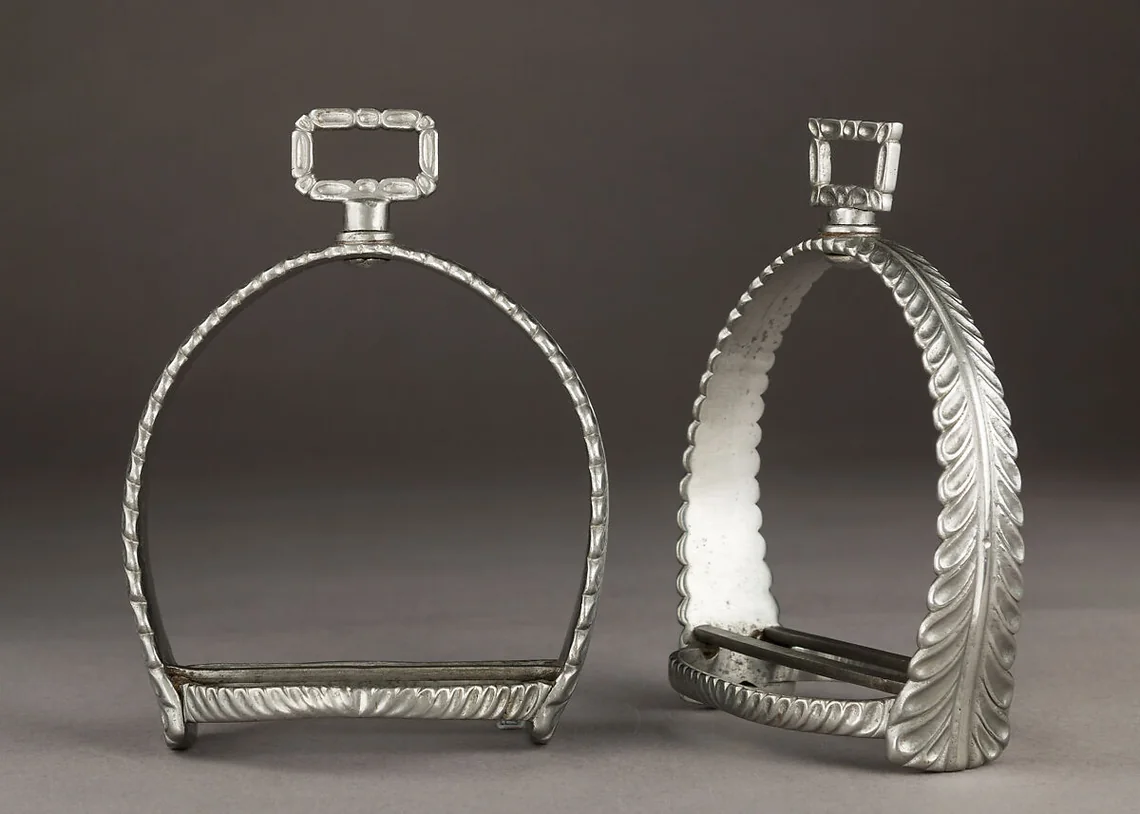
All three pairs contain areas that can look silver-colored. In these records, one pair is cast in silver, one carries plated silver decoration, and one is polished iron alloy, with no silver listed. The useful comparison is not which pair looks richest. It is which components were formed from which metals, and how we know.
What to record
Photograph the suspension opening, the sides of the arch, both surfaces of the tread, and any mark or old repair you can see without disturbing the object. Keep measurements for each stirrup separately. Read the records for a comparable pair; labels such as “silver-colored,” “silver plate,” and “cast silver” are not interchangeable. Our guide to comparing the whole object explains why similar dimensions or a matching appearance cannot establish material or authenticity by themselves.
Leave a worn surface alone. Scraping or polishing away a detail would remove evidence before you knew what it meant. In the Mongolian example, the remarkable sight is right at the bottom: a decorated tread made of the same precious material as the frame overhead. The Moroccan and Italian comparisons make clear how much it took to arrive at that sentence.
Sources
Museum records and image credits
- The Metropolitan Museum of Art, Pair of Stirrups, Mongolian, 2017.313a, b: late eighteenth–mid-nineteenth century, object weights, cast-silver construction, and display context.
- The Metropolitan Museum of Art, Stirrups from the Surkhang Family, 2005.427.2a, b: a separately documented Tibetan ceremonial set, approximately 1930s. Image link only; museum does not clear reuse.
- The Metropolitan Museum of Art, Pair of Stirrups, Moroccan, 36.25.530a, b: plated silver decoration, iron/silver/copper, and the catalogue's discussion of Moroccan riding display.
- The Metropolitan Museum of Art, Pair of Stirrups, Italian, 14.25.1746a, b: polished chiseled steel that resembles silver, iron-alloy medium.