
The price below the box
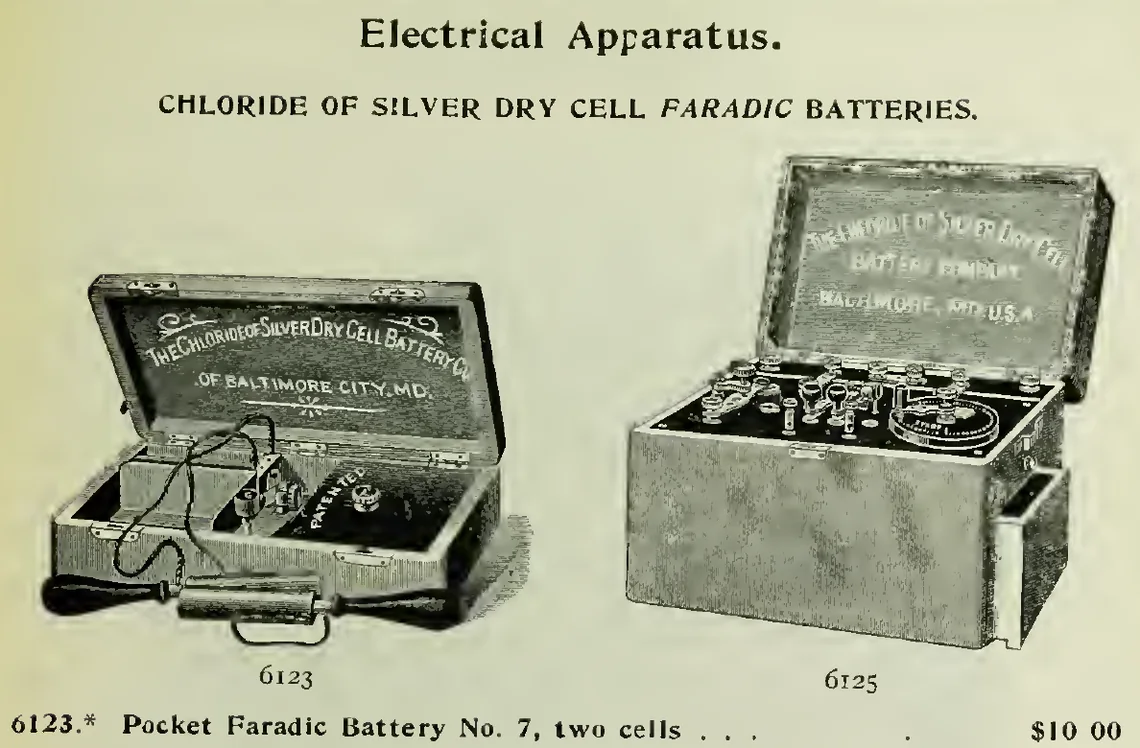
The little mahogany case on the left of a 1915 Charles Lentz & Sons catalogue page opens like a traveling kit. The underside of its lid carries a Baltimore manufacturer's name: the Chloride of Silver Dry Cell Battery Company. Philadelphia dealer Lentz numbered this outfit 6123 and sold it as the Pocket Faradic Battery No. 7. It came with two cells; the catalogue price was ten dollars.
The more interesting price was printed just beneath it. Returning an exhausted Faradic cell for restoration cost 75 cents, with postage additional. A separate page priced a new Faradic cell at two dollars. The same catalogue offered a 90-cent galvanic cell and a 30-cent replacement in exchange for a spent one. The dealer explained the galvanic discount plainly: the silver elements coming back still had value. For the galvanic line, “restoring” meant giving the customer a new cell in exchange, not necessarily restoring and sending back that particular cell. The catalogue is evidence of a business arrangement; it is not proof of the exact amount of silver recovered or how it was processed.
Where the silver was
The handsome box did not need to be silver. The silver compound did its job inside the cells. The Smithsonian's National Museum of American History records a separate wooden induction-coil outfit whose two cells carry the Baltimore company's label. The catalogue description distinguishes the cells that supply power from the coils that make the apparatus work. There is no reason to treat the coil or the wood case as valuable silver, or to assume this museum outfit is the numbered No. 7 shown in the catalogue. The records tell us what the surviving outfit contains, not what happened in a particular doctor's office.
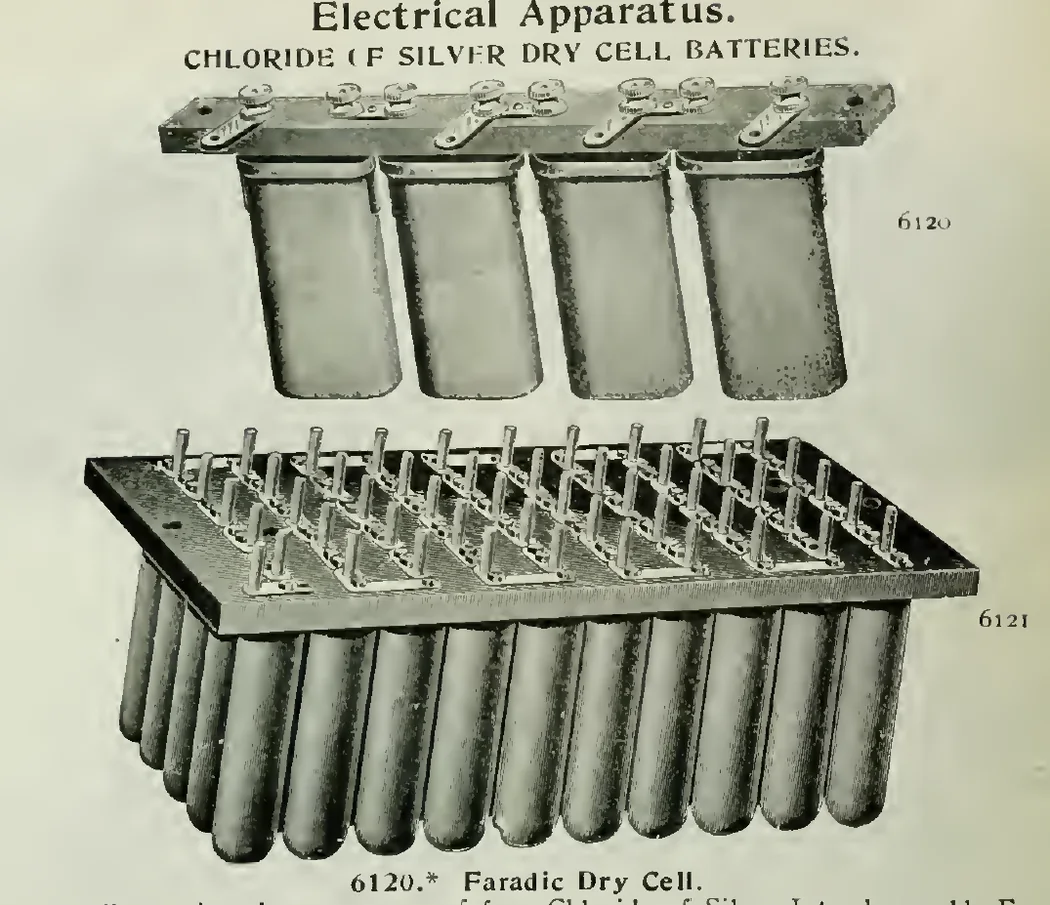
The compact and upright models shared a product name but could have different numbers or arrangements of cells. Lentz illustrated replaceable Faradic cells hanging four to a plate and a separate bank of galvanic cells. That makes the exchange offer easier to picture: what the customer could return was the worn-out part. The comparatively costly apparatus could stay where it was.
What “dry” meant
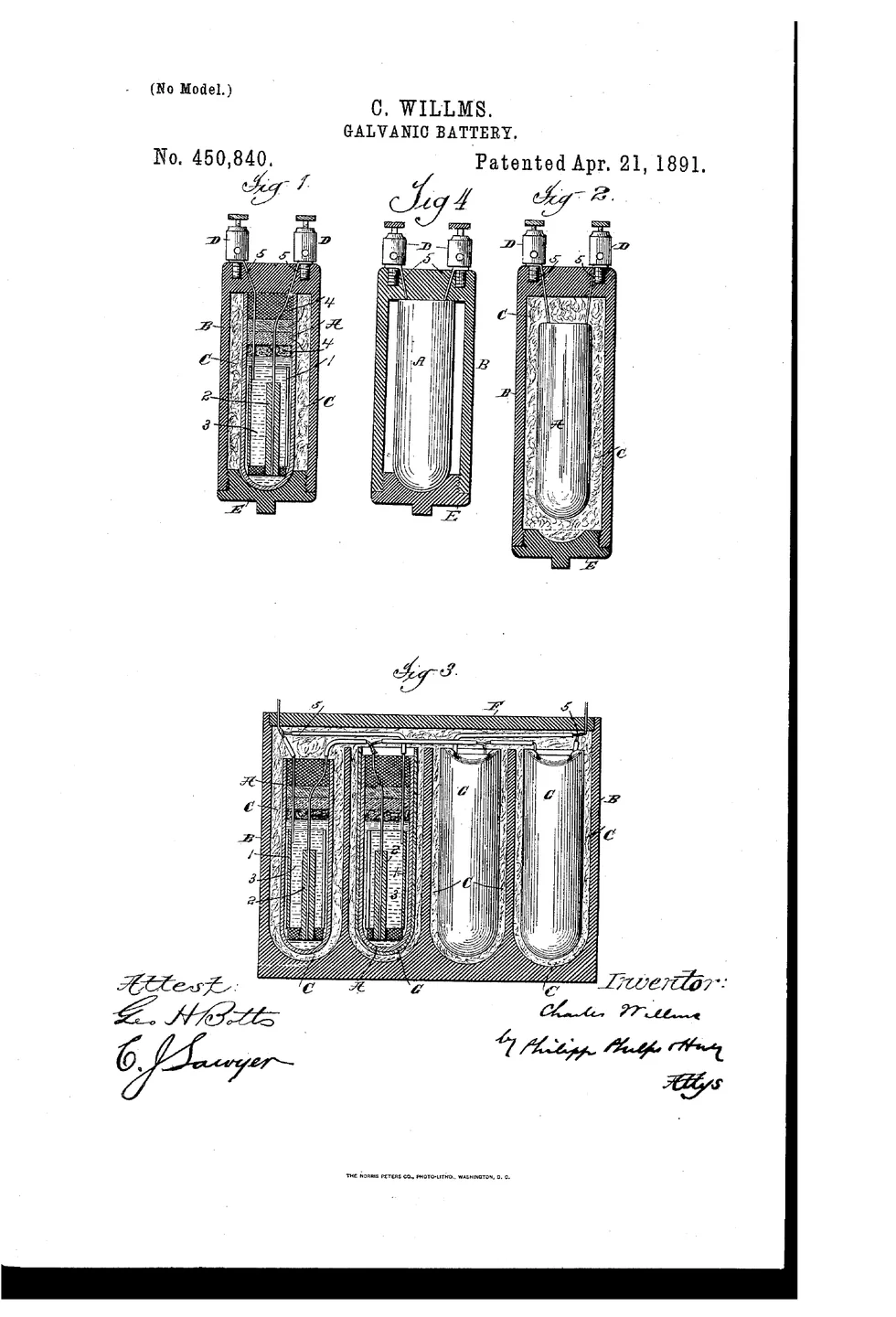
The Smithsonian records an April 21, 1891 patent date on a company label. Charles Willms's patent has a surprisingly specific concern: the material in a sealed cell could leak or force its way out of a fragile container. The patent describes a protected cell and, in one example, identifies a zinc plate, a silver-chloride element and a zinc-sulfate solution. In the design shown here, “dry” did not mean that no liquid existed inside. The enclosing case was meant to contain leaks.
Patent drawings show proposed designs, not a cutaway of every unit the company later sold. An early patent date on a label is therefore not a manufacture date. It helps place the design in time, but not necessarily the particular specimen that carried that date.
Two jobs for a cell
The 1915 pages separate their galvanic products from their Faradic ones. In this context, the former was sold for a steady current and the latter used an induction coil to provide changing output. Both were marketed to a medical audience at a time when therapeutic electricity also reached users at home. Historian Anna Wexler, drawing on period catalogues, found that this very No. 7 was promoted to physicians and to patients using it at home. That tells us how the device was marketed. It does not establish the cures that were claimed for such apparatus, and the surviving apparatus is not an invitation to try it.
Compare that story with a modern silver/silver-chloride ECG electrode. An ECG records very small signals produced by the body. The old outfit was sold to supply electrical stimulation. The shared silver chemistry doesn't give the two instruments the same job.
What to record
If you find one of these, document the lid inscription, the product or inventory number if present, loose accessories already visible, and whether the cells accompany the box. A patent date belongs on its own line, not in the manufacture-date field. If the cells are missing or have been replaced, say so rather than assigning the whole apparatus the metal content of one original part. Leave old cells and wiring undisturbed; there is no need to connect an antique device or open a cell to describe it.
Lentz's exchange offer looks strange until you separate the product from its parts. A dead cell had stopped doing its electrical job, but it had not stopped being silver-bearing material. The same distinction remains useful when asking which materials a modern recovery process actually brings back.
Sources
Catalogue, patent, museum records and image credits
- Charles Lentz & Sons, Illustrated Catalogue and Price List, seventh edition, 1915, pp. 466–467, Yale University, Cushing/Whitney Medical Library copy via Internet Archive. PDF mirror, p. 466. Primary evidence for catalogue models, prices, silver value, and terms.
- Smithsonian National Museum of American History: Faradaic battery, nmah_705910, separate two-cell induction-coil outfit with label and catalogue description. Modern museum photograph link only.
- Smithsonian National Museum of American History: Battery, nmah_1131301, identifies Willms, the company's 1890 renaming, and the April 21, 1891 patent. Modern museum photograph link only.
- Charles Willms, U.S. patent 450,840, April 21, 1891. Original patent PDF. Historical precedent for the protected cell, not universal specifications for the dealer's 1915 lineup.
- Anna Wexler, “The Medical Battery in the United States (1870–1920),” 2017, original historical study of clinic and home use, with No. 7 example (see discussion and note 99). PubMed record.
- Yale/Internet Archive: catalogue illustration on printed page 467.
- Yale/Internet Archive: cell illustrations on printed page 466.