
What does 1692 actually date?
The spoon is only four and a quarter inches long. Its plain bowl leaves the storytelling to the handle: Historic Odessa describes a broom, a crescent, a cat, and the words SALEM 1692. If all you have is the front of the spoon, that date is a seductive clue. Turn it over, though, and you find marks for a very different time. The museum dates the piece to about 1890–95.
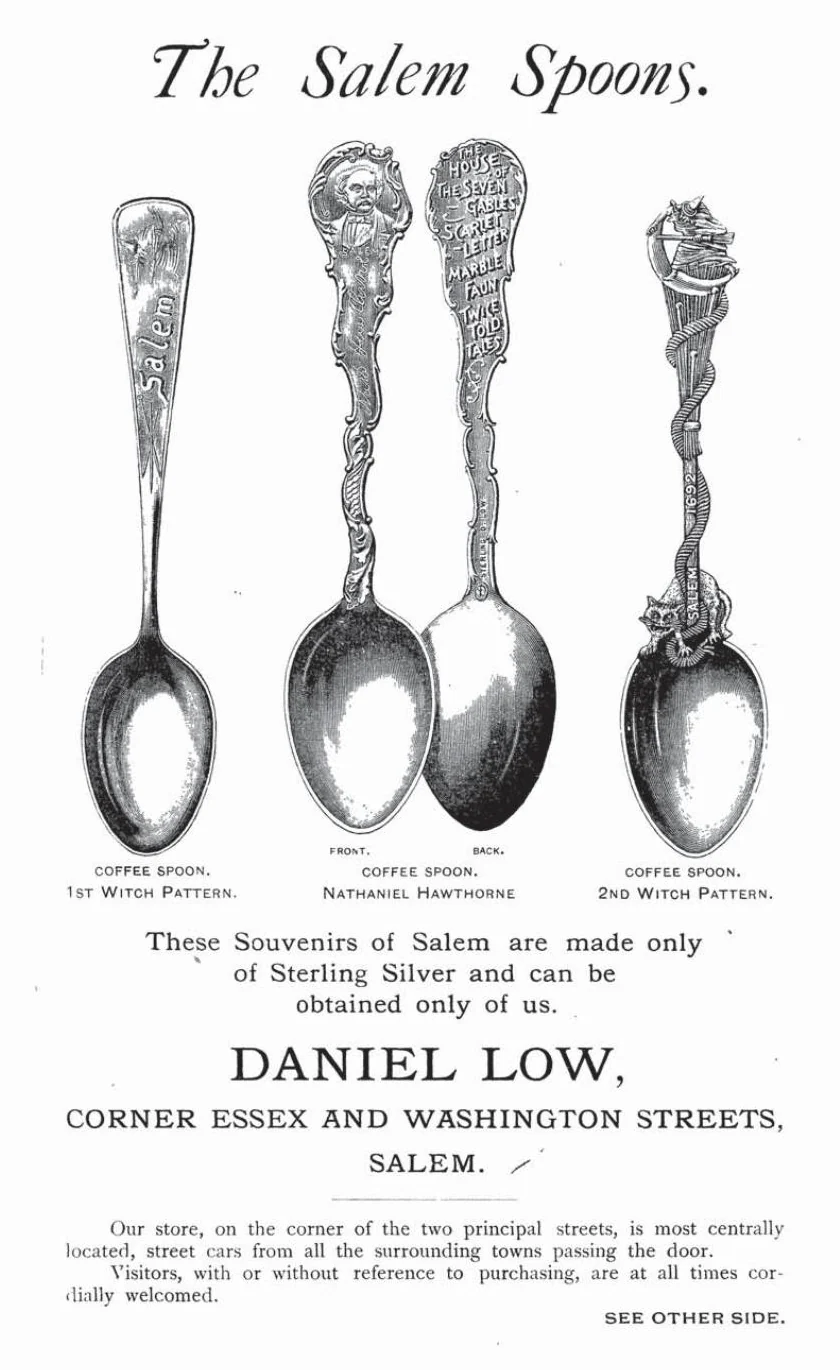
The 1893–94 Salem city directory lets you see what a shopper would have seen. Daniel Low’s advertisement shows three sterling coffee spoon patterns: the first witch design on the left, two views of a Nathaniel Hawthorne pattern in the middle, and the second witch design at right. It is not a catalogue of artifacts from 1692. It is a jeweler’s advertisement for new things to take home.
One spoon, two businesses
The back of the Historic Odessa spoon carries DANIEL LOW, Gorham’s marks, and STERLING. Those marks answer different questions. The museum identifies Gorham in Providence as the manufacturer. Daniel Low was the Salem retailer whose address and name appear on the page where the pattern was sold. Sterling describes the silver, not the maker, the shop or the year.
A different Salem spoon in Historic New England’s collection is a useful cross-check. It shows a witch and straight pins, carries Salem on its handle, and is catalogued as the work of the William B. Durgin Company for Daniel Low & Co. Finding the same retailer on a spoon therefore gives you a lead, not permission to assign the same manufacturing mark to every example. Compare the actual back with the evidence for a maker attribution, and compare patterns before dating anything.
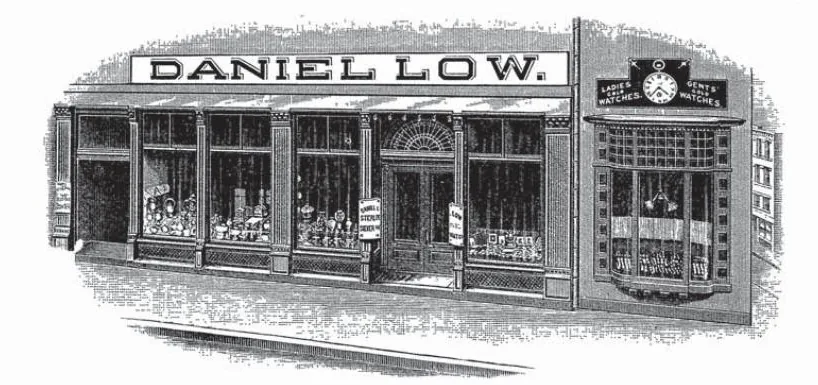
The other side of the directory advertisement shows the shop at Essex and Washington streets. The spoon had a place on its handle and an address where a buyer could find it. Only one of those places tells you where it was sold; neither alone tells you where it was made.
How a place became something you could collect
In May 1891, Scientific American called historic spoons the latest fad. Its writer took readers from a Mayflower spoon in Plymouth to a Charter Oak spoon in Hartford and a New Orleans spoon decorated with cane, a crane and a cotton bale. What made the fad repeatable was the format. A different design could mark each place, but it was still small enough to put alongside the others.
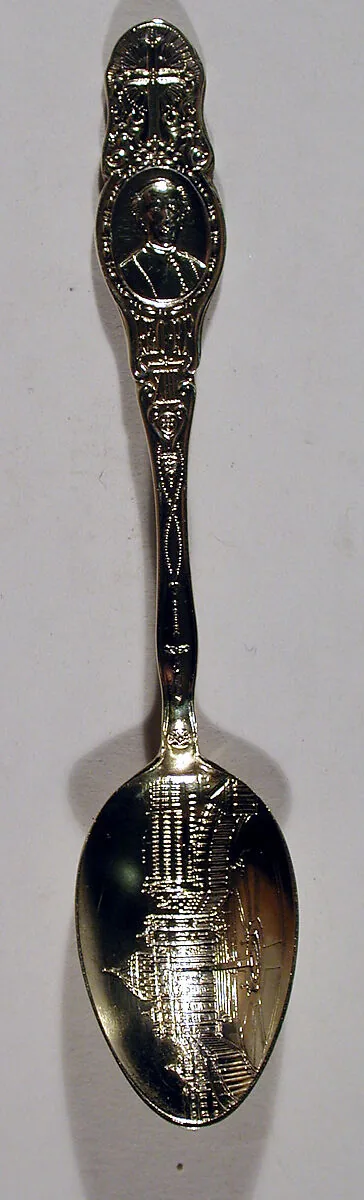
The Salem advertisement made that choice possible even within a single store. Buy the witch motif, or choose Hawthorne: the back of his design lists book titles. One shop offered more than one version of what Salem meant. A spoon depicting St. Peter’s Basilica from the same broad period shows how the idea worked elsewhere, without implying that either shop copied the other.
Historic Odessa notes that the design marked 1692 was published in 1891. The date on the handle is not evidence that it was launched in 1892 for the bicentenary, and it does not date the manufacture of this particular spoon. The publication dates the documented design. The museum’s range dates its particular object.
The distance between the trials and the souvenir
In the trials, “witch” was an accusation used against actual people. The 1692 records in the Phillips Library include petitions, testimony and the death warrant for Bridget Bishop. None of that makes a broom-riding figure on an 1890s spoon a portrait of an accused person. The familiar motif shows what a jeweler thought a customer would recognize two centuries later.
That distance matters when a reader meets the date on the silver. Our story about Maria Van Rensselaer’s funeral spoon describes a family commissioning copies in 1899 for another funeral. There, the older spoon came back into use as a model for a private act of remembrance. In Salem, a shop used a historical date and recognizable figures to sell something a stranger could carry away. Both made memory tangible. They did not make the same kind of claim about the past.
Read the front, then date the back
Record the inscription as seen. Is there a place, a year, or both? Photograph the whole front before taking close-ups. Compare the tip, the lettering and the space just above the bowl. A seller’s label of “witch spoon” is broader than one design.
Separate the marks on the reverse. Photograph the maker and retailer stamps and any mark for metal. Write down the exact letters before expanding them to a name. If the date on the front is part of the design, put it in a different field from the date of manufacture. An advertisement can establish that a design existed by a date; it usually cannot date an unprovenanced example to a specific year.
The most revealing thing about the word sterling on the back is that it says nothing about the story on the front. To read the object you need both sides: one shows what people could buy, and the other helps you find out who made it.
Object records and further reading
- Historic Odessa Foundation, Salem Witch souvenir spoon, 1971.1145, date and maker from the collection record.
- Historic New England, Souvenir Spoon, 1974.282, a Durgin example retailed by Daniel Low & Co.
- Salem Public Library, 1893–94 Salem city directory, scanned page 57, Daniel Low’s spoon advertisement. See also the storefront on page 58.
- Scientific American, “Historic Spoons, the Latest Fad”, May 23, 1891, p. 324.
- Peabody Essex Museum Phillips Library, Salem Witch Trials Collection, trial documents and interpretation.
- The Met, souvenir spoon depicting St. Peter’s Basilica, 00.19.39, a late nineteenth-century comparison.