
A hand at the end of a silver stem
Against the red velvet in a Honolulu display case lies a slender piece of silver with a chain at one end and a pointing hand at the other. It is a yad, the Hebrew word for hand. A reader can use the little finger to follow the words of a Torah scroll without putting a bare finger on the parchment. This one had a long journey for such a small tool: it passed through the household of King Kalākaua and later returned to the scroll it had accompanied to Hawaiʻi.
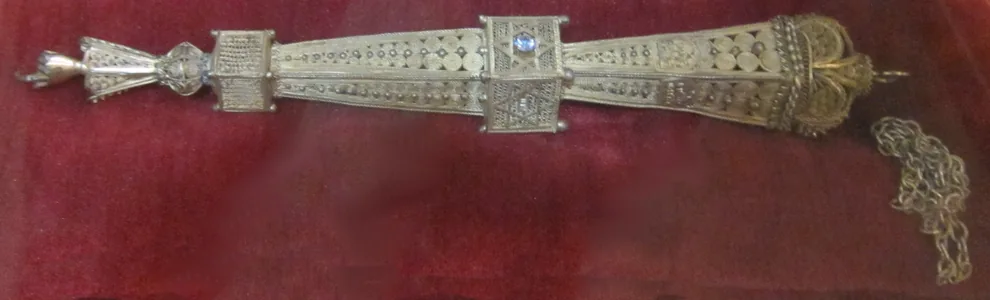
Look left in the photograph. The hand is much smaller than the decorated stem, but it tells you what the object does. The chain is at the other end. Neither the chain nor the elaborate metalwork makes the reading tool work by itself. The essential feature is a tip a reader can guide precisely along a line of text.
What is a yad used for?
The silver crown and finials in our story about Venetian Torah ornaments fit around or over the staves of a scroll. A yad belongs at a different moment: when the scroll is open and someone is following the words. The pointer is a means of finding your place, not a fixture attached to the parchment. It is a practice, not a claim that every reader must use one or that a pointer must be silver.
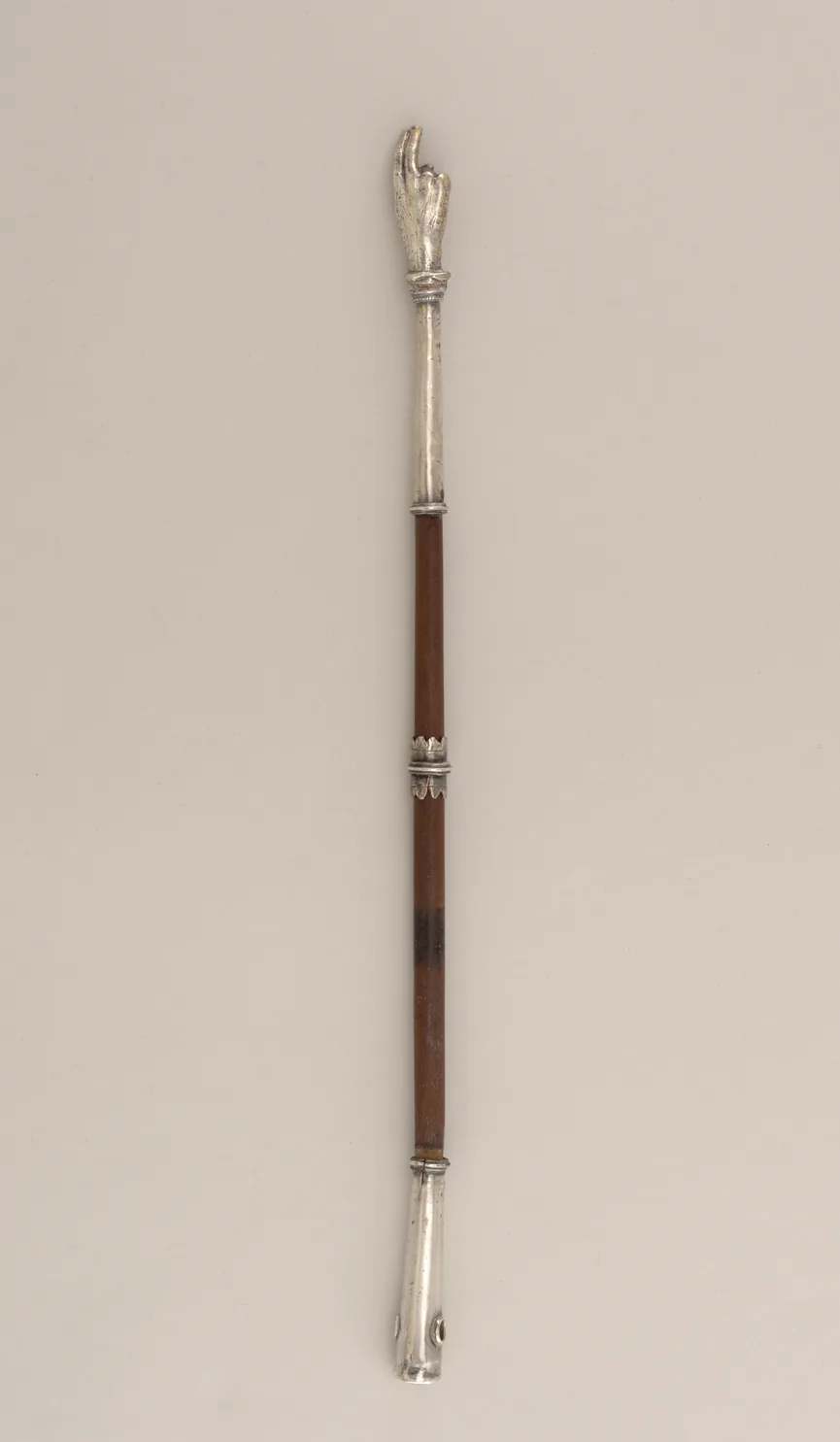
Around 1800, the maker of a pointer now at Cooper Hewitt made most of the shaft from wood, sheathed both ends in silver and added a movable finger rest. The hand on that example extends two fingers. The wooden shaft and the silver hand are parts of the same tool; the material of one does not describe the whole. The pierced end is for suspension rather than reading.
From San Francisco to the royal household
Temple Emanu-El’s history names Elias Abraham Rosenberg as the person who brought the scroll and pointer from San Francisco in 1886. In January 1887 he had an audience with Kalākaua at ʻIolani Palace, according to historian Jacob Adler’s research. A contemporary column reported that Rosenberg taught the king Hebrew. The column was often satirical, as Adler points out; it should not be treated as a transcript of a lesson.
The Jewish Museum of the American West gives a reading of the yad’s inscription that names Elias Abraham Rosenberg and the Hebrew year 5645. The name on the silver is not Kalākaua’s, and the inscribed year is not a record of the palace audience or of the object’s arrival in Hawaiʻi. It is one date on an object that would accumulate several more.
Rosenberg went back to San Francisco in 1887. The congregation’s account says he left the scroll and pointer with Kalākaua for safekeeping; other accounts call them a gift. The important point the accounts share is that the objects stayed in Hawaiʻi. After the king’s death they passed through Queen Kapiʻolani into the Kawānanakoa family. According to the congregation, the family lent the scroll to the Jewish community for High Holy Day services from time to time, into the 1930s. The exact years of those loans are uncertain.
The pointer and the scroll arrived separately
The pointer reached Temple Emanu-El before the scroll came back into view. Temple Emanu-El records that an emissary of Princess Abigail Kekuaulike Kawānanakoa delivered the pointer to Rabbi Roy Rosenberg, who dedicated it at the opening of the sanctuary on May 29, 1960. The rabbi at that dedication was not Elias Abraham Rosenberg. The same surname turns up at two very different points in the history.
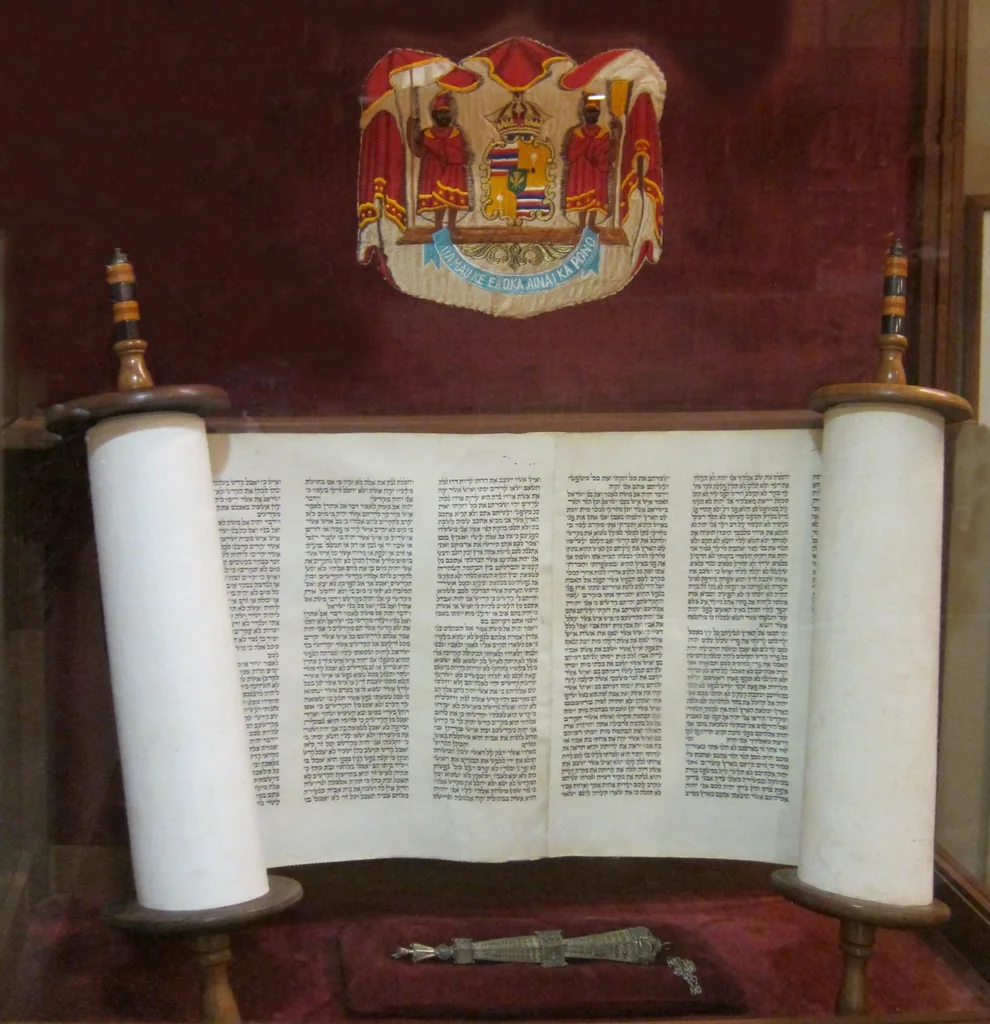
In 1970, Adler’s article could locate the silver pointer but described the scroll as lost. That statement records what was known then, not what became of it. Temple Emanu-El records that the scroll was donated in 1972 through the Flora Allen Kaai Hayes family. The congregation researched its identity and put the scroll and pointer together in a specially made koa cabinet. What looks like an uninterrupted pair in the photograph is really a reunion.
What the silver can tell us, and what it cannot
The little hand explains the purpose of the tool. The inscription supplies a name and year. Neither can tell us which words the king heard, why Rosenberg left the objects, or which family member held them at every date. For those details, a label, a newspaper and the congregation’s own records do different kinds of work. The photograph of the two together is evidence of the display, not of a nineteenth-century reading.
On any historical pointer, record the shape of the hand, the materials of the stem and fittings, and where any marks or writing appear. Keep the inscribed date separate from dates of manufacture, custody, and dedication. The aim is not to put the whole history into one date. It is to preserve the distinctions that let a small object tell more than one part of its own story.
Object records and further reading
- Temple Emanu-El, “The Kalakaua Torah Scroll”, for the congregation’s account of custody, dedication, and reunion.
- Jacob Adler, “Elias Abraham Rosenberg, King Kalakaua’s Soothsayer”, Hawaiian Journal of History 4 (1970), pp. 53–58.
- National Register nomination, Naval Station Pearl Harbor Library / Navy Relief Chapel, section 8, p. 13, for early Jewish history in Hawaiʻi and the silver pointer.
- Jewish Museum of the American West, Elias Abraham Rosenberg, for the pointer inscription and its translation.
- The Met, Yad (Torah Pointer), a separate object; catalogue description of a yad’s purpose.
- Central Conference of American Rabbis, responsum on the Torah pointer, for variation in practice.
- Wmpearl, photograph of the Kalākaua yad, CC0.
- Wmpearl, photograph of the scroll and yad in their display case, CC0.
- Cooper Hewitt, Smithsonian Design Museum, ca. 1800 Torah pointer, 1966-3-13, Public Domain.