
Look at the small break in the circle
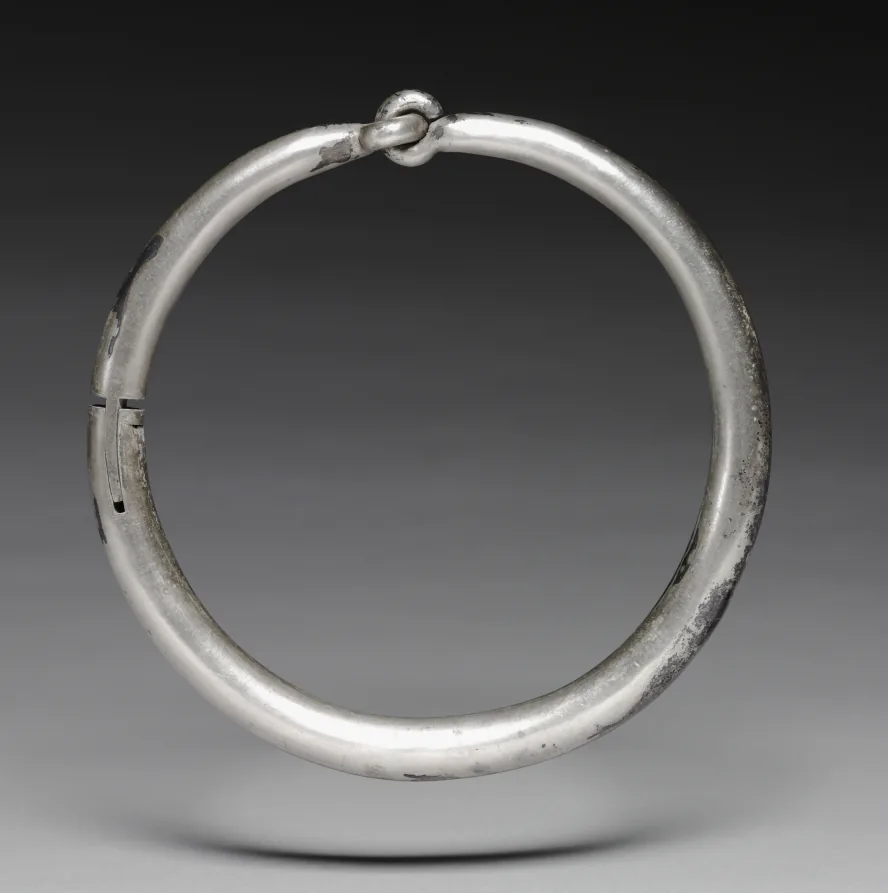
Set this silver necklace down and it almost closes into a circle. The metal swells across the bottom, tapers as it rises and ends in a hook and loop that nearly disappear into the outline. Just to the side of that closure is a hinge. The Cleveland Museum of Art dates the necklace, a type called a torque or torc, to 200–1 BCE. Its opening is a clue to how someone could get that nearly closed circle around their neck.
The hinge is not the only surprise. Cleveland describes the round body as a single sheet of silver, rolled into a tube, soldered along its length and then bent into the ring. Here the broad curve is not a solid rod. The maker used the silver at the surface to give the necklace its shape without filling the whole cross-section with metal.
One piece doesn’t answer every question
There are two ways to follow the metal. Imagine looking across the body: the original sheet wraps around a space to make the tube. Now follow the long direction of the tube: the joined length is bent round to make the necklace. The long soldered joint closes the sheet. The separate hinge lets the finished necklace open. Those are two different solutions to two different problems.
Hollow describes the shape of the body, not its silver content. A piece can have a wall of silver surrounding empty space. Plating is a different idea: a layer of silver covers another material. The museum identifies the material of this necklace as silver and explains its construction, but its public record does not give a silver percentage or wall thickness. There is no reason to supply either number by guessing from a photograph.
The bracelet makes a good comparison, not a shortcut
Cleveland also holds a silver bracelet of the same period that it groups with the necklace as a set. The bracelet looks like a smaller version at first: a rounded body, tapered ends and a hook and loop. The necklace’s listed overall diameter is 17 cm; the bracelet’s is 8.3 cm. The two shapes make a compelling pair even before you know what each one does on the body.
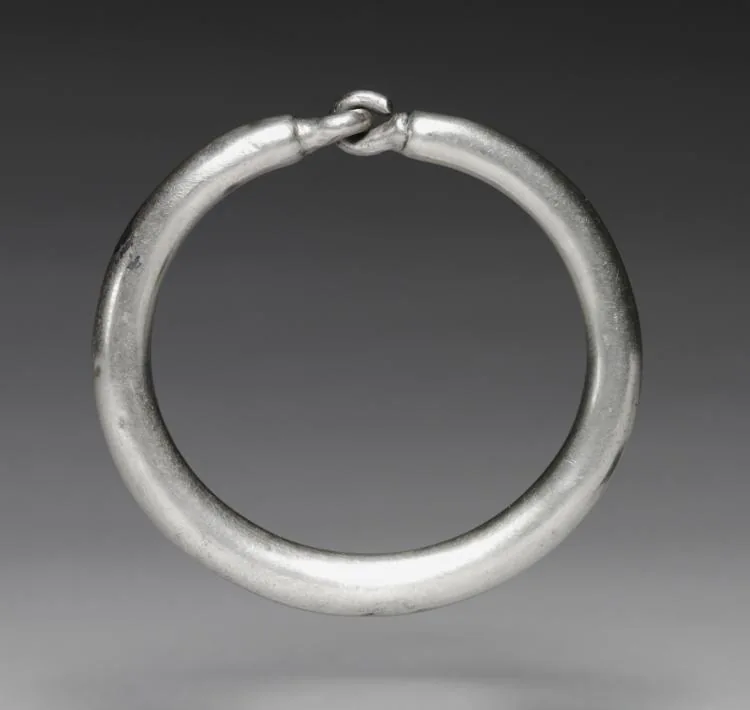
The bracelet entry says it was made from a single piece of metal. It does not describe a rolled sheet and a long soldered seam. Similar appearance is good reason to compare the two, not good reason to write the necklace’s construction into the bracelet’s record. The museum also places torque-and-bracelet sets in a wider world: it notes their importance among Thracian and Scythian wearers and their use in Greek imagery to mark people as non-Greek. That history gives the shape context; it does not identify the person who wore this necklace.
What to record on a necklace or bangle today
Start with what you can show. A photograph of a thick band tells you how wide it looks. A measured weight tells you how much the whole piece weighs. A side view, an interior view or an existing opening may give more information about construction. Write down the evidence separately from any reported material or fineness. A light piece is not necessarily plated, and width alone does not prove a piece is solid all the way through.
Photograph the ends, hinge and fastening in good light. If the mechanism is stiff, misaligned or unfamiliar, don’t pry it open, flex the ring or scratch it to find out what is underneath. If all you know is “rounded silver body; hinge beside the hook and loop; interior not verified,” that is useful information. Cleveland’s torque rewards the same approach: its appearance is the start of the investigation, not the answer.
Keep exploring
Sources
Museum records and Open Access credits
- Cleveland Museum of Art: Torque, 1986.181, sheet-to-tube construction, hinge, date, dimensions and collection image.
- Cleveland Museum of Art: Bracelet, 1986.182, bracelet attribution, one-piece description, relationship to the necklace and historical context.
- Cleveland Museum of Art: Open Access, use terms for the public-domain photographs.