
The last piece the Glasgow Assay Office hallmarked was a bowl, according to Glasgow Museums, which keeps it in its Scottish metalwork collection. The maker was Edward & Sons. When the office closed in 1964, its stamps belonged to a system almost a century and a half old. The smallest one to look for on an older piece is a tree with a remarkably crowded set of branches.
A fish, a ring, and a tree
At first glance a worn Glasgow punch can look like a tree on a little mound. With a clearer impression, there is more: a bell on a branch, a bird at the top, and a fish across the trunk. The fish in Glasgow’s arms carries a ring in its mouth.
In the city’s telling of the St Mungo legends, a lost ring is recovered from a salmon in the River Clyde. The bird is a robin restored to life, the tree recalls the branch with which Mungo rekindled a fire, and the bell is associated with the saint. These are stories about the city’s emblems, not accounts of how an assay was done. On silver the little group had a practical job: it identified the office that marked the piece.
The punch is a compressed version of the city’s device, not a miniature copy of every detail on a civic shield. Don’t expect a clean view of the ring or the bird on a rubbed spoon. Look for the cluster and then read its neighbors.
Read the 1824 row from left to right
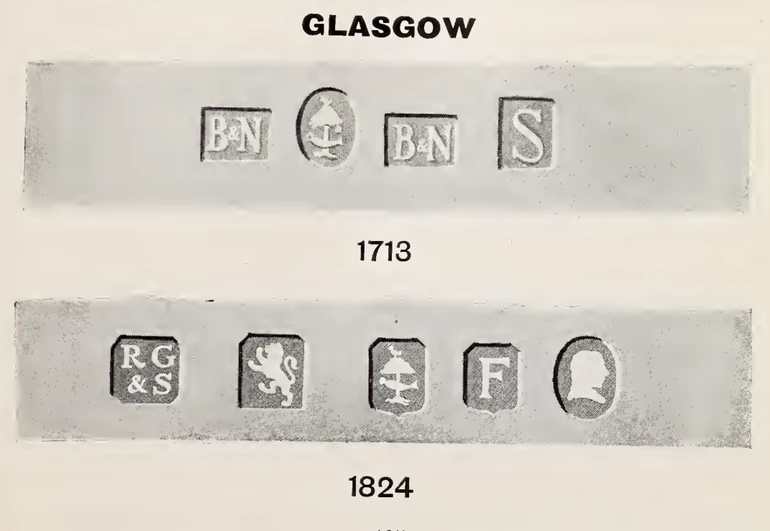
Arthur Hayden’s Chats on Old Silver reproduces two Glasgow stamp groups on the same page. The lower group, which he dates to 1824, gives you a five-punch example. The sequence in this particular row is:
- RG & S: the initials associated with Robert Gray & Son. The firm was already listed as goldsmiths in the Trongate in the 1814 Glasgow directory. The 1827 teapot in the University of Edinburgh’s exhibition shows the kind of work the firm made, but it is not identified as the source of this impression.
- The lion on its hind legs: the Glasgow standard mark in this group. It is a different punch from the city device beside it.
- The tree device: the Glasgow office mark. Start here before opening a date-letter table.
- F: the assay date letter that Hayden reads as 1824. James H. Sanderson’s historical account of Scottish plate marks says Glasgow’s letter changed on July 1 in the period he describes. A date letter marks an assay year, not an object’s birthday.
- The sovereign’s head: a duty mark, not another maker or another indication of purity. Hayden identifies this head as George IV.
Compare the higher row on the same plate. Hayden labels it 1713, and it has no rampant-lion punch. Glasgow silver existed long before the assay office established in 1819. A local device on an early piece is not proof that it passed through that later office.
What ended in 1964
Glasgow Museums identifies the Edward & Sons bowl as the last item hallmarked at the office before it closed. The illustrations here show earlier marks, not marks taken from that bowl. What ended was the office’s work, not the making or collecting of silver in Glasgow.
The Edinburgh Assay Office’s Hallmarking Archive still provides access to information from surviving Glasgow records for 1819–1964. Its warning matters: the records are incomplete. An absent maker in the search is a reason to keep looking, not proof that the punch is false.
What to do with a mark you can barely see
Take a photo of all the punches in one frame, then another close enough to see the edges of each punch. Try light from the side before trying to clean anything. A lone letter might match several dates; read it with the office device, its enclosing shape and the letter style.
Keep two lines in your notes: where it was assayed and who submitted it. A city mark is good evidence for the first, not necessarily for the place the workbench stood. Start with the silver markings guide to separate the jobs of the punches, then use the UK hallmark tracing guide to find the right records.
A second Scottish town mark Not every British anchor points to Birmingham. Compare the Glasgow punches with the Greenock anchor story.