
Two pieces of silver, each labelled fifty taels
In a display case at the Handan City Museum are two pieces of silver with their ends turned up like the bow and stern of a boat. There is no portrait in the middle. Instead, rectangular stamps press words into the silver. The labels call both pieces official silver of fifty liang, or taels. You could mistake the two for a pair from the same office until you read the names.
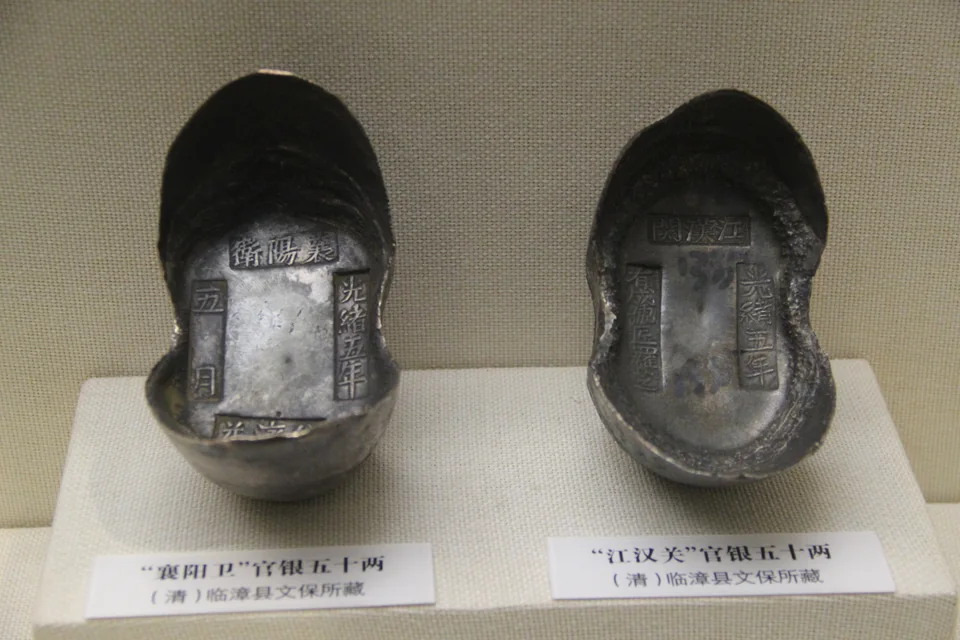
These are examples of sycee, an English term often used for Chinese silver ingots that circulated by weight. An ingot could carry a date and the name of a place or an office and still not function like a coin of fixed face value. For a payment reckoned this way, the questions were what the piece weighed, how much of it was silver, and whose rules for reckoning the payment applied.
Read the office, then the date
On the photograph’s left, the upper stamp reads 襄陽衛, Xiangyang Guard, from right to left. The stamp in the corresponding position on the right-hand ingot reads 江漢關, Jianghan Customs. That was the customs office established in 1862 at Hankou, now part of Wuhan, after Hankou opened to foreign trade. The name on the piece of silver points to an institution, not necessarily to a person who handed it over.
The tall stamp at the right of each ingot reads 光緒五年, the fifth year of the Guangxu reign, corresponding to 1879. The left ingot also has a visible 五月, or fifth lunar month. That does not translate to May. The fifty-tael designation in this photograph comes from the exhibit labels; it is not a modern weighing of either object. The photograph gives us a way to check particular readings, not a record of every place the silver went.
The Shanghai Museum records a different ingot on which part of a stamp names a gold-and-silver shop and another part describes the silver’s fineness. Compare that with the offices on the Handan examples. “It’s stamped” is only a start. The next question is what the stamp was meant to tell someone who received the silver.
Why you couldn’t just multiply by fifty
In 1878, a U.S. diplomatic memorandum tried to explain the money its merchants encountered in China. It distinguished the Kuping treasury tael and the Haikwan customs tael from other local measures. Its imperial customs source gives 37.578 grams for one customs standard. That is a useful number with a name and a source attached. It is not a single conversion for every historical tael, and it does not give the present mass of the Handan pieces.
Weight tells you how much material is on the scale. Fineness tells you how much of that material is silver. A reckoning for payment has to account for both. The periodical and diplomatic sources of the time describe offices in some places where silver was weighed and assessed. The memorandum reports that other places did not have such an office. Even within a world that used silver widely, rules for accepting it were local enough to occupy pages of explanation.
None of that means everyone used these hefty pieces for ordinary shopping. The same record describes copper-alloy cash as well as silver for duties and certain government remittances. Foreign silver coins circulated too. The Spanish dollar with Chinese chop marks shows a different way to put trust in silver: later users tested or marked a coin whose original denomination and royal design were already on it. A sycee had no need for that same design to carry value.
Not every ingot was a boat. Not every boat was silver.
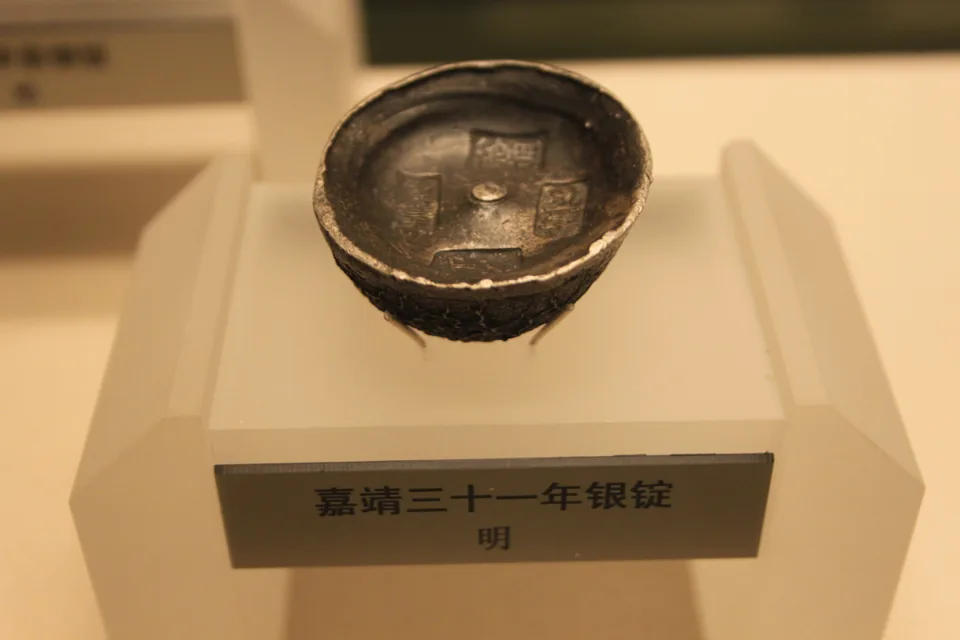
In a display case at the Shanghai Museum is a visibly rounder silver ingot. Its label gives the thirty-first year of the Jiajing reign, or 1552, more than three centuries before the Handan pair. Its silhouette is a reminder not to define the whole category by one famous profile. Compare the date and material on the label before trying to make a shape do the work of identification.
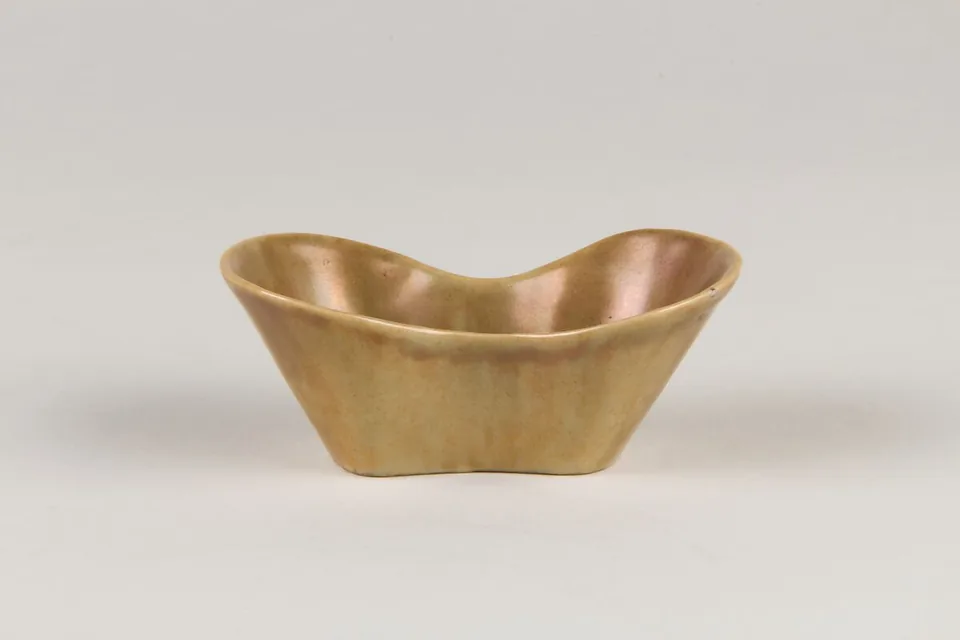
The Metropolitan Museum of Art has an object that makes the reverse point. It has the turned-up ends people recognize from silver ingots. It came out of the Jingdezhen ceramic tradition in the first half of the nineteenth century. Its gold-colored surface covers porcelain, and the museum catalogues it as a cup. The form was recognizable enough to use on an entirely different object. It is not a gold or silver ingot.
Keep the mark, the weight and the claim separate
Photograph first. Keep a record of where the marks sit and how they are oriented. Take a full overhead view and side views that show the raised ends, then photograph inscriptions in angled light. Do not polish or scrape the silver to bring out the writing. The dark and light areas are part of the record as you found it.
Write two different weight entries. Put a historical designation such as “50 taels” in one field, with its source, and a measured present weight in another. Do the same for an inscription date, a museum attribution, and a date of acquisition. Neither a shape nor a stamp by itself authenticates an ingot.
The two boats at Handan agree on a year and on the amount printed below them. The names in their silver are different. That is where the story gets interesting: what looked like a pair turns out to hold two separate records of who put their name on weighed money.
Object records and further reading
- Gary Todd’s photograph of the Handan City Museum display, CC0. Read the two exhibit labels and the visible year stamps in the photograph.
- Gary Todd’s photograph of the Jiajing-period ingot at the Shanghai Museum, CC0, with its exhibit label.
- The Met, Cup in the shape of silver ingot, 79.2.1014, Qing dynasty, gilt porcelain.
- Wuhan municipal history of Hankou, including the opening of the port and the establishment of Jianghan Customs.
- U.S. diplomatic papers, “Memorandum on the Currency of China”, 1878, enclosure 2, for the uses of silver and different standards of weight.
- The Bankers’ Magazine, “Notes on Chinese Currency”, March 1874, pp. 718–724, contemporary reporting on weighing and assaying.
- Shanghai Museum, silver ingot with a shop stamp and fineness description, a separate example.